

Common Spiders in Boca Raton Homes: Which Ones Need Action
Quick Answer: Boca Raton homes regularly host five spiders: brown widow, golden silk orb weaver, wolf spider, jumping spider, and house spider. Only the brown widow warrants real concern; the other four are common, harmless, and rarely worth more than clearing a web.
A Boca Raton homeowner who starts photographing every spider on the property will end up with a small zoo by the end of a single week: something dark and patterned tucked under a patio chair, a fist-sized web strung across the pool cage corner, a fast gray blur that vanishes under the garage shelving, a tiny striped one that seems to watch back before hopping away, and a plain brown one sitting in a loose cobweb behind a picture frame. Five very different animals, five very different reactions warranted, and almost no way to sort them out from a panicked glance.
That sorting is the actual point of this piece. South Florida's warm, humid climate supports a wide range of spider species outdoors and in, but the overwhelming majority of what turns up in and around a home here narrows down to five: the brown widow, the golden silk orb weaver, the wolf spider, the jumping spider, and the common house spider. Knowing which is which changes what you actually do next, because four of the five need nothing more than a broom, and one of them is worth treating like it matters.
The One That Needs Action: Brown Widow
A brown widow is a relative of the black widow, and it's the one spider on this list actually worth pausing for. Look for a body roughly a third of an inch long, a mottled tan-to-dark-brown abdomen (never the glossy solid black of a true black widow), and an orange-to-yellow marking on the underside. She doesn't spin an open, visible web the way an orb weaver does; instead, she tucks herself into a tight, shaded gap somewhere on the property and builds a loose, messy tangle from there rather than out in open air.
Color and web shape sort a brown widow from the rest of this list fast: small, mottled, tucked low in a loose tangle. Bigger, wide-webbed and overhead, or fast-moving across open ground, is one of the other four.
Verdict: Worth having identified and the actual site closed off, not just the visible strand swept away. A web knocked down with the spider still in place typically reappears within a day or two.
The Big, Harmless One: Golden Silk Orb Weaver
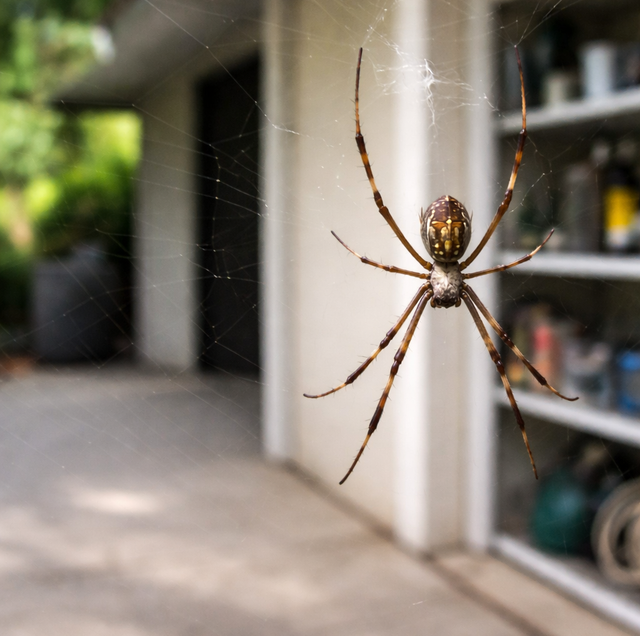
The golden silk orb weaver, locally nicknamed the banana spider, is unmistakable by its web alone, before you even spot the spider: a broad, sun-catching span stretched corner to corner across a pool cage or lanai, with a big yellow-and-black-banded body anchored near the center. Nothing else on this list spins anything close to that scale.
Verdict: a broom handles it. Of the five species covered here, this is the one where size and actual risk sit furthest apart.
Wolf Spiders: Big, Fast, and Ground-Hunting
A wolf spider is the one most likely to trigger a startled step backward, mostly because of speed and size rather than anything dangerous about it. Most individuals actually found indoors run smaller than the reputation suggests, body length typically 10 to 25 millimeters (roughly four-tenths of an inch to a full inch); South Florida's largest species, Hogna carolinensis, can approach an inch and a half at full maturity, but that's an outlier size, not what's typically crossing a garage floor. The pattern is the better giveaway than raw size: gray, black, or brown mottling across the back that can look almost bark-like. Unlike an orb weaver or a widow, a wolf spider doesn't build a web to catch anything. It hunts on foot, prowling leaf litter, mulch beds, and open concrete after dark for crickets, roaches, and whatever else is moving.
Hold a flashlight low across a dark yard at night, and a wolf spider gives itself away: its eyes throw back a sharp green shine from ten to thirty feet out, a byproduct of a reflective layer behind the retina that other common household spiders don't have. Its parenting is just as distinctive. Rather than leaving eggs behind in a web, a female tows her silk-wrapped egg case fastened to the rear of her body, and once the brood hatches, the newly emerged spiderlings climb aboard and ride along for one to several weeks before scattering on their own, a level of maternal investment nothing else on this list shows.
In much of Boca Raton and West Boca's tile-roof construction, the soffit-fascia gap where the roofline meets the wall is one of the more common paths a wolf spider takes from the eave line down into a garage or attic space, the same entry geometry that lets roof rats in. A bite occurs only if one is handled or trapped against the skin, and the result is typically brief, localized redness and mild soreness that fade within a day.
Verdict: One wolf spider crossing an open floor after dark is ordinary background activity for this climate, not a colony forming. If the same spot keeps producing sightings, that's a pattern worth flagging to whoever checks the exterior; the spider is rarely the actual problem.
Jumping Spiders: The Curious Ones
Jumping spiders are the easiest of the five to like, and also the easiest to misjudge as aggressive because of how directly they engage with a person nearby. The giveaway is the face: two large, forward-facing anterior eyes give a jumping spider unusually sharp vision for an arthropod its size, along with a compact, often fuzzy or iridescent body under half an inch long. The bold jumper (Phidippus audax), black with white or orange spots and green or blue iridescent mouthparts, and the larger regal jumping spider (Phidippus regius), also black-bodied with pale spots, are the two most likely to turn up around a South Florida home, on a sunny wall, a windowsill, or patio furniture.
Unlike every other spider on this list, a jumping spider doesn't spin a snare web at all. It stalks prey visually across a short distance, then covers the last stretch in a single pounce, anchoring a silk safety line to whatever surface it launched from as it jumps. The silk it does produce goes into a small, sealed retreat, tucked into a leaf fold, a window track, or a gap under siding, used for molting, laying eggs, and sheltering overnight rather than for catching food. That visual hunting style is also why a jumping spider seems to track a person's movement and occasionally turns to face someone directly: it's actually watching, not preparing to strike. A bite is rare and mild if it happens at all, on par with a mosquito bite for most people.
Verdict: No action needed. A jumping spider on a sunny patio wall or windowsill is one of the more useful predators in a yard, working through small flying and crawling insects without building the visible webs that draw complaints.
House Spiders: The Everyday Cobweb Builders
The common house spider, *Parasteatoda tepidariorum*, is the plain, unremarkable one behind most of the loose cobwebs found in a closet corner, garage shelving, or an undisturbed window frame. UF/IFAS Entomology lists it among the most abundant household spiders across the southeastern United States, and Florida homes are no exception. It's small, usually under half an inch, tan to brown or gray with a bulbous abdomen and no distinctive marking, and it builds an irregular, three-dimensional tangle web rather than a flat wheel or a low ground snare, typically anchored in a corner where two surfaces meet and airflow stays low.
A house spider's web is a permanent structure it returns to and repairs rather than abandons after each catch, which is why the same corner tends to collect the same loose cobweb again within days of being cleared with a duster. It feeds on whatever small flying or crawling insects wander into the tangle- ants, gnats, the occasional moth- and stays put in one spot for weeks at a time as long as the corner isn't disturbed. It isn't a threatening species to have around; a bite would be an unusual, defensive last resort rather than typical behavior, and most people never experience one at all.
Verdict: A duster or vacuum on a routine basis is really all this species requires. Repeated buildup in the same handful of corners is more a sign of low airflow and undisturbed clutter than anything specific to the spider.
Sorting the Five at a Glance
Size and web style separate these five faster than color does. A web-builder that's plainly enormous and spans an open corridor is almost certainly the orb weaver; a low, messy tangle tucked into a tight gap is the one worth checking for a brown widow. Anything moving fast across open ground without a web is a wolf spider, and anything small that seems to look back before hopping away is a jumping spider. What's left, a plain, unremarkable spider sitting in a loose closet cobweb, is almost always the common house spider. Species aside, the same trigger applies across all five: one individual anywhere on the property is unremarkable, but repeat activity concentrated in one spot, several webs on the same pool cage corner, sightings in the same room week after week, egg sacs turning up faster than they're cleared, points to something at the structure feeding or sheltering more of them than usual, and that's worth a source-first look no matter which of the five is doing the showing up. The brown widow's actual hiding spots and the golden silk orb weaver's web behavior each get a full breakdown elsewhere on this site.
Frequently Asked Questions
Yes, and the pattern is fairly consistent. Wolf spiders concentrate at ground level near exterior doors and garage entries, since they're walking in rather than dropping from above. Jumping spiders favor sunny vertical surfaces, exterior walls, window glass, and patio furniture where visual hunting works best. House spiders cluster in low-airflow interior corners: closets, undisturbed baseboards, garage shelving. Brown widows and orb weavers stay almost entirely outdoors, on structural voids and open framing rather than inside living space, which is itself a useful clue when sorting an indoor sighting from an outdoor one.
The middle ground, roughly a quarter-inch to half-inch body length, is where mix-ups happen most, since a juvenile wolf spider, an adult jumping spider, and a house spider can all fall in that window. Web presence resolves most of that confusion: a spider sitting in an obvious tangle or snare is a web-builder (house spider or, outdoors, a widow or orb weaver), while one found moving across open ground or a wall with no web nearby is a hunter (wolf or jumping spider). Eye shine at night under a flashlight is a wolf-spider-specific tell that neither jumping spiders nor house spiders share.
More than most people expect, once you know the shapes. A brown widow's sac is small, spiked, and burr-like, tan to cream in color. A wolf spider doesn't leave a sac behind at all; she carries it, so an abandoned sac on the ground rarely belongs to a wolf spider. A house spider's sac is a smooth, papery, tan-brown teardrop tucked into the web itself, often several at once in an older, undisturbed web. Golden silk orb weaver sacs are rarely seen at all, since they're typically tucked into bark or foliage away from the web rather than left in plain sight near the structure.
Not usually. Of the five, only the house spider regularly establishes a permanent indoor web. Wolf spiders and jumping spiders that show up inside are almost always strays that followed prey or light through a gap, and most don't last long without it: away from the yard's humidity and prey density, a stray hunter typically dehydrates or starves out within a week or two rather than settling in. Brown widows and orb weavers almost never set up indoors. One stray sighting isn't worth acting on; several of the same type turning up in the same week is a better sign that something at the structure is letting insects, and the spiders hunting them, inside.
Some, and it's part of why a yard with a healthy jumping spider or wolf spider population sometimes has fewer of the species people worry about more. Wolf spiders and jumping spiders are both opportunistic hunters that will take smaller spiders, including juvenile house spiders and stray widows, when the opportunity comes up, alongside their usual insect prey. It's not a control method to rely on, and it shouldn't be treated as one, but it explains why a yard rarely ends up dominated by a single species, even without any treatment at all.
South Florida hosts other, less common species beyond this list, and a spider that clearly doesn't fit any of the five- unusual color, an unfamiliar web shape, a size well outside these ranges- is worth photographing rather than guessing about from memory. A clear photo, or the spider itself contained rather than crushed, gives a far more reliable identification than trying to match it against a mental list, and most county agricultural extension offices will identify a submitted photo for free.
Not sure which spider you're actually dealing with — get it identified and, if it's a brown widow, the real nesting site addressed. Buggify Pest Solutions serves Boca Raton, West Boca, and communities across Palm Beach and northern Broward. Call Tyler: (561) 672-0200.
