

Golden Silk Orb Weavers: Why That Giant Web Isn't a Threat
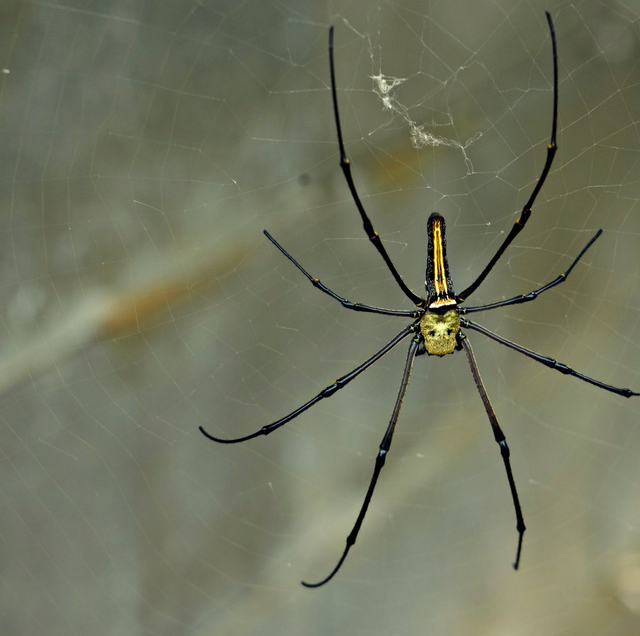
Quick Answer: A large, gold-tinted web spanning a pool cage corner or screened walkway almost always belongs to a golden silk orb weaver. They aren't medically significant, don't nest indoors, and rarely bite. Clearing the web is usually all that's needed.
The web across the corner of your pool cage isn't subtle. It can span three or four feet post to post, the strands thick enough to catch the afternoon light with a genuine gold shimmer, and sitting near the center is a spider bigger than anything that turns up indoors: a body about the size of a large grape, legs banded in yellow and black, sometimes with a second, much smaller spider perched near the edge like it wandered onto someone else's property. That combination- the size, the color, and the exact spot it chose- points to one species almost every time: the golden silk orb weaver.
Golden silk orb weavers are some of the most visible spiders in South Florida yards, mostly because they build large, obvious, semi-permanent webs in the exact structures a home hands them: pool cage framing, lanai screen corners, the gap between a hedge and a fence line. None of that makes them a threat. It does explain why the same web keeps reappearing in the same corner no matter how many times it gets knocked down with a broom.
What You're Actually Looking At
The species is *Trichonephila clavipes*, still commonly listed under its older name, *Nephila clavipes*, and known locally as the golden silk spider or banana spider. It's one of the largest orb-weaving spiders found in the eastern United States, and it's established year-round across Florida and the rest of the Gulf Coast.
Females do the building: An adult female's body typically runs 24 to 40 millimeters (a bit over an inch to about an inch and a half), with a leg span pushing four to five inches at full size. She's the one spinning and maintaining the web, and she's almost always the spider a homeowner notices first.
Males are the tiny hitchhikers: Males top out around a quarter-inch, a fraction of the female's size, and typically don't build their own webs at all. Instead, a male often takes up residence at the edge of a female's web, waiting for a mating opportunity. That smaller spider at the edge isn't always the male, though: it's just as often a completely different, kleptoparasitic species that has moved in to steal scraps (see the FAQ below), and the two can be hard to tell apart without a close look.
The gold cast in the silk isn't a trick of the light. The strands actually carry a yellow-gold pigment, most visible when sunlight hits the web at an angle, and some entomologists believe the color lures pollinating insects into the strands, since certain bees are drawn toward yellow tones the way they're drawn to flowers. That's a working theory more than settled fact, but the color itself is real and consistent across the species.
Why Pool Cage Corners and Open Corridors Draw Them
A golden silk orb weaver isn't picking a pool cage because it likes people or the pool. It's picking the geometry. These spiders need evenly spaced vertical anchor points to stretch a web across, and pool cage support posts, lanai screen frames, and porch corners provide exactly that spacing, ready-made and permanent, at a height that keeps the web clear of ground-level disturbance.
The second draw is airflow and prey traffic. A screened walkway or pool cage corridor funnels flying insects the same way it funnels a breeze, moths and flying beetles included, and a web strung across that corridor catches far more prey than one built in open air with no channel directing anything toward it. Add a porch light or pool light running at night, which pulls insects into that same corridor after dark, and the corner becomes one of the most productive hunting spots on the property. The spider isn't drawn to the light or the water. It's drawn to what both of those things funnel past its web.
Clear an unwanted web with a broom or a long stick rather than bare hands. Golden silk orb weavers rarely bite unless one gets pressed directly against skin, but walking face-first into the strong, sticky silk is the more common surprise.
The Web That Doesn't Get Rebuilt Every Night
Most web-building spiders eat their own silk at the end of the night and spin an entirely fresh web before the next one, which is why some species show a brand-new pattern every morning. Golden silk orb weavers work differently. A female typically holds onto the same web for days or weeks at a stretch, patching torn sections rather than consuming and respinning the whole structure, because silk production takes real biological cost and a working web isn't worth abandoning over a few damaged strands.
That habit is the actual answer to "why does it keep getting bigger?" Nobody is rebuilding it larger every night. The web is being reinforced and extended in place, strand by strand, over a stretch of weeks, which is also why the female herself tends to grow larger the longer a web survives undisturbed: more time in one productive spot means more prey caught and more growth between molts. Golden silk orb weavers reach their largest size and their most visible webs in late summer into fall, when a season of feeding has caught up with them, but that's a peak in visibility, not a season-only story. In South Florida's climate, without a hard freeze to end activity the way it does farther north, mature spiders and active webs can persist well past what a four-season calendar would predict.
Are Golden Silk Orb Weavers Dangerous?
Not in any medically meaningful way. Their venom is built to subdue small flying insects, not mammals, and it isn't considered dangerous to people. A bite is rare and almost always defensive, happening when a spider gets trapped against skin, inside a sleeve or a stored towel, for example, rather than an unprovoked attack. When it does happen, the usual result is localized redness and mild discomfort, similar to a bee sting for most people, resolving without treatment. There's no reason to treat a golden silk orb weaver the way you'd treat a species with genuine medical significance.
When to Just Clear the Web (and When to Call for More)
For a single web in one corner of the pool cage, clearing it yourself is usually the whole job. The spider may rebuild in the same spot within a day or two, because the anchor points and prey corridor that made it a good location haven't changed, and that's expected rather than a sign anything went wrong.
It's worth a professional look when the pattern shifts from one interesting spider to a broader signal: several large webs strung across different parts of the same pool cage or lanai, a heavier-than-usual population of flying insects feeding those webs, or other spider activity turning up nearby, like a brown widow tucked into patio furniture or a mailbox. At that point, the web itself isn't really the issue; the insect population and harborage behind it are, and a source-first inspection of the exterior lighting, screen gaps, and yard moisture around the pool cage addresses what's actually drawing the activity, rather than resetting the same web removal every week.
Living With (or Without) the Web
A single golden silk orb weaver on the pool cage is closer to a sign of a productive backyard insect population than a problem in its own right. It isn't going to come inside; it isn't dangerous in any way that matters to a household, and knocking down its web doesn't require gloves, sprays, or a second thought beyond a broom and a few minutes. The moment it's worth paying closer attention is when the webs multiply, or when other spider species start showing up in the same stretches of screen, because that's the pattern that actually points to something worth addressing at the source.
Frequently Asked Questions
If a spider ends up trapped inside a sleeve, shoe, or folded towel, the safest move is to shake the fabric out over a hard surface or step outside rather than swatting at it through the fabric, since swatting is what triggers a defensive bite in the first place. If a bite does happen, wash the area with soap and water and use a cold compress for swelling; skip home remedies like heat or drawing salves, which don't help and can prolong the irritation. One real exception is worth flagging: anyone with a known bee-sting allergy should treat the bite the same way they'd treat a bee sting and seek medical attention if swelling spreads or breathing feels affected, even though the bite itself isn't considered medically significant for most people.
That smaller spider at the edge could be one of two very different things, and it takes a close look to tell them apart. If it's banded in the same yellow-and-black pattern as the female, just far smaller, it's likely the male, present for mating rather than to build a web of his own. If instead it's a small, silvery or dark spider tucked into loose strands at the margin, it's more likely a kleptoparasite, most commonly a species in the genus *Argyrodes*, sometimes called dewdrop spiders, which builds a minimal web of its own inside the outer framework of the larger structure and survives by stealing small, already-wrapped prey items rather than catching food itself. Location alone won't tell you which one you're looking at; color and size will. Either way, its presence isn't a sign of a bigger infestation; it's a normal part of the ecosystem a large, established web supports.
Direct, low-angle light, like early morning or late afternoon sun, brings out the gold cast strongly, while overcast conditions or midday sun straight overhead can make the same web look pale gray or nearly transparent. That's one reason a web that seemed obvious yesterday afternoon can be easy to walk into this morning.
In much of their northern range, adult golden silk orb weavers die back sharply after the first hard freeze, and only egg sacs survive through winter to hatch the following spring. South Florida's spiders and webs follow a slower arc instead of a hard cutoff: a web usually starts small and easy to miss in late spring, when a newly matured spider first begins spinning, and doesn't reach the eye-catching three- to four-foot span most homeowners notice until late summer or fall, after months of steady feeding and molting have let both the spider and the web grow into it.
Yes, and it's often the gentler option. A female can be encouraged onto a long stick or broom handle and moved to a fence line, tree, or another spot away from foot traffic rather than killed outright, since she'll typically rebuild a web wherever she ends up regardless. If the web itself is the only obstacle, whether in a doorway or on a walking path, taking down only the strands in the way and leaving the rest intact is usually enough to solve the immediate problem.
No, and the shared nickname causes real confusion. The banana spider that occasionally turns up in international news for arriving inside shipments of bananas is typically a Brazilian wandering spider (genus *Phoneutria*), a fast-moving, ground-hunting species from Central and South America with medically significant venom. The golden silk orb weaver is a web-building species native to the southeastern United States, unrelated to that genus, and not the spider behind those stories, despite both carrying the same common nickname in different regions.
Get a source-first look at the pool cage and exterior lighting — not just the web cleared, but the actual prey and lighting draw behind it addressed. Buggify Pest Solutions serves Boca Raton, West Boca, and communities across Palm Beach and northern Broward. Call Tyler: (561) 672-0200.
