

Why the Pool Cage Is the Worst Spot for Spiders
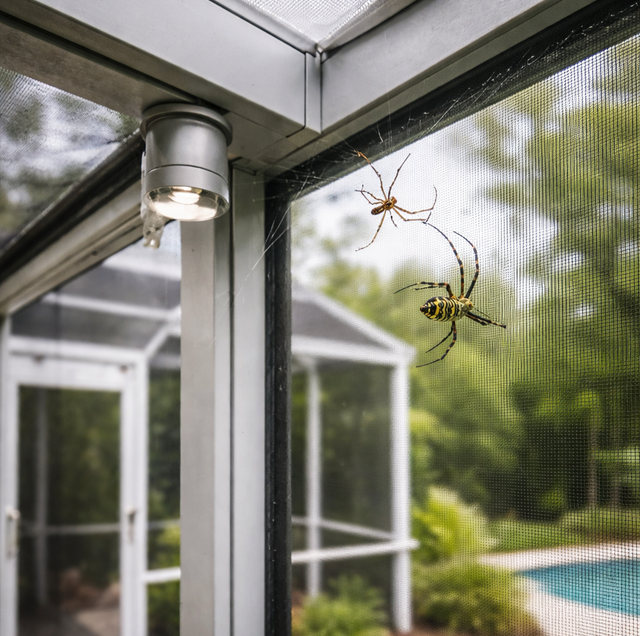
Quick Answer: A pool cage combines shelter, prey, and structure in one place: frame corners and screen seams shelter spiders while nearby lighting draws the insects they eat. Clearing webs doesn't change any of that.
You clear the pool cage on Saturday morning, corner posts, the screen door frame, the light fixture over the spa, and by the following weekend every one of those spots has a new web strung across it. Meanwhile, the rest of the house, the garage, the closets, the baseboards inside, stays mostly quiet. That split isn't random, and it isn't bad luck. A screened enclosure is built out of the exact features spiders look for, and it happens to sit right next to the thing that feeds them.
What Makes a Screened Enclosure Different From the Rest of the House
Most parts of a home offer a spider one of three things: a place to hide, a supply of prey, or a stable structure to build on. A pool cage offers all three at once, in the same footprint. The aluminum framing is full of joints and voids that stay dry and undisturbed. The screen mesh itself intercepts flying insects day and night. And the whole structure- posts, horizontal beams, screen panels- gives a web-building spider fixed anchor points that don't move in the wind the way a shrub or a patio umbrella does. Indoor rooms rarely combine all three; a pool cage is built to.
Frame Corners and Support Posts Function as Shelter
Aluminum pool cages are assembled from extruded beams joined at corner fittings and support posts, and those joints leave small hollow gaps behind the fascia and inside the elbow brackets. Debris, dead leaves, and old insect casings settle into those voids over time and are rarely disturbed, since nobody has a reason to open a corner joint during routine pool maintenance. Spiders that favor tucked-away, low-traffic spots, house spiders and brown widows among them, use that kind of gap the same way they'd use a gap behind a shutter or under stored patio furniture. The corner nearest a light fixture or the screen door tends to fill in first, because it combines shelter with the shortest walk to the food supply.
The Seam Where Screen Meets Frame Is Both Shelter and Weak Point
Screen fabric is held in the frame by a thin rubber spline pressed into a groove that runs the length of every beam. That groove is a natural crevice on its own, and in South Florida's UV exposure and heat cycling, the spline and the screen material both lose some tension over years, which can open a hairline gap where the screen meets the track. A web anchored right at that seam gets the stability of the aluminum frame plus a hidden lip to sit against, which is why so many webs show up along the screen edge rather than in the open middle of a panel.
Run a hand along the lower screen-to-frame seams near doors and light fixtures once a season. A section that flexes or separates slightly under light pressure is worth having checked before it becomes an entry gap and a web site.
Exterior and Pool-Area Lighting Keep the Prey Supply Coming
None of the shelter above matters much to a spider without something to eat nearby, and a lit pool cage supplies that on its own. Flying insects, midges and moths especially, are drawn to light at night and collect against the nearest solid surface, which is often the screen itself. Mosquitoes add to the same prey supply through a different cue, pulled in by carbon dioxide, heat, and body scent rather than light, and South Florida's canal-lined yards and standing irrigation water keep local mosquito numbers high enough to matter year-round. Orb weavers in particular set up directly across a screen panel facing a light fixture because the position puts them in the flight path of whatever gathers there after dusk. Underwater pool lighting adds a second draw at the waterline, and a spa or fountain running after dark further compounds the effect. Spiders aren't drawn to a pool cage because it's screened; they're drawn to it because the screened space next to a lit water feature is one of the most reliable insect traps in a residential yard.
Why Clearing Webs Every Weekend Doesn't Change Anything
Removing a web only resets one piece of the setup, the silk itself, while leaving the corner void, the screen seam, and the light source exactly as they were. Exactly how fast a new strand shows up varies by species and by individual spider, but that timing detail isn't the point. Whatever spider is using a given corner is there because the void and the food supply are still there, and clearing the silk doesn't touch either one. The visible web was never the target that mattered; the harborage and the prey supply feeding it were.
What Actually Interrupts the Pattern
Treating a pool cage effectively means working the structure itself rather than the webs hanging off it: the frame corners and support posts where spiders shelter, the screen seams and door tracks where webs anchor, and the insect pressure around the lighting that keeps drawing prey in. A pest control visit that only sprays open screen panels misses the corners and seams where the spiders that matter are actually sitting, and skips the lighting question entirely. Addressing all three- harborage, seams, and light-driven prey- together is what separates a cage that stays clear from one that needs rewebbing every few days no matter how often it's swept.
Frequently Asked Questions
Some. Standard pool-cage screening is typically a fiberglass mesh in the 18-by-14 range, open enough to let air through while blocking larger insects, and a fair number of small flying insects still pass through or land directly on it. Tighter "no-see-um" mesh blocks smaller insects more effectively but also cuts airflow and can hold humidity against the frame longer, which is a trade-off worth weighing with whoever installed or last rescreened the enclosure rather than assuming tighter is automatically better.
Skip pointing a flashlight straight into the joint; that tends to wash out exactly what you're looking for. Hold the light at a low, raking angle across the corner bracket and the base of each support post instead. Old debris and packed insect casings show up as a fine, grayish buildup that a direct beam misses, and a fresh strand anchored to the outside edge of a bracket is often visible before a full web forms across the opening, giving a head start on spotting which corners are actually in use.
Yes, often more than people expect. Dense shrubs, hedges, or mulch beds pressed up against the outside of a screen give ground-dwelling and jumping insects a bridge straight to the mesh, and overhanging branches can rub the screen enough to strain the seams. Pulling plantings back 12 to 18 inches from the frame and trimming anything that touches the screen removes one more prey pathway without changing the pool cage itself.
It carries more risk than spraying an ordinary patio. Aerosol products applied near open water can drift onto the pool surface and affect water chemistry, and broadcasting a general-purpose spray across open screen panels isn't necessary in the first place, since that's not where the spiders sheltering in the corners and seams actually are, and it can still leave residue on pool decking that's difficult to remove. A label-compliant product applied to the frame joints and screen seams rather than broadcast across open panels avoids most of that risk, which is one reason this is usually better handled as a targeted treatment than a DIY spray-down.
It helps, but most homeowners don't want to give up evening pool use entirely, and there's a middle option. Switching exterior and pool-cage fixtures to warmer, longer-wavelength bulbs reduces the extent to which they attract flying insects compared with standard cool-white LEDs, without leaving the area dark. It won't eliminate the draw since underwater lighting and neighboring properties still contribute, but it can meaningfully reduce the insect supply feeding the spiders on the screen closest to the fixture.
The visit stays focused on harborage, not open water or the pool deck, and keeps off any surface that contacts the pool. That means treating the voids at frame corners and support-post bases and cutting into the prey supply feeding them, not the screen material itself: a separated or failing screen-to-frame seam is a rescreening repair, handled by whoever installed or last rescreened the enclosure, not a pest treatment. Closing off the adjacent corner and post-base voids still removes most of the shelter a spider anchored at that seam was relying on, even while the seam itself waits on a separate repair.
Tired of rewebbing the pool cage every weekend — get the frame corners and lighting addressed at the source instead of just the webs swept away. Buggify Pest Solutions serves Boca Raton, West Boca, and communities across Palm Beach and northern Broward. Call Tyler: (561) 672-0200.
