
Boca Raton Ant Control — Species ID First, Then the Right Bait, Then Exclusion
Six South Florida ant species, six protocols. Tyler IDs first, then treats.
South Florida is home to six common ant species, and each one needs a different bait and a different barrier. Carpenter ants follow a moisture source and need a non-repellent residual alongside the moisture fix. Fire ants need granular bait plus direct mound injection to reach the queen. Pharaoh ants are uniquely dangerous to treat wrong — they bud, or split into multiple sub-colonies, when sprayed with the wrong product, turning a single problem into three. Tyler identifies the species during the first inspection and selects the protocol from there, rather than running the same default treatment on every ant call.
every call himself
Six ant protocols, one local technician
Species ID Before Treatment
Carpenter, fire, sugar, ghost, pharaoh, big-headed — each needs a different bait. Tyler IDs the species before product selection.
Pharaoh Ant Protocol — Don't Spray
Pharaoh ants bud (split colonies) when sprayed with the wrong product. National-chain default sprays make them worse. Tyler uses bait-only on pharaoh.
Sugar/Ghost Ant Gel Bait at Trail Source
Indoor sugar/ghost ant trails get gel bait at the actual trail source — perimeter spray doesn't reach the colony.
Fire Ant Mound Injection
Granular bait + mound-injection for fire ants. Standard perimeter doesn't reach the queen — direct mound treatment does.
Carpenter Ant Moisture-Source Fix
Non-repellent residual plus moisture-source identification. Carpenter ants nest in damp wood — find the moisture, end the problem.
Same Technician Every Visit
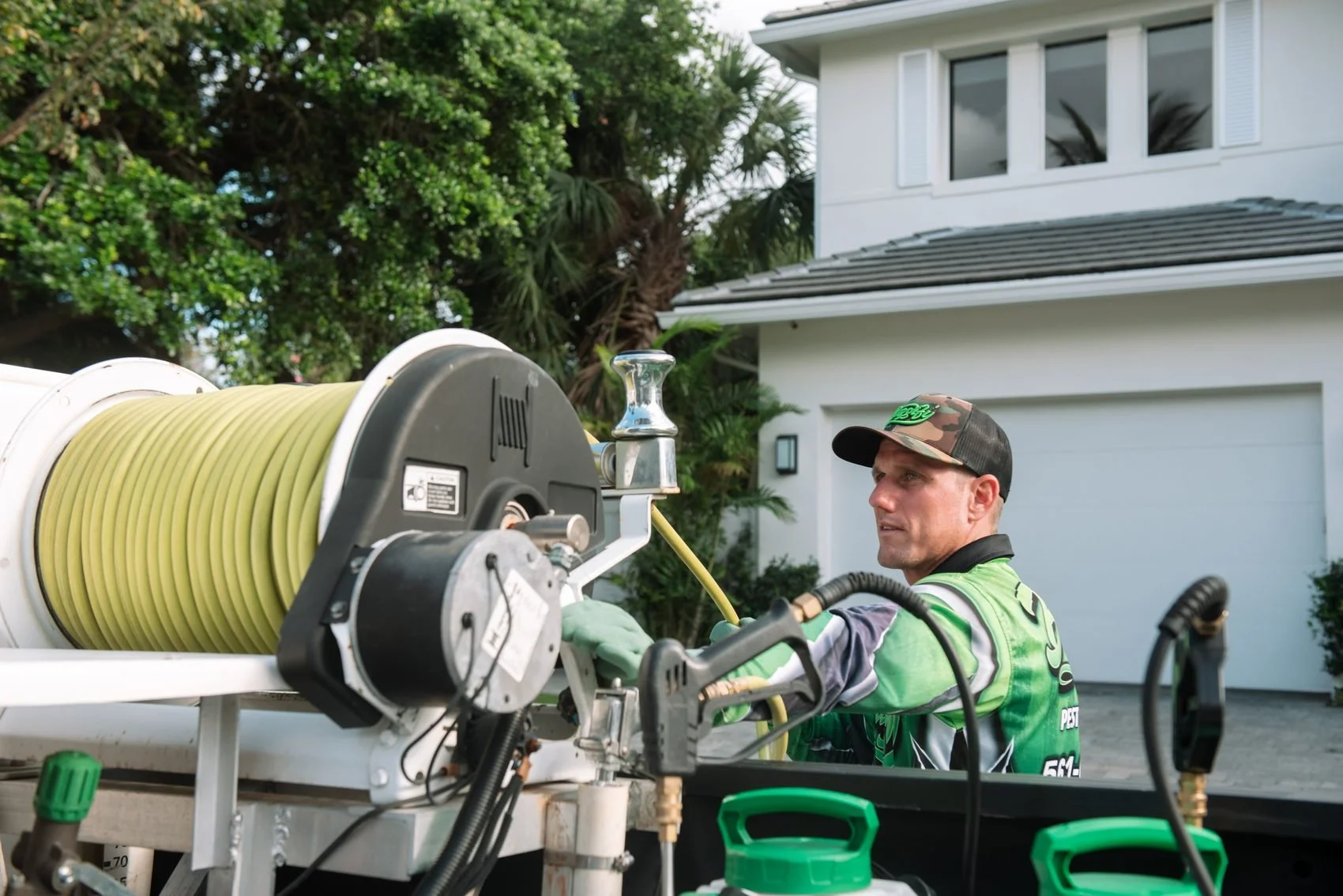
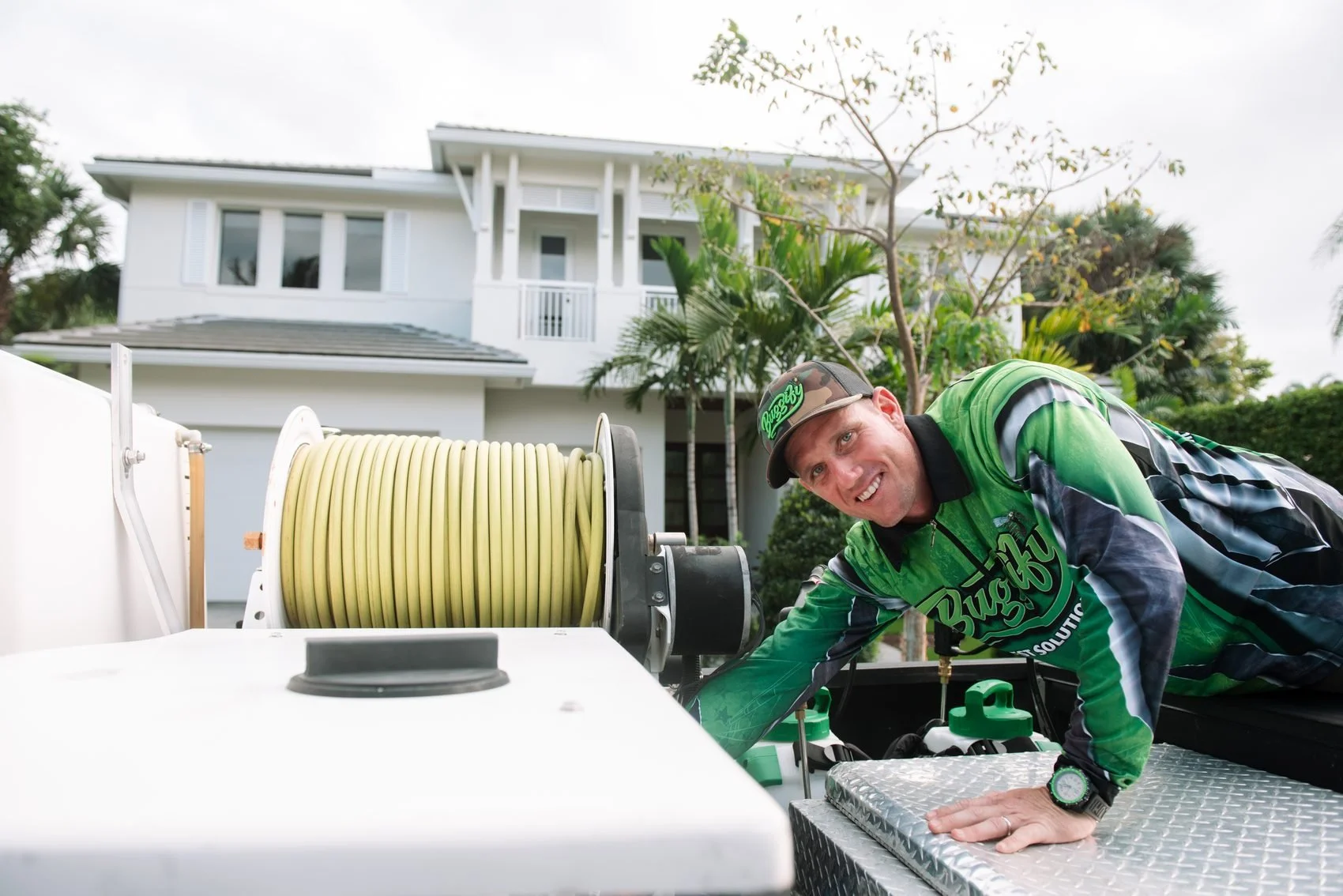
Tyler answers the phone, runs the inspection, and treats the property. No rotating route techs.
“For carpenter ants and fire ants, perimeter spray is incomplete. For pharaoh ants it's actively destructive — the colony responds by budding into multiple sub-colonies, so one problem becomes three.”
Most pest companies show up, spray the perimeter, and leave. For carpenter ants and fire ants, that approach is incomplete. For pharaoh ants, it's actively destructive — pharaoh colonies respond to chemical disturbance by budding (splitting into multiple sub-colonies), so a single problem becomes three problems.
Tyler's protocol starts with species identification. Six South Florida ant species, six different treatment approaches. Carpenter ants need non-repellent residual plus the moisture-source fix that's actually drawing them in. Fire ants need granular bait plus direct mound injection to reach the queen. Sugar/ghost ants need indoor gel bait at the trail source. Pharaoh ants need bait-only — no spray. Big-headed ants need carbohydrate-protein bait rotation seasonally.
Every South Florida ant, its own protocol
Correct identification is the whole job — the wrong bait makes budding species worse.
Indoor pests — roaches, ants, spiders, silverfish
German and American cockroach harborages. Carpenter, fire, sugar/ghost, pharaoh, and big-headed ants (each needs a different bait + barrier strategy). House spiders, lanai-edge orb weavers, and brown widow exclusion. Silverfish in older humid homes. Earwigs and millipedes during the rainy season.
Outdoor pests — mosquitoes, wasps, hornets, yellow jackets
Mosquito yard barrier on a monthly cadence, May–October. Paper wasp, mud dauber, yellow jacket, and bald-faced hornet nest removal — same-day response when scheduling allows. Carpenter bee identification and removal (often confused with honey bees — they need a different treatment). Stinging-insect emergencies prioritized over scheduled visits.
Rodent control — roof rats, Norway rats, mice
Roof rats dominate South Florida (tile-roof entry geometry); Norway rats are secondary, canal-adjacent only. Trapping for active populations, baiting for ongoing pressure, copper mesh + polyurethane exclusion for the long-term fix. Attic and wall-cavity work both in scope.
Whole-home pest exclusion + specialty work
Entry-point sealing (copper mesh + Tremco/GE polyurethane). Soffit-fascia gap repair, plumbing-vent screening, slab-crack treatment, pest-grade vent screening. Bee removal ($250–1,200+ by hive size and access). Commercial / HOA / property management (50–200 home communities preferred). Luxury home pest management (gated communities). Lawn care (HOA + luxury-estate add-on only).
Exactly what happens, start to finish
Most pest companies won't tell you the plan. Here's ours — proven, source-first, and transparent — so you can spot anyone cutting corners.
You call. Tyler picks up.
Direct line to Tyler, Mon–Fri 8 am – 5 pm. He'll ask what you're seeing, where, and how long. You'll get a free phone estimate range, then decide together whether a $175 on-site inspection is needed (credited toward your first treatment if you book ongoing service).
Same-day or next-day inspection in your home.
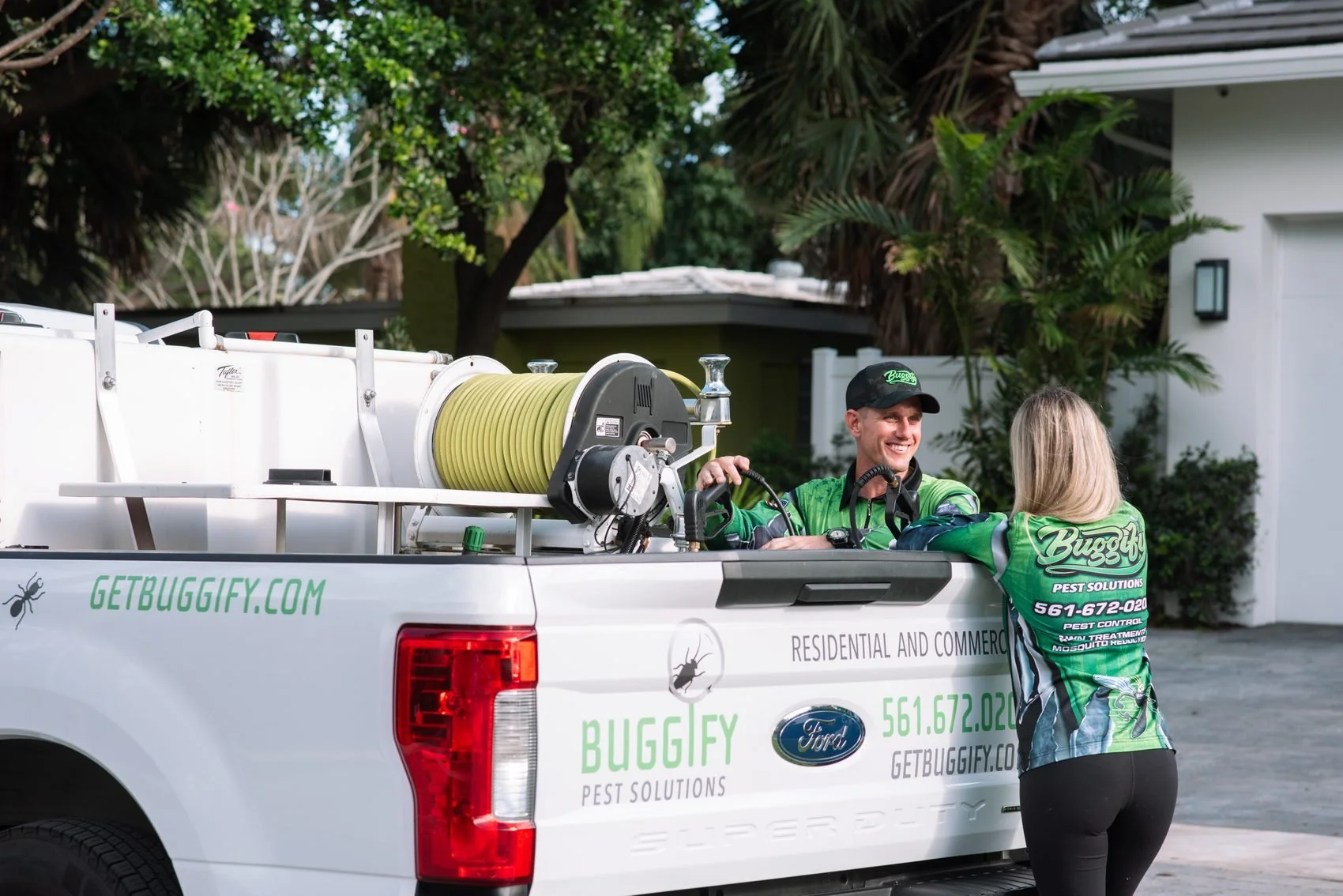
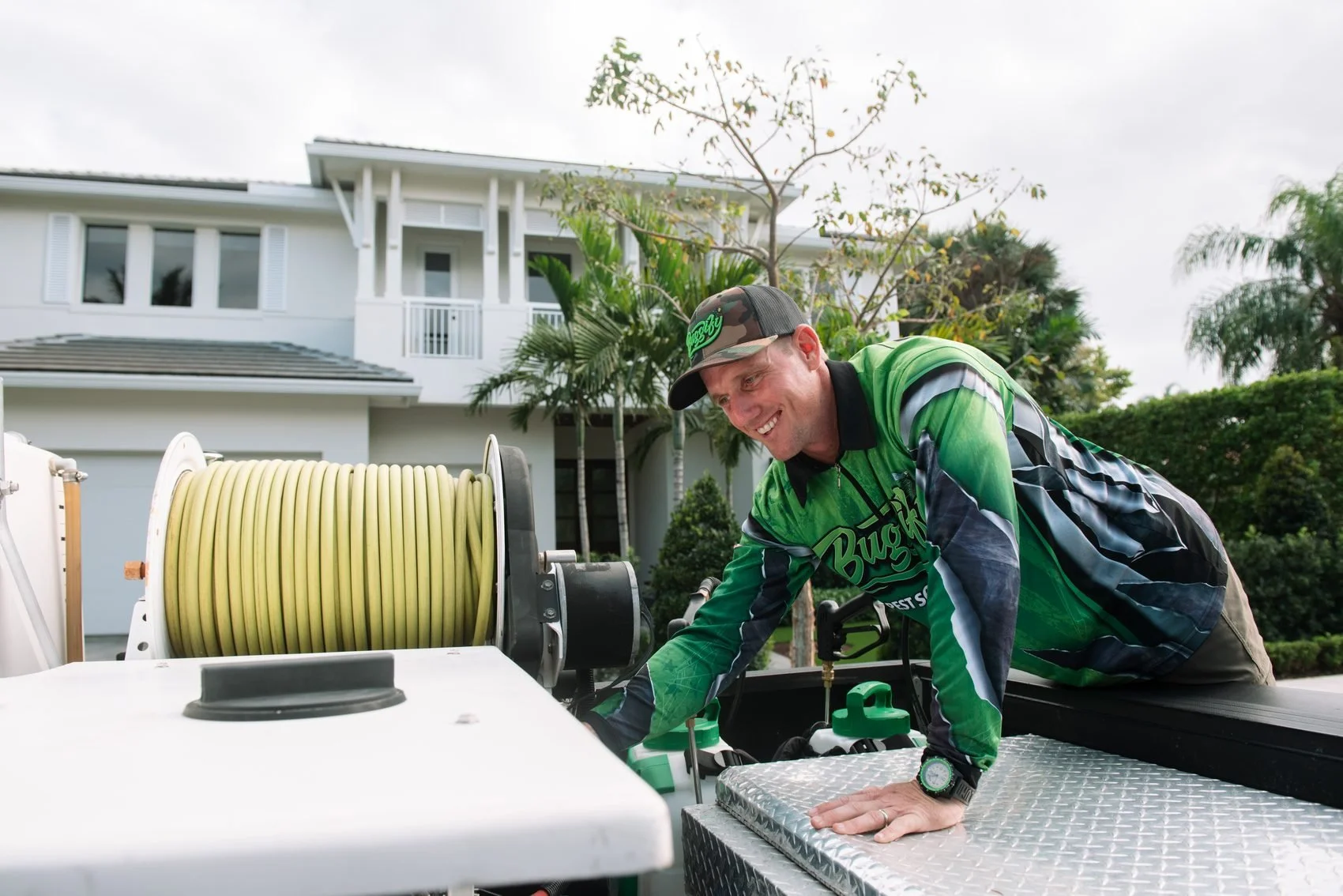
Same-day routine inside the core service area (Boca, West Boca, Parkland, Coral Springs, Deerfield Beach) when you call before noon. Tyler arrives in the big white Buggify truck — green uniform, cowboy hat, easy to spot. He follows the trails to find where the ants are entering and where the colony is nesting — wall voids, soil, wood, or mulch beds.
Species identification — the step that decides everything.
Carpenter, fire, ghost, white-footed, pharaoh, big-headed, or sugar ant? Tyler IDs the species on-site, because the wrong bait or a repellent spray makes budding species split into new colonies. This is where most DIY and chain treatments go wrong.
Species-matched bait + barrier treatment.
Non-repellent residual + moisture fix for carpenter ants; granular bait + mound injection for fire ants; slow-acting gel bait for budding species (ghost, pharaoh, white-footed); trail-source bait + perimeter barrier for sugar and big-headed ants. FMC professional products; SDS available on request.
Walkthrough, written summary, and follow-up.
Final walk-through — what was treated, what to expect over the first 1–3 weeks as the bait reaches the queen. Written work summary. Bi-monthly plan customers: next visit (8 weeks out) scheduled on the spot, with free re-service between visits if ant activity persists.
A local owner beats a route tech
Bi-monthly plans, every 8 weeks
Three tiers, same cadence. They differ in scope, not frequency. Bills per visit — cancel anytime.
Basic
General pest — perimeter, entry-point, crack-and-crevice.
- ✓Every-8-week service
- ✓Perimeter + entry-point treatment
- ✓Crack-and-crevice work
- ✓Free re-service between visits
Full Home Protection
The standard for typical Boca / Parkland / West Boca homes.
- ✓Everything in Basic
- ✓Interior on request
- ✓Rodent + ant monitoring
- ✓Termite-sign check + licensed WDO referral
Complete
Built for luxury, gated, or high-pressure properties.
- ✓Everything in Full Home
- ✓Mosquito barrier
- ✓Attic + exclusion monitoring
- ✓Lanai treatment + termite-sign referral
Single visit for a localized trail (sugar/ghost) or an active fire-ant mound cluster. Includes species ID, treatment, and a 30-day callback warranty. Larger/multi-zone priced higher.
Larger scope — moisture-source identification + non-repellent residual + colony injection. Pricing varies by access (deck framing, fascia, lanai post).
Granular bait broadcast (full property) + direct mound injection at active mounds. Lots over 1/2 acre priced higher. Re-treatment at 4–6 weeks if needed.
Recurring ant pressure homes are best on the Full Home Protection plan ($720–960/yr). The Complete plan ($900–1,400/yr) adds mosquito barrier for multi-pest properties.
13 cities, two counties, one local guy
Buggify runs out of the West Boca shop at 22617 Middletown Dr. Same-day service is routine in the core area when you call before noon.
Outer zones by appointment — Highland Beach, Wellington, Lake Worth Beach & Tamarac case-by-case. Travel surcharge may apply beyond a 15-mile radius.
Why Boca pest pressure isn't like anywhere else
National playbooks are built for four-season climates with a real off-season. South Florida has none — seven local factors that change the whole approach.
Year-round ant pressure — no off-season
South Florida heat compresses ant reproductive cycles, so foraging never fully stops. Sugar/ghost ant trails, carpenter activity, and fire-ant mounds stay active all year. The bi-monthly (every 8 weeks) cadence is built for continuous pressure — a quarterly calendar leaves 12-week gaps the colony exploits.
Year-round humidity drives moisture harborage
70–85% humidity keeps moisture-driven harborage active continuously. Irrigation overspray, lanai-edge transitions, and soaker hoses become harborage zones; under-sink and wall-cavity leaks are the #1 indoor carpenter-ant driver. Fixing the moisture is part of the treatment, not an afterthought.
Lawn irrigation drives fire ant migration
Heavy irrigation keeps fire ant mounds shifting — a treated mound is often replaced 10–20 feet away within 2–3 weeks. That's why the protocol pairs a yard-wide granular baseline with targeted mound injection, rather than spot-treating one mound at a time.
Pre-1978 hardwood decks drive carpenter ants
Older Boca and Delray homes (Old Floresta, Boca Highlands, early Mission Bay) often have hardwood deck framing softened by decades of moisture. Carpenter ants excavate that damp wood for galleries until the moisture source is addressed.
Outdoor harborage outsizes indoor
The climate keeps ant colonies viable outdoors year-round, so mulch lines, landscape moisture, and lanai screens are the primary harborages. Indoor-only treatment misses ~70% of the driver — Tyler starts every inspection on the exterior.
Hurricane-season displacement (May–Oct)
Heavy summer storms flood ground nests and shift outdoor harborage, pushing colonies toward the structure. Active plan customers get a post-storm inspection offer — water-pooling zones, soffit damage, and lifted tiles checked after every named storm.
Pharaoh ants concentrate in 55+ & multi-family
Pharaoh ants prefer stable indoor environments with consistent food access. Boynton's 55+ corridor (Leisureville, Sterling Village, Hunters Run) and Margate's mid-century multi-family buildings see disproportionate pharaoh activity — where bait-only (never spray) is non-negotiable.
Not sure what's driving it on your street?
Tyler knows the pressure block by block. Get a free read on the phone.
(561) 672-0200
The technical depth behind every visit
Seven things most route techs are never trained on — each tied to a real outcome for your home.
60-second species ID — size, color, trail, nest
Large + black = carpenter; very small + indoor trail = sugar/ghost; very small + uniform yellow = pharaoh (CAUTION — bait only); reddish + outdoor mound = fire; disproportionate head = big-headed; raised abdomen = acrobat. Species first, then protocol — never the other way around.
Pharaoh ant bait-only protocol — why spray makes it worse
Pharaoh colonies respond to chemical disturbance by budding — workers and queens split off and start new sub-colonies. One problem becomes 3–4. Protocol: protein-and-carbohydrate bait rotation over a 4–8 week timeline, no spray, no aerosols, no perimeter residual.
Fire ant mound injection — reaching the queen
Fire ant queens nest 4–6 inches below the surface. Perimeter spray and granular broadcast both miss the queen — the colony rebuilds within weeks. Direct mound injection with concentrated product reaches her. Tyler combines a granular baseline with direct injection at active mounds.
Carpenter ant moisture-source identification
Carpenter ants don't eat wood — they excavate damp wood for galleries. Killing visible workers without addressing the moisture guarantees return in 30–60 days. The protocol finds the moisture (irrigation, gutter overflow, wall-cavity leak) and the homeowner addresses it as part of the job.
Sugar/ghost ant gel bait at the trail source
Trails follow micro-cracks at counter-to-backsplash transitions, plumbing penetrations, and baseboard gaps. Tyler deploys gel-bait dots at the actual trail source; workers carry bait to the queen via colony food-sharing (trophallaxis). Perimeter spray never reaches the colony.
Non-repellent residuals — why Termidor works
Termidor (fipronil) is non-repellent — ants don't detect it, keep trafficking through treated surfaces, and transfer active ingredient back to the colony via grooming. Repellent pyrethroids make ants detour around the zone. Non-repellent vs. repellent is the key decision in ant protocol design.
IGRs as a supplemental reproductive interrupt
Insect Growth Regulators prevent worker pupae from developing into reproductives — a supplemental tool on persistent multi-species and long-duration carpenter jobs. Most national-chain ant protocols skip IGRs; Tyler adds them when the species and case warrant.
SDS available on request
Every product, every time — full transparency, no "proprietary blends."
homes served
What our customers say about Buggify
Verified 5-star reviews from Boca Raton, Parkland & Coral Springs families — straight from Google.
Eleven questions Tyler gets about ant control
If yours isn't here, call (561) 672-0200 — Tyler answers directly.
Why can't you just spray and kill them all?
–Because the wrong product on the wrong species makes things worse. Pharaoh ants split colonies (budding) when sprayed. Carpenter ants return until the moisture source is fixed. Sugar ants need bait at the trail source, not perimeter spray. Species-blind spraying isn't pest control — it's a billing event.
I see little ants on my kitchen counter — what should I do?
+Don't spray over-the-counter products yet — many push the ants into wall voids where they're harder to bait. Wipe up obvious trails, identify where the ants are entering (counter-backsplash edge, plumbing penetration, baseboard gap), and call Tyler. Gel bait at the entry point is usually the fix.
How long until the activity stops?
+Depends on species. Sugar/ghost ants: 7–10 days after gel bait is deployed. Carpenter ants: 14–21 days once the moisture source is also addressed. Fire ants: 14–21 days after granular + mound injection. Pharaoh ants: 4–8 weeks on bait-only protocol (slow but complete).
Are the products safe for my pets?
+Yes — every Buggify product is label-compliant pet-safe when applied per label. Gel baits are deployed in cabinet voids and behind appliances (not on accessible surfaces). Granular baits are broadcast in yard zones away from pet-traffic areas. SDS available on request.
What's the warranty on a one-time ant treatment?
+30-day callback warranty. If the same species returns within 30 days, Tyler comes back at no additional cost. Beyond 30 days, follow-up treatments are billed at the standard one-time rate.
Do you treat fire ant mounds the same as indoor ants?
+No — completely different protocol. Fire ants are outdoor, mound-nesting, queen-driven; require granular yard baseline + direct mound injection. Indoor ants are mostly worker-driven with the colony hidden behind walls; they require species-specific bait at the trail source. Different products, different equipment, different visit duration.
I keep getting carpenter ants in the same place. Why?
+Almost certainly a moisture source you haven't fixed. Carpenter ants nest in damp wood — once the wood dries out, they leave. The recurring activity tells you the source is still active: irrigation overspray on a deck post, gutter overflow at fascia, a slow plumbing leak in a wall cavity. Treatment without moisture fix = recurring activity.
Can I prevent ants from coming back?
+Yes — a combination of: monthly perimeter inspection for new entry points, mulch-line setback (12 inches from the foundation), regular gutter cleaning, prompt repair of irrigation overspray, and sealing cracks at counter-backsplash and plumbing penetrations. Bi-monthly plan visits handle the inspection and treatment side.
Same-day service available?
+Same-day inspection routine in the core service area (Boca, West Boca, Parkland, Coral Springs, Deerfield Beach) when you call before noon. Outside the core, the next day is typical.
Do you handle ants for HOAs and property management companies?
+Yes — custom-quoted by location and scope. Fire ants are the most common HOA-driven ant call (common areas, playgrounds, pool decks).
Do you sell DIY products?
+No — Buggify is a service business, not a retail operation. The professional products Tyler uses (Bayer Termidor, FMC residuals, professional gel baits) aren't available retail in this exact formulation. If you want DIY, Home Depot or Lowe's carries consumer-grade gel baits; for trail ants, those work reasonably well at the trail source.
Three things Buggify will never do to you
Quote a real price without inspecting first
The phone gives a range; firm pricing comes after an on-site walkthrough, so the scope matches what's actually driving the activity.
Indoor spraying when the source is outside
Most South Florida pest pressure is driven by outdoor harborage. Indoor-only work is a short-term cover-up, not a fix.
Lock you into a long-term contract
Bi-monthly plans bill per visit and cancel anytime, no fees. Service should be based on need, not contractual obligation.
Call Tyler. Get a price range on the first call.
No contract, no sales pitch, no callback queue — in most cases, on the schedule the same day or next morning.