
Why Ant Spray Makes an Infestation Worse — and What Works
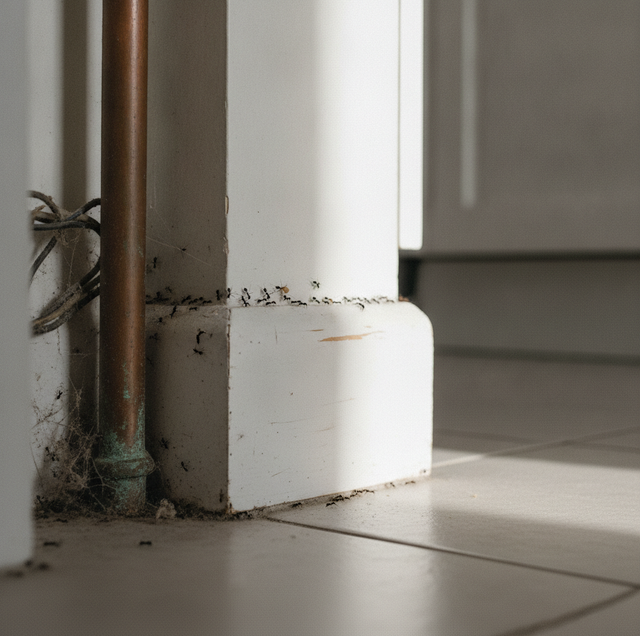
Reach for the ant spray, and you would swear it is working. The trail breaks up, the ants scatter, and the counter wipes clean in under a minute. It feels like a win. With a lot of common household ants, it is closer to the opposite of one.
A few days after that satisfying knockdown, the ants are back, and not where you sprayed. A trail behind the bathroom sink, a few crossing a bedroom windowsill, a cluster at a hallway baseboard. One trail became three. The spray reached them. It told the colony to split up and spread out, and the reason traces almost entirely to how these ants are built.
What the Spray Actually Reached
The ants you see on a counter are foragers. They are the scouts and the food carriers, the small percentage of the colony sent out to find and haul back a meal. The nest, where the queens and the brood and the vast majority of the workers live, is somewhere else entirely: inside a wall void, under the slab, behind the dishwasher, in the soil against the foundation, up in a soffit. You rarely see it.
So when you spray a trail, you are killing the delivery drivers, not the warehouse. Even a spray that drops every ant on the counter has touched only a fraction of the colony that happened to be out working that shift. The queens keep laying. The brood keeps maturing into new workers. The colony's actual production line was never in the room with you.
That alone would make spraying the trail a losing move. A colony that loses a batch of foragers simply sends more. But the common contact sprays sold for ants do something worse than fall short. They actively provoke the nest into spreading.
Why One Trail Turns Into Several
Most over-the-counter ant sprays are repellent. That word matters. A repellent product is designed to create a barrier ants avoid, leaving a residue they read as hostile ground. When foragers hit that treated zone, and some of them drop, the survivors carry a clear signal back toward the nest: this route is dangerous.
For many ant species, that is a manageable disruption. But two of the most common indoor invaders, ghost ants and pharaoh ants, are polygyne, meaning a single colony runs many queens at once rather than one. A multi-queen colony has a survival trick that single-queen species lack. Under stress, especially a chemical threat along its trails, it can bud. Budding is when a group of workers picks up brood and one or more extra queens, then walks away to start a satellite nest somewhere safer. The colony does not die. It divides.
That is the mechanism behind your three new trails. The repellent did not spread the ants by carrying them on the air or on your rag. It frightened a colony that is wired to respond to danger by splitting up and relocating. One nest under stress becomes two or three smaller nests in new hiding spots, each with its own queen and its own foragers, each running its own trail. You did not miss. You triggered the exact behavior that turns a contained problem into a scattered one.
This is why the spray can feel like it made things worse, even when it killed ants on contact. Killing foragers was never going to end the infestation, and the repellent residue gave a budding species a reason to fan out.
Repellent Spray Versus Non-Repellent Bait
The fix is not a stronger spray. It is a different product category that operates on the opposite principle. Here is the contrast that matters.
| Repellent contact spray | Non-repellent bait | |
|---|---|---|
| What the ant senses | Detects it and avoids the area | Cannot detect it; treats bait as food |
| What it kills | Foragers on contact, on the trail | The whole colony, including queens |
| Effect on a multi-queen nest | Can trigger budding and relocation | No alarm, so no budding |
| Where it acts | The surface you sprayed | Carried back into the hidden nest |
| Speed and result | Fast knockdown, problem returns | Slower, but the colony collapses |
A non-repellent bait is the reverse of a repellent spray in the one way that counts: the ants cannot tell it is there. A gel bait or a granular bait pairs a slow-acting active ingredient with something the ants want to eat, such as sugars, proteins, or oils, depending on the species. Foragers find it, feed on it, and carry it home as food. Because it is slow and undetectable, they do not associate it with danger, so there is no signal to bud and no zone to avoid.
How Bait Reaches a Queen You Cannot Find
This is the part that makes baiting work where spraying cannot. Ants feed each other. A forager that eats bait returns to the nest and shares the meal mouth-to-mouth with other workers, and they, in turn, feed the brood and the queens. That food-sharing is called trophallaxis, and it is how a colony that lives entirely on foragers still keeps its queens and young fed. Bait rides that same distribution network straight into the nest you never located.
Because the dose is slow, the forager lives long enough to make the trip and pass it along before anything happens. The active ingredient spreads queen by queen through the colony. On a multi-queen ghost or pharaoh colony that has already budded into several nests, foragers from those satellite nests often share the same food sources, so a well-placed bait can move between the split-off nests too. You do not have to find every hiding spot. You have to get the bait onto the trails the ants are already using.
Why Killing the Ants You Can See Does Not Solve It
It comes down to what you are actually removing. Squashing a trail or wiping out a swarming line removes foragers, and foragers are the most replaceable part of the colony. They are meant to be spent. A queen that can lay hundreds of eggs replaces a lost work crew in short order, and in a polygyne colony, there are many queens doing exactly that at once.
Ending an infestation means reaching the reproduction, not the traffic. Every strategy that only targets ants in the open, whether that is a spray, a wipe, or a sticky trap, works on the visible traffic and leaves the engine running. That is the single reason these infestations feel impossible to knock out with the can under the sink.
Why Species Identification Comes First
Not all ants bud, and not all ants want the same bait, which is why a pro identifies the species before choosing a product. Ghost ants (tiny, pale legs and abdomen, dark head) and pharaoh ants (small and yellowish) are the classic multi-queen budders, and they are the ones a repellent spray scatters. Carpenter ants, big-headed ants, and others behave differently and call for their own approach.
Diet matters just as much as behavior. Many ants swing between craving sugars and craving proteins or grease, depending on what the colony needs at the moment, so a bait that gets ignored one week may get accepted the next. Matching bait type to the species and to what it is feeding on right now is the difference between a bait station that the ants swarm and one that they walk past. Guessing the species usually means guessing the bait, and the wrong bait is a week lost while the colony keeps growing.
What to Do If You Already Sprayed
If you have already hit the trails with a repellent spray, you have not ruined anything permanently, but a couple of moves will help you recover. Stop spraying first, because every fresh application of repellent gives a budding colony another push to relocate. Give the treated surfaces time and let the ants re-establish their trails, since you need active trails for bait to work.
Avoid laying bait directly on top of fresh repellent residue. Ants avoid that residue, which is the whole problem, so bait placed in a repellent zone gets skipped. Place bait slightly off the treated line, near where the trail enters the room or along the baseboard the ants are traveling, and leave it undisturbed. Resist the urge to clean the trail with a strong cleaner while you are baiting; wiping away the ants' scent path just sends them looking for new routes and can scatter them further.
Frequently Asked Questions
Bait is deliberately slow, so expect activity to keep going for several days to a couple of weeks before the colony collapses. In the first day or two, you may actually see more ants, not fewer, because the bait is drawing foragers to feed and carry it home. That surge is the bait working. If you see zero uptake after several days, the ants are usually rejecting that formula, and switching between a sugar-based and a protein or grease-based bait often fixes it.
Not in the same area. A repellent spray and a bait cancel each other out because the ants avoid the sprayed area and never reach the bait placed there. If a situation truly needs both, a technician uses a non-repellent product on the trails and reserves a repellent barrier for the outside perimeter, well away from the interior bait placements, so the two do not fight each other.
Vacuuming or wiping up the foragers on a counter is fine and will not push the colony to bud the way a repellent spray does, because you are removing ants, not laying down a chemical the colony reads as an attack. The one thing to avoid is scrubbing the trail with a strong cleaner right next to a bait placement, since that erases the scent line the ants follow to reach the bait and can scatter them off it. If a visible trail bothers you, wipe a few inches away from the bait and leave the path to it alone. Removing the ants you see will also not speed up the kill, because the nest and its queens are the parts that have to be reached.
Ghost and pharaoh ants do not sting or damage the structure the way some pests do, so they are mostly a contamination and nuisance problem indoors. The real concern is food contact and their habit of getting into everything, including sealed-looking packaging and, in the case of pharaoh ants, sensitive settings like kitchens and healthcare spaces. Carpenter ants are a different story because they excavate wood to nest, which is a reason to get the species identified rather than assumed.
In a single-queen species, removing the queen ends that colony. In a polygyne colony, it does not, because there are many queens and losing one barely registers. This is exactly why bait that spreads throughout the colony via trophallaxis matters so much for ghost and pharaoh ants: it reaches many queens at once rather than just one. A single dead queen in a multi-queen nest changes almost nothing.
Cutting off food and moisture reduces what draws foragers indoors and is worth doing, but sanitation alone rarely clears an established colony, because the nest can live off other food sources and simply forage elsewhere in the house. Wiping counters, fixing drips, and sealing food help the bait compete less with crumbs, so the ants take more of it. Think of cleanup as making bait work better, not as a standalone cure.
What Finally Clears Them
The reason ant spray so often makes an infestation look worse is that it treats a colony as if it were the handful of ants you can see. It is not. The trail on your counter is a delivery route; the nest is hidden and full of egg-laying queens; and the repellent residue that kills a few foragers also signals a multi-queen colony to pack up and spread out. The tool that actually ends it does the opposite: an undetectable bait the ants carry home and share, reaching the queens you were never going to find with a can. Get the species right, put the bait where the ants already walk, and stop spraying long enough for it to work.
If spraying has only scattered your ants into new rooms, get the species identified and the colony baited the first time properly. Buggify Pest Solutions serves Boca Raton, West Boca, and communities across Palm Beach and northern Broward. Call Tyler: (561) 672-0200.