

Porch Light Color and Spiders: Why Yellow Bulbs Help
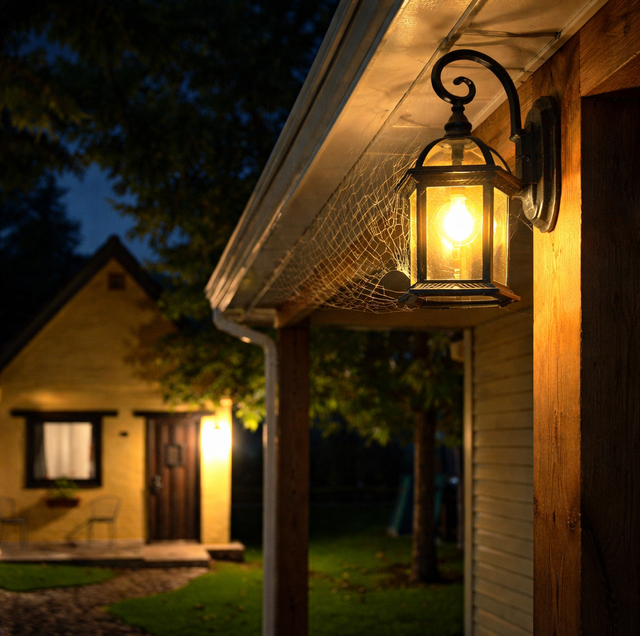
Quick Answer: White and UV-rich porch bulbs draw the moths and gnats spiders hunt, building web activity at doors and windows. Most night-flying insects see UV and blue far better than amber, so a bulb swap cuts that prey traffic.
Every porch light left on after dark is doing two jobs at once: lighting the doorway and calling in a steady stream of moths, gnats, and midges from across the yard. Spiders don't care about the bulb itself. They care about what's flying around it, and a plain white or blue-white porch light can turn one fixture into the single best hunting spot on the property. Swap that bulb for a warm amber or yellow one, and the web count near that door usually thins out within a couple of weeks, not because the new bulb repels spiders, but because it stops feeding them.
What Insects Actually See When They Fly Toward a Light
Flying insects don't head toward a porch light the way a moth in a cartoon does, drawn in blindly by brightness alone. Their compound eyes carry photoreceptors tuned to specific wavelengths. In most night-flying species, those receptors are most sensitive to the ultraviolet and blue end of the spectrum, roughly the same range a cool-white LED or a mercury-vapor security light puts out in quantity. Longer wavelengths toward amber, orange, and red sit at the far edge of what those receptors register well, so an insect that would circle a white bulb for an hour often flies past an amber one without much reaction at all. That's the mechanism behind the whole fix: it isn't that yellow light "repels" bugs, it's that most of them simply can't see it as clearly as they see white or blue-white light.
Why a Porch Light Becomes a Spider's Best Hunting Spot
A spider building a web isn't choosing a location at random. It's choosing the spot with the most food moving through it, and a lit doorway, garage fixture, or lanai light concentrates insect traffic the same way a porch light concentrates moths on a summer night. Orb weavers in particular favor a web site with reliable airflow of prey passing through, which is why a strand strung across a lit entryway or a screen panel facing a fixture fills back in faster than a web anywhere else on the property. The light isn't attracting the spider directly. It's attracting the meal, and the spider is simply working the spot where the meal shows up most reliably, night after night.
Why Amber and Yellow Bulbs Change the Equation
Swapping a fixture's bulb doesn't change the porch, the door, or anything structural about the house. It changes what's visible to an insect flying past at night. A bulb coated or filtered to emit mostly amber and yellow wavelengths, rather than the broad white-to-blue spectrum of a standard LED or incandescent, puts out far less light in the range most flying insects key in on. Field research on insect attraction to outdoor lighting has generally found that amber and yellow-filtered bulbs draw fewer flying insects than white or UV-rich fixtures meaningfully, with true amber and red-shifted bulbs drawing the fewest of all. Nothing about the swap changes the yard's total insect population; it just removes one fixture from the list of places those insects gather after dark, which is enough to change where a spider decides to set up.
Not every fixture needs the same treatment. A garage light left on all night pulls in more insects over time than a porch light on a timer, and a lanai or dock light near standing water or a canal edge has a bigger prey supply to work with than a light on a dry side yard. Prioritizing the swap at whichever fixture collects the most webs is a faster fix than replacing every bulb in the house at once.
Look for bulbs rated 2200K or lower, or ones described as "amber" rather than just "warm white." A standard 2700K warm-white LED still emits meaningful blue-spectrum light and keeps drawing insects, just fewer than a cool-white bulb would.
Making the Swap Without Losing Usable Light
The color temperature printed on most LED packaging, measured in kelvins, is the fastest way to sort a "warm white" bulb that still attracts insects from one that actually cuts down on them. Standard warm-white LEDs are around 2700K to 3000K and still emit a meaningful amount of blue-spectrum light. Bulbs marketed specifically as amber "bug lights," or true yellow-coated incandescent bulbs, shift much further down the spectrum and substantially cut the blue component. Lumens matter too: dropping to a dim amber bulb at a front door people actually use at night can leave the entry too dark to be practical, so pairing an amber bulb with a slightly higher lumen output, or adding a second fixture, keeps the doorway usable while still cutting the insect draw. A motion-sensor fixture set to amber compounds the effect further, since the light is only on, and only pulling in insects, when someone's actually approaching the door.
What Bulb Color Won't Fix
A bulb swap is a real, high-value change, but it's solving one piece of a larger picture, and it's worth being clear about what it doesn't touch. Mosquitoes are drawn far more by carbon dioxide, body heat, and standing water than by light, so a yard near a canal or with irrigation overspray pooling in low spots will keep producing mosquito activity, and the spiders that feed on it, regardless of bulb color. Ground-hunting spiders like wolf spiders don't build light-adjacent webs at all; they hunt on foot and respond to harborage and moisture near the foundation, mulch beds, and stored items, not to what's lit up overhead. And a neighbor's floodlight, a streetlamp, or a pool light left on can still supply enough insect traffic to keep a nearby web occupied even after every fixture on the house itself has been changed. Bulb color shifts the odds at a given fixture; it doesn't remove every reason a spider has to be in the yard.
Where a Bulb Swap Fits Into a Full Spider Control Plan
Changing bulb color is exactly the kind of fix worth doing yourself: cheap in effort, no chemicals involved, and it targets a real mechanism rather than just knocking down whatever web is currently visible. But it's one input into a bigger picture that includes mulch lines, lanai screens, irrigation moisture, and the actual harborage spots, frame corners, soffit gaps, stacked items, where spiders are sheltering between hunts. A professional visit that starts by identifying those harborage points and the prey sources feeding them treats the parts of the pattern a bulb can't touch, while the lighting swap keeps doing its part at the fixture level. The two aren't competing fixes; the bulb handles what happens at the light, and a source-first treatment handles what happens everywhere else.
Frequently Asked Questions
Only marginally on bite risk itself, and it's worth not overestimating this one. Mosquitoes locate targets mainly by carbon dioxide, body heat, and skin scent rather than by light, so an amber porch bulb does little to reduce how many find their way to a person standing nearby. What actually helps is removing standing water close to the house, gutters, plant saucers, bromeliad cups, tarps, anywhere water sits long enough for a batch of eggs to complete their cycle, and swapping standard porch screening for a finer no-see-um mesh, which blocks far more mosquitoes than any bulb choice ever will. Where the bulb swap does help is indirectly, by thinning out the moths and gnats that would otherwise draw web-building spiders to that fixture.
There's a real difference worth checking before buying. Some LED bulbs sold as bug lights are simply warm-white LEDs with amber-tinted plastic housings, which cuts some blue light but not as much as a true amber or yellow-filtered bulb. Checking the listed color temperature, ideally 2200K or lower, is a better indicator than the word "bug light" on the packaging alone, since that label isn't a regulated standard.
No, and expecting that sets up disappointment. Spiders that hunt on the ground, in mulch, or inside garages and sheds aren't relying on a lit fixture to find food; roaches, silverfish, and other non-flying prey keep those populations fed regardless of bulb color. Ground hunters like wolf spiders also behave differently around an entryway than a web-builder does: instead of anchoring in one spot near the light, they patrol a territory on foot after dark and duck back into a mulch bed, stacked planter, or gap under a doorstep to wait out daylight. Pulling mulch back a few inches from the foundation and keeping stored pots or boxes off the ground near entry points does more for that population than any bulb ever will. A full bulb swap reduces activity concentrated at light-adjacent web sites specifically, not the property's spider population as a whole.
Mostly, with one difference worth knowing. Brown widows tend to build low, tucked-away webs in patio furniture, grills, and mailboxes rather than directly beside a bright fixture, so a bulb swap has less effect on them than it does on light-adjacent web builders like orb weavers. Brown widow activity responds more to reducing clutter and checking those low, sheltered spots directly than to changing what's lit overhead.
Yes, and a well-placed sensor offers more than just a shorter runtime. Set the detection range to cover only the walkway or steps, rather than the whole driveway or yard, since a wide radius re-triggers on passing cats, raccoons, and windblown branches, and the light keeps cycling most of the night anyway, which erases the advantage. A 60- to 90-second stay-on time is usually enough for someone to reach the door without the fixture re-arming every few seconds. Worth knowing: a motion sensor only cuts exposure for moths and gnats keying in on the light itself; it does nothing for wolf spiders and other ground hunters working the mulch and foundation line nearby, since they were never responding to the fixture in the first place.
Partly, but a screened enclosure has an extra variable a front door doesn't: underwater pool lighting and reflections off the water surface can still draw insects to the screen even after the overhead fixture is switched to amber. The bulb swap still reduces the draw from the visible light source itself; it just isn't the whole answer in an enclosure built around a lit pool, where the water adds a second source the front door doesn't have to compete with.
Swapped the bulbs and still finding fresh webs at the door — get the harborage and prey sources treated at the root instead. Buggify Pest Solutions serves Boca Raton, West Boca, and communities across Palm Beach and northern Broward. Call Tyler: (561) 672-0200.
