

Spiny Orb Weaver Spider: The Spiky 'Crab Spider' That Isn't
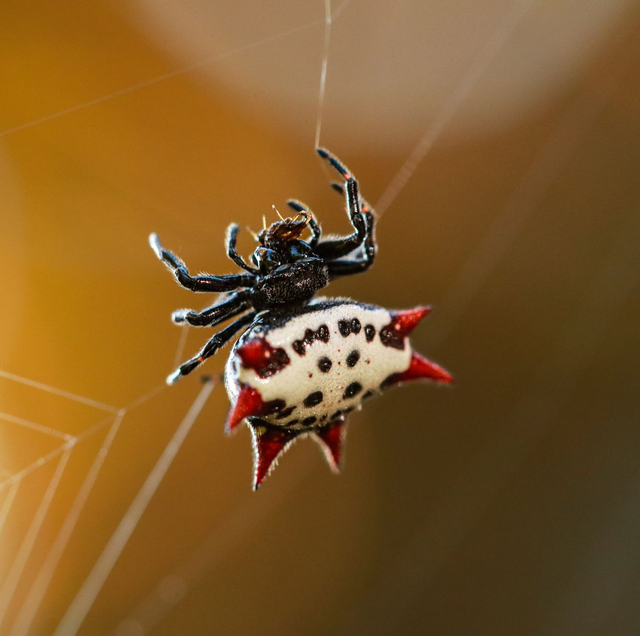
Quick Answer: The spiny-backed orb weaver is a small, spiky, colorful spider common in shrubs and along garden edges in South Florida. Despite its "crab spider" nickname, it is a true orb-weaver unrelated to actual crab spiders and is not dangerous to people or pets.
A web strung low across a hibiscus hedge or a mailbox post, big enough to span a couple of feet across, with something small, white, and spiky sitting dead-center, shows up in South Florida yards often enough that most homeowners eventually walk face-first into one. Get close, and the spider looks almost too deliberate to be real: a flattened, shield-shaped body ringed with six sharp points, some tipped in red, arranged with a symmetry that reads more like a toy than an animal. The reaction is close to universal. Whatever built that shape can't possibly be harmless. It is. This is the spiny-backed orb weaver, and its alarming look does more to scare people than it ever does to catch anything bigger than a moth.
It's often introduced under a different name first: crab spider. That nickname sticks to the shape, not the behavior, and the distinction matters because the same spider is also mistaken for something much larger already covered on this site: the golden silk orb weaver, or banana spider. Sorting out what this spider actually is, and why "crab spider" is the wrong label entirely, takes about two minutes.
What the Spiny-Backed Orb Weaver Looks Like
The species is *Gasteracantha cancriformis*, and the name packs in two separate Latin roots. *Gasteracantha*, the genus, means "spiny belly," a nod to the six points ringing the abdomen; *cancriformis*, the species name, means "crab-shaped" on its own, describing the broad, flattened outline of the abdomen rather than any crab-like habit.
Females are the ones almost anyone actually notices: A female's body runs about a quarter- to a third-inch long but measures noticeably wider, roughly 10 to 13 millimeters across, which gives the abdomen a broad, hexagonal, shield-like shape instead of the round abdomen most spiders carry. Six pointed projections, the "spines" in the common name, ring the outer edge of that shield. In Florida, they're typically red set against a white abdomen scattered with black spots, though the exact combination shifts from one individual to the next.
Males are dramatically smaller: Closer to a tenth of an inch, and they skip the prominent spines entirely. Where a female's abdomen carries six sharp points, a male's carries four or five small, rounded bumps instead, and he spends most of his time near the edge of a female's web rather than out building his own.
The web itself is a second, fast tell. Instead of the sprawling, multi-foot spans some orb weavers spin, a spiny-backed orb weaver typically builds a fairly compact, tidy wheel, roughly one to two feet across, with 10 to 30 straight lines radiating out from the center and a tight spiral of sticky silk crossing them. It's the classic, storybook shape most people picture when they hear "spider web," just built at a smaller, tidier scale than the biggest webs in the yard.
Why It's Called a "Crab Spider" (and Why That's Not Accurate)
True crab spiders earn the name from behavior, not just looks: Members of the family Thomisidae never spin a web to catch prey. Instead, a crab spider parks itself on a flower, a leaf, or a patch of bark, holds its two longer front leg pairs out wide the way a crab holds its claws, and waits, sometimes for hours, to ambush whatever pollinator lands within reach. Some species can also shuffle sideways or diagonally rather than walking straight forward, which is the other half of the crab comparison.
The spiny-backed orb weaver does none of that: It spins a classic wheel-shaped web and sits anchored at the center, waiting for flying insects to blunder into the sticky spiral, which is precisely the behavior a true crab spider never shows. The "crab" reference here describes the shield-shaped body outline alone, not a hunting style or a sideways gait, so a spiny-backed orb weaver and a true crab spider share a nickname and almost nothing else: different family, different hunting method, different relationship to a web entirely.
Spiny-Backed Orb Weaver vs. Golden Silk Orb Weaver: Not the Same Spider
The other mix-up is with the golden silk orb weaver, and size alone settles most of it. A golden silk orb weaver's body runs over an inch long with a leg span that can reach four to five inches, spinning a gold-tinted web that can stretch three or four feet across a pool cage corner or a screened corridor. A spiny-backed orb weaver's entire body could sit on a fingertip, and its web, at one to two feet across, is a fraction of that span, without the gold cast, and without the banded yellow-and-black legs that mark the larger species.
Color is the other giveaway. A spiny-backed orb weaver's shield is white or pale with black spots and red spines in most Florida specimens, a pattern that reads as spiky and angular up close. A golden silk orb weaver, by contrast, has a smooth, elongated abdomen with none of the pointed projections. Side by side, the two aren't easy to mix up; it's really only the shared "orb weaver" label and the fact that both build wheel-shaped webs in shrubs and screened structures in South Florida that put them in the same conversation at all. The golden silk orb weaver's biology is fully explained elsewhere on this site.
Where It Turns Up Around the Yard
Spiny-backed orb weavers favor the same shrub-and-hedge structure that supports a lot of South Florida's outdoor insect activity: hibiscus, ixora, and citrus plantings, the edge of a mulch bed, a fence line, or the gap between two shrubs where a web can anchor to stable branches on both sides. Webs turn up at heights anywhere from ankle level to well up into a tree canopy, depending on what structure is available, which is why one might stretch across a garden path at head height while another sits three feet up in a hedge and goes unnoticed for weeks.
They don't set up indoors. This is strictly an outdoor, plant-anchored species, and a sighting inside a garage or a lanai is almost always a strand that got carried in on clothing or plant material rather than an established web. Outside, though, they're common enough: a single well-planted South Florida yard can easily host several webs at once across different shrubs without that being a sign of anything wrong.
A web blocking a walkway or doorway is fine to clear with a stick or broom; the spider usually rebuilds nearby. A web tucked inside a hedge or fence line that nobody walks through can be left alone with no downside.
Is the Spiny-Backed Orb Weaver Dangerous?
No, not in any way that matters to a household. University entomology sources describe the bite as not known to cause any serious effects in people, since the venom is meant to subdue small insects, not deter something the size of a person. Bites themselves are uncommon to begin with, since the spider spends nearly all its time anchored at the center of its own web rather than wandering. The usual way anyone gets bitten by any small web-building spider is by pressing it against skin directly, inside a sleeve or against a hand reaching into a hedge, rather than an unprovoked encounter.
The Verdict on the Spiky Spider in Your Hedge
A spiny-backed orb weaver strung across a hedge or a garden path is closer to background scenery in a South Florida yard than a problem worth solving. The shape looks armored and deliberate, but the spines are a defense against birds and larger predators, not a threat to anyone walking past. The web itself is quietly controlling pests on small flying insects the whole time it's up. Knowing it apart from a true crab spider and from the much larger golden silk orb weaver is really the whole exercise: once the identification clicks, there's nothing left to actually worry about.
Frequently Asked Questions
Florida specimens are fairly consistent, red spines against a white abdomen with black spots, but the species shows real variation across its broader range. In other parts of its range, the abdomen shows up yellow, orange, or almost entirely black instead of white, and the spines themselves can be black rather than red. A homeowner comparing a local sighting to a photo found online from another state may be looking at a legitimate color form of the same species rather than a different spider entirely.
That's almost certainly a male, and behavior is the fastest tell: he holds a fixed position on a single strand at the margin rather than moving around the web, because he isn't hunting it; he's waiting on it. Unlike the golden silk orb weaver, where a similar-looking edge spider is often a completely different, uninvited species stealing scraps, the small spider near a spiny-backed orb weaver's web is typically just the male of the same species. The way to rule out an imposter is shape, not size: a genuine male keeps the same flattened, shield-like abdomen outline as the female, just smaller and duller. A true kleptoparasite, most often a dewdrop spider in the genus *Argyrodes*, the same genus that sometimes moves in on a golden silk orb weaver's web, has a rounder, soft-bodied abdomen with no shield shape at all, and it tends to sit tucked into loose scaffolding strands rather than anchored along a main radius line.
Some individuals weave visible silk tufts into the foundation lines that anchor the web to surrounding branches. Researchers haven't settled on a single explanation, but one working idea is that the tufts make the otherwise near-invisible strands easier for birds to spot in flight, reducing the chance of a bird tearing through the web by accident. It's a small detail, but it's one more difference from the golden silk orb weaver's web, which doesn't show the same tufted pattern.
Yes. Recorded prey for this species includes whiteflies, small flies, moths, and beetles, the same soft-bodied flying insects that trouble ornamental shrubs and, historically, citrus plantings. A single web isn't a pest-control plan on its own, but a yard hosting several of these spiders across its hedges is getting a modest amount of free insect removal running around the clock.
They're active in South Florida year-round rather than on a seasonal switch, but activity does build toward a peak: male activity tends to concentrate in the fall, adult females are most numerous from roughly October through January, and egg-laying follows in that same window. A web that seems to appear out of nowhere in November isn't a new arrival so much as a spider that's been present all along becoming more visible as the population peaks for the season.
In most cases, yes. When a web does need to come down, the gentler option is nudging the spider itself onto a stick or broom handle first and setting it down inside a nearby hedge or along a fence line, rather than destroying the web outright, which spares the spider the cost of spinning a whole new one from scratch. Rebuilding is quick either way: because this web is far more compact than a golden silk orb weaver's multi-foot span, a relocated or disturbed spiny-backed orb weaver typically has a full replacement web up again within a day, sometimes overnight, using a fraction of the silk and time a larger species needs to recover.
Get a source-first spider inspection for the hedge line, mulch beds, and lanai edge — not just a web knocked down, but the plantings and lighting drawing insects in the first place addressed. Buggify Pest Solutions serves Boca Raton, West Boca, and communities across Palm Beach and northern Broward. Call Tyler: (561) 672-0200.
