

Screened Porch Mosquitoes: Why the Cage Isn't the Fix
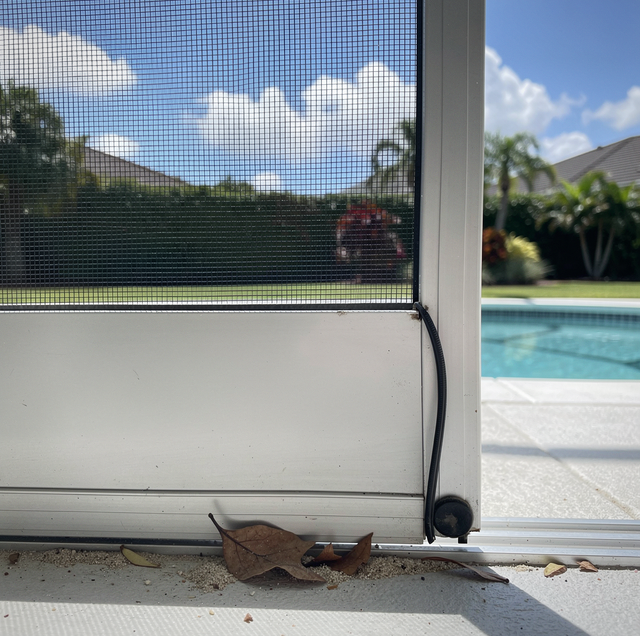
Quick Answer: A screened cage fails at specific hardware points. A walled courtyard has no mesh to fail; it's an airflow and shade problem instead. A covered patio has no walls at all. Name which one you have before deciding what fixes it.
You had the enclosure built so you could eat dinner outside without waving a hand in front of your face every few minutes. The pool cage went up, the courtyard walls went in, the patio roof got framed, and you're still sitting inside that space slapping at your ankles. That's not proof the enclosure failed. It's proof that "enclosed" covers three different setups, each with its own reason mosquitoes are in there with you.
A Screened Pool Cage Fails at Specific Hardware Points
A pool cage or lanai enclosure is common enough across Boca Raton, Parkland, and Coral Springs housing stock that it's worth being precise about how the mesh actually loses. It's rarely the screen field itself, the flat expanse of mesh across a panel. Mosquitoes get in at a short list of specific, findable places:
- Door sweeps and closers: A door that doesn't pull itself fully shut, or that rests a gap off the frame where it should be seating flush, leaves an opening no amount of intact mesh around it matters for.
- Kick-plate seams: Where the solid kick plate at the base of a door meets the screen panel above it, the transition between two different materials is a common place for a seam to open.
- The base track, where screen meets deck: The channel that runs along the bottom of the enclosure can separate from the screen above it, especially where it meets an uneven paver or deck edge.
- Panel corners and the spline: Each screen panel is held into its frame by a spline pressed into a groove around the perimeter, and corners are where that hold is weakest first.
A screen panel pulling loose from its track is a wind hazard as much as an entry point — a section that lifts free can become airborne debris in a storm. That calls for a screening contractor, not a pest treatment.
The whole cage almost never needs attention. One of those four spots does, and finding which one is a screening contractor's job. A technician walking your lanai can tell you the enclosure is letting mosquitoes through; only a contractor can tell you why that specific door or track is doing it.
Three of those four points are at or below knee height, which aligns with where people are actually bitten inside a cage. If you are taking them at the ankles while sitting still on the deck, that is a different picture from mosquitoes working at head height near the door, and the difference is worth passing on to whoever comes to look. It turns a walk of the whole perimeter into a check of a few feet of track.
A Walled Courtyard Has No Mesh, so the Problem Is the Air Inside It
A walled courtyard is a different problem from a pool cage, and treating it like a smaller version of the same problem misses what's actually going on. There's no screen to fail because no screen was ever installed. Solid walls, open sky or a partial roof above, a gate at one end: nothing there was built to exclude a mosquito in the first place, so nothing "broke."
What the walls did do is block wind. A courtyard with tall walls on three or four sides holds still, shaded air the way an open yard never does, and still, shaded, humid air is exactly what a resting mosquito wants. Adults spend roughly 23 of every 24 hours doing nothing but resting on a shaded surface, not flying around looking for a host, and a walled courtyard with plantings in the corners gives them a comfortable place to do it a few feet from where you're sitting. That's a foliage and edge-treatment question, the same one that applies to open yards generally. The courtyard just concentrates it inside four walls, where an open lot would spread the same thing thin.
A Covered Patio Has a Roof and No Walls, so What It Changes Is Habitat
A covered patio sits at the opposite end from a pool cage. It has a roof and often little or nothing at the sides, so unlike a cage it was never built to keep anything out, and air moves through it freely with mosquitoes riding along; filing "covered" next to "screened" in your head is the mistake, because a roof stops sun and rain and nothing else. What the roof does change is shade, and shade is enough to matter on its own. The underside of that roof, and the ground beneath it, stays cooler and darker than your open lawn a few feet away, so a covered patio sitting against dense plantings, hands resting, is a second good option within a short flight of the first. You get bitten under your patio roof for the same reason you get bitten in a courtyard: nothing failed to keep mosquitoes out, and the space you built for shade is also the kind of place they rest.
All Three Share One Thing: Airflow and Shade Favor Resting Adults
Set the entry question aside for a moment, because a pool cage, a courtyard, and a covered patio all do the same thing to the air around them: they slow it down and shade it. That matters more than it sounds like it should, because the mosquitoes biting you at a given moment are a small fraction of the ones actually on the property. The resting population on foliage and structure edges typically runs somewhere between ten and a hundred times the number you'd count flying or landing on a person at any one time.
That ratio is why a treatment protocol targets resting sites, not just the visible, biting few. A lanai's screened zones, the plantings along a courtyard wall, and the shaded edge under a covered patio roof all get treated the same way a yard's tree line and mulch beds do, on the same rotation, because a mosquito doesn't distinguish between the two. Regular service on a monthly cycle May through October, stretching to every other month November through April, keeps residual coverage on those resting surfaces throughout the year mosquitoes are most active. Outdoor harborage (mulch beds, the underside of lanai screening, moisture held by irrigation) outweighs anything happening inside the house, which is a separate question in its own right. What rain does to that coverage between visits is its own question too, and a two-sided one, so do not assume it either way.
When the Right Call Belongs to a Screening Contractor
Here's the part worth saying plainly. A torn panel, a door that won't seat shut, or a gap opening up at a track is a hardware problem. No residual treatment can close a hole, and no amount of foliage spraying can compensate for a door that doesn't latch. If that's what you're looking at, the fix is a screening contractor, and pretending otherwise wastes a service visit.
Rescreening, repair, and enclosure installation are a screening contractor's work, and no treatment plan solves a mesh problem it cannot touch. What a treatment does solve is the resting and breeding side of the picture: the foliage, the shaded edges, the still air a walled courtyard or covered patio creates regardless of whether any mesh is involved at all. Plenty of properties need both: a contractor to close the specific gap and a treatment to handle the remaining population that a sealed enclosure alone won't remove, since adults already established in nearby foliage don't leave just because a door finally closes. What the pool deck, drains, and any pool cover are doing as a water source is its own question, separate from what the cage is letting through.
Frequently Asked Questions
Because most self-closing doors on an enclosure run on a hydraulic closer, and hydraulic fluid changes viscosity with temperature. On a cool morning, the fluid is thicker, the door drifts shut slowly, and it can stop just short of seating against the frame. On a hot afternoon, the same unit swings fast enough to slam. A closer adjusted to seat perfectly in the middle of a July day can leave your door standing a hair open at seven in the morning and again after dark, which happens to be when the biting is heaviest. If you can tell a screening contractor what time of day the door hangs, you have narrowed the adjustment for him before he arrives.
Repetition is the diagnostic here. If one panel on your cage has already been patched and is opening up again in the same place, the mesh wasn't the one that gave out. The groove it seats into has widened or deformed, so each new screen goes back into a channel that can no longer grip it, and the repair comes apart on roughly the same schedule as the last one. Tell whoever installed your enclosure which panel you have already had redone and how long that patch held before it went. Two failures in one location, each with a date attached, point him at a few inches of frame and save him a walk around your whole perimeter.
Yes. A cage over open water traps the water's evaporation in the same shaded, wind-blocked air the frame and roof create, so humidity near your deck runs higher than it would under a cage over a plain concrete pad. With the ambient humidity here already sitting between seventy and eighty-five percent, that extra margin is not a small thing. Your pool is a separate water-source question from what the mesh lets through, but the moisture it puts into the air inside your cage helps keep that space comfortable for resting adults later into the day than your open yard does.
That junction is where two different trades meet, and it is often the least continuous seal on the whole structure. A cage frame fastened to the house wall, a slider track running along the threshold, and a weep channel draining under both of them leave a narrow run where the enclosure's envelope ends, and the building's begins. Mosquitoes work low, shaded lines like that one. If you find them concentrated around the doorway you use most while the pool end of your cage stays quiet, that junction is the first thing to have looked at. It belongs to whoever built your enclosure and whoever set your slider. A treatment has no way to reach it.
A flap cut into a screen panel is a built-in gap by design, and most flaps don't seal against the frame the way the mesh around them does. It also tends to sit low and shaded, which is exactly the kind of line mosquitoes use to move between your plantings outside and the enclosure floor. If your bites cluster at the end of the cage where the flap is, that is the first thing to point out. Whether it needs a better-sealing flap or a different placement is a question for whoever installed it.
Nothing has to happen to it. Screen, spline, closer springs, and track sections all wear on their own clocks, and not one of them runs on the frame's, so any one of them can reach the end of its service life in a year when nothing struck your enclosure, and no storm came through. A door swinging shut a few thousand times is the entire cause. The practical consequence for you is that the year your cage went bad tells you very little about what went wrong inside it. Where in the cage you are now getting bitten tells you a great deal more.
Work out which of the three problems you actually have (a hardware gap, a shaded microclimate, or both) — that decides whether you need a contractor, a treatment, or both. Buggify Pest Solutions serves Boca Raton, West Boca, and communities across Palm Beach and northern Broward. Call Tyler: (561) 672-0200.
