

Why the Exterminator Can't Get Rid of Your German Roaches
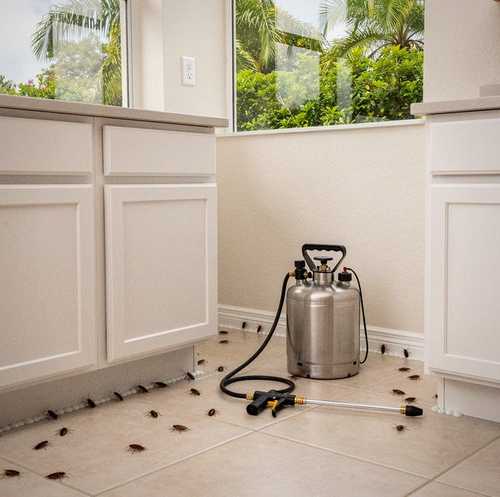
A German roach spends almost its entire life pressed into a crack you never look at: behind the toe-kick under the cabinets, in the hinge recess of the dishwasher door, inside the warm motor housing of the refrigerator. It comes out to feed in the dark and ducks back in before the light finds it. That single habit is the reason a treatment aimed at open surfaces rarely holds.
So when the roaches are back on the counter a week after a technician sprayed the baseboards, it is rarely bad luck or a lazy tech. A perimeter spray treats the wrong surfaces, leaves the egg cases alone, and does nothing to stop the next generation from growing up. Understanding what got missed is the difference between another failed visit and actually clearing them.
The Spray Hit the Baseboards, Not the Harborage
A German cockroach spends almost its whole life crammed into a tight, warm, humid crack within a few feet of food and water. Think of the seam behind the dishwasher, the gap under the sink where the drain line passes through the cabinet floor, the hinge pockets of the cabinet doors, the motor housing of the refrigerator, and the void behind the stove. That is harborage. It is dark, it is close quarters, and it is where the colony actually lives.
A perimeter or baseboard spray runs a band of residual along the open base of the wall. The problem is that a German roach has little reason to walk across that open band. It moves along edges and through voids, staying hidden, coming out briefly to feed and going right back in. The spray sits on surfaces the colony rarely touches. Worse, many perimeter products are repellent, so a roach that does sense the treated edge turns around and stays deeper in the wall. You killed the few that wandered into the open and left the nest intact.
This is why the counter looks clear for a few days, then fills back in. You knocked down the strays. The harborage never got treated.
The Egg Cases Were Shielded the Whole Time
Here is the part that makes German roaches feel unkillable. The female carries her egg case, called an ootheca, attached to the back of her body until a day or two before it hatches. One ootheca holds roughly 30 to 40 eggs. That case is a hard, sealed capsule, and contact spray does not soak through it. Whatever was inside is protected from the treatment that killed the adults walking around.
So even a visit that kills many active roaches leaves a wave of egg cases behind, tucked into harborage or still riding on females that stayed hidden. A week or two later, those cases hatch, and a fresh batch of nymphs pours out right where the food and moisture are. The reason the roaches "came back" so fast is that they were never gone. They were sealed inside capsules that the spray could not touch, waiting to open.
Nothing Was Placed to Stop the Next Generation
Killing the roaches you can see does not end an infestation, because the colony is built to replace itself faster than you can spot the survivors. That is the job of an insect growth regulator, or IGR, and a perimeter spray does not include one.
An IGR does not kill an adult roach on contact. It interferes with the molt, the stage where a nymph sheds its shell to grow toward a breeding adult. Roaches that pick it up cannot complete that transition. They fail to mature, and the ones that do reach adulthood are often unable to reproduce. Placed near harborage, an IGR quietly caps the population at the source: the adults age out, and there is no next generation coming up behind them to take their place. Skip it, and you are stuck killing visible roaches forever while the ones you cannot see keep breeding on schedule.
The Bait, the Spray, and Why One Holds
The fix that actually clears a German roach infestation is not a stronger spray. It is targeted gel bait worked into the cracks and crevices of the harborage, paired with an IGR, placed within about five feet of the food and water the colony depends on. Here is how the two approaches compare.
| Approach | What it reaches | Why it holds or fails |
|---|---|---|
| Perimeter/baseboard spray | Open floor edges and wall bases; the colony rarely crosses | Fails: misses harborage voids, cannot penetrate egg cases, and repellent versions push roaches deeper into walls |
| Harborage gel bait + IGR | Cracks, hinges, voids, and appliance housings where roaches actually live and feed | Holds: roaches carry bait back to harborage, secondary spread reaches those that never left, and the IGR shuts down the next generation |
Gel bait works with roach behavior instead of against it. A roach feeds at the bait placed in its own crack, returns to harborage, and dies there. Others in the colony feed on its droppings and body, so the active ingredient spreads to roaches that never came out into the open. That secondary reach is exactly what a surface spray cannot do. Placed at the crack-and-crevice points, a spray skips, and backed by an IGR, the bait keeps working for weeks as the hidden roaches and the newly hatched nymphs find it.
The Food and Moisture the Roaches Live On Stayed Put
Even good bait struggles if the kitchen is offering an all-night buffet. German roaches need almost nothing to get by: a film of grease behind the range, crumbs in the toaster tray, a pet bowl left down overnight, the drip under a leaking p-trap. When easy food and standing moisture are everywhere, the bait has to compete with them, and fewer roaches take the dose that matters.
This is why a real treatment pairs product with correction. Wiping down grease, drying out the cabinet under the sink, fixing a slow drip, and pulling standing water at night are not busywork. They shrink the roaches' options until the bait becomes the most reliable meal in the room. A visit that only sprays and never addresses the moisture and food source is treating half the problem.
The Source May Be on the Other Side of the Wall
If you live in a townhome, a duplex, a condo, or any home that shares a wall, the treatment can be flawless, and the roaches can still return, because the colony may not be starting in your unit at all. German roaches travel through shared wall voids, along plumbing chases, and behind common cabinetry that runs between units. A neighboring kitchen with an untreated infestation acts as a steady feeder, sending roaches back through the shared spaces every time.
In that situation, treating only your interior is like bailing a boat without patching the hole. The lasting fix combines bait and IGR at the harborage on your side, with attention to shared entry points, sealing gaps around plumbing penetrations and cabinet voids where roaches cross over, and often coordinating so the source unit is handled too. Monitoring with sticky traps at those crossover points shows whether roaches are being produced inside your unit or marching in from next door.
What a Real Treatment Reaches
A recurring German roach problem is almost always a coverage problem, not a product problem. The spray landed where the roaches were not, left the egg cases sealed, and included nothing to stop the young from maturing. Fix those three gaps, get bait and an IGR into the actual harborage, cut off the food and water, and check the shared walls, and the population runs down over a week or two instead of resetting after every visit. The roaches are not indestructible. The last treatment just never reached them.
Frequently Asked Questions
You usually see a sharp drop in visible roaches within the first one to two weeks as the adults feed and die. Full clearance takes longer, often six to eight weeks, because egg cases that were already formed still hatch on their own timeline, and the new nymphs have to find the bait. Sticky monitors placed near harborage indicate whether counts are trending down. If they are flat after a couple of weeks, the bait placement is probably off the harborage, not the wrong product.
Yes, in two ways. Some populations have developed resistance to certain active ingredients in sprays, especially the pyrethroids common in over-the-counter products, which is another reason repeated surface spraying underperforms. There is also bait aversion: strains that learned to avoid the sugar used to make older baits palatable will walk right past them. A pro handles this by rotating the bait matrix and the active ingredient rather than hammering the same product, so the colony never adapts to a single formula.
They tend to make it worse. A fogger releases a mist that settles on open surfaces and does not penetrate the tight voids where the colony hides, so it kills the exposed few and misses the nest. The repellent effect also scatters survivors, driving them deeper into wall voids and, in attached homes, into the neighboring unit. Homeowners who bomb a kitchen often end up with roaches spread across more rooms than they started with.
German roaches seek warmth and tight spaces, and the motor housing of a refrigerator, the underside of a microwave, a coffee maker, a cable box, or a gaming console offers both. These spots sit close to the kitchen food supply and retain gentle heat around the clock, making them ideal harborage. It also means a treatment that ignores the inside of appliances leaves a protected pocket the colony rebuilds from, so those housings need bait placed at their access points, not just the cabinet around them.
They are a real health concern, not only an unpleasant sight. Roaches travel from drains and garbage to counters and dishes, and they can carry bacteria like Salmonella on their bodies and leave it on food-contact surfaces. Their shed skins and droppings also break down into a fine debris that is a recognized indoor asthma and allergy trigger, which matters most in bedrooms and for children. That health angle is a big part of why a lingering roach population is worth clearing properly rather than living with.
It usually undoes the bait. Most retail sprays are repellent, and spraying them near gel placements contaminates the bait and pushes roaches away from the exact spots meant to draw them in. You end up scattering the colony and neutralizing the one thing that was working. If you see activity between visits, the better move is to leave the bait alone, tighten up sanitation, and let the technician adjust placements rather than reaching for a can.
If your German roaches keep coming back after treatment, find the harborage and place the bait where they actually live. Buggify Pest Solutions serves Boca Raton, West Boca, and communities across Palm Beach and northern Broward. Call Tyler: (561) 672-0200.