

Why Roof Rats Keep Coming Back — and What Finally Stops Them
It starts again around midnight. A scratch, then a scurry, then that hollow rolling sound of something moving along the top of the ceiling above your bed. The exterminator came weeks ago, set traps, maybe left bait, and told you it was handled. For a while, it was quiet. Now you are lying awake listening to the same tenant move back into the same space, and you are wondering what you paid for.
You are not imagining it, and you did not get unlucky. Roof rats return after treatment for reasons unrelated to how many were caught the first time. If the way they got in was never closed, the trapping was only ever a pause.
What the Scratching Is Telling You
Roof rats are climbers before they are anything else. They travel fence tops, tree limbs, and power lines, and they enter a house from the top down rather than from the ground up. That is why they end up in the attic, the soffit, and the upper wall voids instead of the basement. Their whole body plan, long tail, light frame, is built for running a roofline like a highway.
The house gives them the on-ramps. Where the soffit meets the fascia board along the eave, construction leaves a gap, and on many roofs, that gap is wide enough for a rat to slip through. A roof rat can push through an opening about half an inch wide, because its skull and ribs flex more than its outline suggests. Tile roofs add their own openings at every course end and around each plumbing-vent and exhaust penetration. So the scratching overhead is not random. It follows the geometry of your roof's construction.
Trapping removes the animals that are inside on the day the traps are set. It does nothing for the openings. The next rat working the same fence line finds the same gap, smells the grease and droppings the last colony left behind, and moves in. Below is how the usual complaints line up with what is actually driving the return.
| What you're noticing | Likely cause | What it points to |
|---|---|---|
| Scratching returns weeks after service | Entry gaps were never sealed | Exclusion at the soffit-fascia line, not more traps |
| Activity concentrated near one eave or vent | An open penetration on that side | Borescope inspection of that run, then seal it |
| Droppings and gnawing near the pantry or garage | An indoor or outdoor food source is still available | Remove the drawer, store food in hard containers |
| Caught several, then quiet, then noise again | A trap-out that stopped before the colony was cleared | Finish the removal on a 4 to 6-week cycle |
| Neighbors have rats, too | Shared roofline and yard pressure | Seal your envelope regardless of the block |
Entry Points That Were Never Sealed
This is the reason roof rats come back more often than every other reason combined. A treatment that only sets traps treats the symptom and leaves the door open.
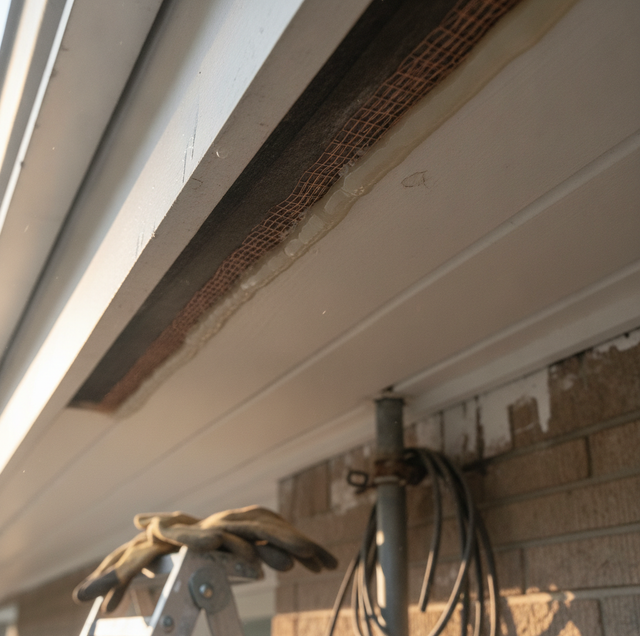
Sealing a roofline correctly is a trade skill, not a tube of caulk. The material that holds up is copper mesh packed tight into the gap, then locked in place with a polyurethane sealant so a rat cannot pull it back out. Copper is used instead of ordinary steel wool because it does not rust apart in humid air, and rats will not chew through a dense copper plug the way they gnaw softer fillers. Along the soffit-fascia gap that runs the length of each eave, a technician packs the void, seals the face, and leaves the painted surfaces intact so the repair disappears.
Vents and penetrations get a different fix. Attic gable vents, off-ridge vents, and turbine bases get backed with quarter-inch galvanized hardware cloth, which is a welded metal screen a rat cannot bite through or bend aside. Plumbing vent boots and exhaust collars are sealed where they pass through the roof deck. Finding every one of these openings is why a real inspection uses a borescope, a small camera on a flexible cable that lets the technician see into a soffit run or a wall void without tearing it open. The gaps a rat uses are usually in the spots a person cannot see from a ladder, which is exactly why they get missed.
Do this part, and the trapping you already paid for finally sticks. Skip it, and you will be back here in a month.
The Food and Harborage Still Pulling Them In
A sealed house is still a target if the surrounding yard is a buffet. Roof rats forage within a modest range of the nest, and they will keep testing your roofline as long as the reward is worth it.
The draws are ordinary and easy to miss. Fallen fruit under an ornamental or citrus tree feeds a colony night after night. Pet food or bird seed left on a lanai or in an open garage does the same. Overgrown ivy, dense shrubs against the wall, and stacked firewood or cardboard give rats the cover they need to reach the roof unseen and to nest close by. Even a dripping hose bib or irrigation overspray gives them the water that lets them stay.
Cutting tree limbs back several feet from the roofline removes the bridge. Storing pet food and seed in hard-sided containers removes the meal. Thinning the harborage against the house removes the cover. None of this catches a single rat, but it lowers the pressure on your walls so that the exclusion work has less to hold back.
A Trap-Out That Stopped Halfway
Sometimes the return is a removal that was called finished too early. Roof rats breed fast. A female can produce several litters in a year, and young rats reach breeding age in roughly three months, so a colony rebuilds from a handful of survivors quicker than most people expect. Pulling a few traps after a good first week can leave exactly that handful behind.
A proper trap-out runs on a cycle, commonly 4 to 6 weeks, with snap traps placed along the rub lines and travel routes where the grease marks show, checked and reset until the catch rate drops to nothing and stays there. Where interior sets are not practical, tamper-resistant exterior bait stations along the known runs reduce the outdoor population that keeps feeding the roofline. The point is that removal is a process measured against a falling catch count, not a single visit. Stop it halfway, and the ones you left finish the job of repopulating for you.
Pressure From Next Door and the Roofline They Share
The last reason has nothing to do with your house and everything to do with the block. Roof rats do not respect property lines. They travel the same fences, tree canopies, and utility lines that connect one yard to the next, and a heavy population two doors down will keep sending scouts down your roofline no matter how clean your own yard is.
You cannot fix a neighbor's garage or their fruit tree. What you can do is make your own building a hard target on the street. When your soffit-fascia gaps are packed, your vents are screened, and your food and cover are gone, the scouts that come down the line find nothing to exploit and keep moving. Exclusion is the one part of this that stays under your control regardless of what the rest of the block does, which is why it is the part worth doing right.
Frequently Asked Questions
Check the droppings and the location. Roof rat droppings are about half an inch long with pointed ends, while Norway rat droppings are larger, near three-quarters of an inch, with blunt ends. Location tells you as much as the pellet: roof rats nest high in attics, soffits, and upper wall voids, whereas Norway rats burrow at ground level along foundations and under slabs. If the noise is overhead at night, you almost certainly have roof rats, and the fix lives at the roofline rather than the foundation.
Steel wool is a poor long-term plug. In humid air, it rusts, breaks down, and leaves a stain and an open hole within a season or two, and rats can work it loose faster than a packed metal fill. Copper mesh does not corrode and stays springy in the gap, which is why it holds where steel wool fails. Whatever the fill, it only works when it is compressed tightly and capped with a sealant, not just stuffed loosely into the opening.
There is no reliable evidence that plug-in ultrasonic devices clear an established roof rat infestation. Rats habituate quickly to a steady sound, and the waves do not pass through walls or attic insulation, so a device in a hallway does nothing for a colony in the soffit. They are not a substitute for closing entry points and removing the population that is already inside.
It can, which is why sequence matters. Sealing the envelope before the interior population is removed can leave one or two rats shut inside, where they die in a void and produce a strong odor for a week or more, sometimes drawing flies. A correct job removes the active rats first, or leaves a single monitored exit during trapping, and only makes the final seal once the interior catch has stopped. Rushing the seal ahead of the removal is a common cause of a smell complaint two weeks later.
Bait can lower the number of rats, but on its own it does not end the cycle. A rat that eats bait often dies in an inaccessible wall or attic void, creating the same odor problem as an accidental seal-in, and the empty nest it leaves behind is quickly claimed by the next rat coming down the same roofline. Bait used inside tamper-resistant exterior stations has a place as one tool alongside exclusion, but without closing the entry points it just clears space for the replacements.
The garage is a frequent entry point people overlook. Roof rats slip in through the gaps at the corners of a garage door where the weather seal has worn, and through the wall penetrations cut for cable lines and the air-conditioner refrigerant lineset, which are often left unsealed around the pipe. A rat in the garage can reach the wall voids and the attic from there. Sealing the lineset penetration with an appropriate escutcheon and sealant, and replacing a gapped garage door bottom seal, closes two of the most common ground-level ways a climbing rat still gets up into the house.
The Fix That Actually Lasts
A roof rat coming back is not a sign the first treatment was worthless. It is a sign the treatment stopped at the animals and never reached the building. The rats you caught were real, and catching them mattered. But trapping alone always re-invites, because the gap that let the first colony in is still open for the next one. The lasting fix is duller and more physical than a chemical: find every opening with a proper inspection, pack the soffit-fascia gaps with copper mesh and polyurethane, screen the vents, finish the removal on a real cycle, and take away the food and cover that made your roof worth the climb. Do those, and the ceiling goes quiet and stays that way.
If the scratching is back and you want it closed for good, get a roofline inspection and a copper-mesh exclusion, not just another round of traps. Buggify Pest Solutions serves Boca Raton, West Boca, and communities across Palm Beach and northern Broward. Call Tyler: (561) 672-0200.