

Still Have Mosquitoes After Removing Standing Water? Hidden Sources
The buckets are gone. You walked the yard on a Saturday, tipped out the wheelbarrow, emptied the plant saucers, drilled a hole in the bottom of the kids' old sandbox lid, and felt good about it. Then the sun drops, you step outside to move the sprinkler, and inside a minute, they find your ankles again. Same whine, same welts, same yard you just cleared.
Dumping standing water is the right first move. On most properties, it is also only about half the job. Mosquitoes are patient about where they breed, and the spots that keep a population going are almost never the open buckets you already found.
A Capful of Water Is Enough
Start with what a mosquito actually needs, because it is far less than most people picture. A female does not need a pond. She needs a teaspoon of still water and a surface to lay on. Many mosquitoes that bite around homes are container breeders, and the female glues her eggs to a damp inner wall just above the waterline, not onto the water itself. Those eggs can sit dry for weeks or months and stay viable. The next rain, or the next time the sprinkler overshoots, raises the water level, wets the eggs, and they hatch.
That one detail explains why an emptied container does not end the problem. You poured out the water, but the eggs were already cemented to the plastic an inch up the side, waiting. Once they hatch, the larvae, the little wrigglers you can see darting under the surface, live entirely in the water and breathe through a snorkel-like tube at the top. They molt a few times, curl into comma-shaped pupae, and lift off as adults. In warm, humid conditions, the whole run from egg to biting adult takes only about a week, sometimes as few as five days.
The Cryptic Containers You Walked Past
The open bucket is easy. The sites that survive a yard cleanup are the ones that do not look like containers at all.
Bromeliads and plant axils: The central cup of a bromeliad, and the tight axils where leaves wrap the stem on many broadleaf ornamental plants, hold a spoonful of water for days after a rain. It is shaded, protected, and full of decaying leaf bits the larvae feed on. You cannot tip a planted bromeliad over every morning, which is exactly why it keeps producing. Flushing the cup hard with a hose every few days, so the water and any larvae spill out, breaks the cycle; where that is impractical, a larvicide sits in the cup and handles it.
Corrugated drain pipe: The black ribbed pipe on the end of a downspout, or run out to daylight across a yard, is a hatchery hiding in plain sight. Every corrugation ridge holds a little water that never fully drains, and the inside stays dark and undisturbed, so you never see the larvae. Smooth PVC drains clean; ribbed pipe collects and holds.
Tarps, toys, and the underside of things: A wrinkled tarp over a boat pools water in every sag. Upturned toys, the folds of a pool cover, the rim channel of a trash-can lid, a flowerpot behind the shed. None reads as standing water when you scan the yard, but each holds a capful, and a capful is the whole requirement.
Water That Moves, but Barely
Moving water is not automatically safe. It is safe only if it moves enough to keep the surface broken, unavailable to a larva that has to breathe at the top.
Clogged gutters. A gutter packed with leaf mush does not drain; it ponds behind the dam and stays wet for days. It sits out of sight, so it never makes the cleanup list, and the decaying organic soup in there is exactly the kind of water some species prefer.
Birdbaths and idling fountains. A fountain that only trickles, or a birdbath nobody refreshes, gives larvae a calm-enough film to live under. Culex, one of the main nuisance and disease-carrying groups, favors stagnant water rich in organic matter, so a neglected water feature attracts it more than a fresh one.
| Hidden source | Why it gets missed | What to do |
|---|---|---|
| Bromeliad cups and leaf axils | Looks like plants, not water; can't be tipped | Hose-flush every few days, or drop in a larvicide |
| Corrugated downspout pipe | Larvae are sealed inside, out of sight | Replace with a smooth pipe or flush and slope it to drain |
| Clogged gutters | Up high, off the cleanup radar | Clear the leaf dam, so water runs through |
| Irrigation valve boxes | Buried lids opened once a year | Lift lids, bail the water, treat if it refills |
| Catch basin sump | Holds a pool by design, can't be emptied | Larvicide briquette in the sump |
The Sources Underground
Some of the most productive water on a property is below grade, where a rake and a flashlight never reach.
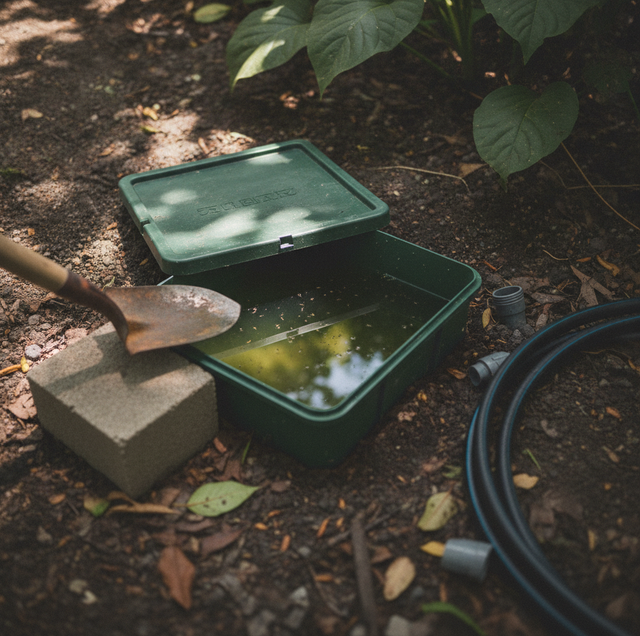
Irrigation valve boxes: The green rectangular lids set into your planting beds cover pits that house the sprinkler valves. They catch rain and irrigation seepage, sit in shade, and get opened maybe once a year. Lift one, and you often find an inch of water and a knot of wrigglers running undisturbed for months.
Catch basins and yard drains: The grated basins that drain a driveway or low corner are designed to hold a permanent pool in their sump, so debris settles rather than washing into the pipe. That makes them a textbook Culex factory: dark, undrainable, organic-rich, refilled by every rain. You cannot dump a catch basin, which is precisely why a larvicide briquette dropped into the sump is the standard answer.
Tree holes and old stumps: A rot pocket where a limb was cut, or the hollow crown of an old stump, cups rainwater, the same as any bromeliad. These are among the original, natural breeding sites mosquitoes used long before anyone left out a bucket, and they are easy to walk right past.
When the Mosquitoes Are Not Even Yours
You can run a spotless yard and still get bitten, because mosquitoes do not respect property lines, and how far they travel depends on the species. The container breeders that come out of a neighbor's bromeliads or clogged gutters are weak fliers and tend to stay close, often within a couple of hundred yards of where they hatched, which is still easily your patio if the source is next door. Others, including many of the stagnant-water Culex, can cover a mile or more from their breeding site on a calm evening.
So two things can both be true: you cleared every source you own, and you are still feeding an adult population drifting in from a canal edge, a retention pond, an untended pool two houses down, or the storm drain at the end of the street. Wherever water and warmth persist, breeding does too, with the warmest stretches simply compressing the cycle and turning up the volume. No amount of bucket-dumping reaches a neighbor's yard, which is where treating your own property as a defended space, and not just a drained one, starts to matter.
What Changes When a Pro Works the Yard
A professional mosquito visit is not mainly a cloud of spray. The durable part is a larval-source audit: a deliberate walk of the property, hunting for the cryptic, subterranean water above, lifting valve-box lids, checking gutters and corrugated pipe, flushing bromeliads, and finding the forgotten catch basin. Anything drainable gets handled on the spot; anything that cannot, the basin sump, a bromeliad bed, or a low area that never dries, gets a larvicide.
Larvicides are the opposite of a fog. Two classes do most of the work: a bacterial larvicide (Bti, a naturally occurring soil bacterium) that larvae eat and that ruptures their gut, and an insect growth regulator (methoprene) that keeps larvae from ever maturing into biting adults. Both come as dunks, briquettes, or granules that sit in water you cannot remove, stay active for weeks, and target mosquito larvae while leaving fish, pets, and beneficial insects alone. They end the next generation in the water instead of chasing adults through the air.
For the adults already flying, the tool is a residual barrier placed on resting sites, not a general fog of the open yard. Between blood meals, adult mosquitoes rest in cool, shaded, humid pockets: the undersides of leaves on dense shrubs, the interior of a hedge, the shaded base of the house. A residual product applied to those surfaces remains lethal to a mosquito that lands there for a few weeks, though heat, rain, and humidity wear it down, so it is renewed on a cycle rather than once a season. Contrast that with ULV or thermal fogging, which knocks down the adults in the air at that instant and then dissipates, with nothing left an hour later. Fogging earns its place before a same-day event, but on its own, it is a reset button, not a fix. What holds a yard is the stack: source reduction, a larvicide in the water you cannot drain, and a barrier on the foliage where adults hide.
Frequently Asked Questions
Treat a week as your outer limit. Because the fastest container breeders can close the loop from egg to flying adult in about five to seven days in warm weather, a saucer that refills on Monday can be producing adults by the weekend. There is a second step people skip: the eggs are glued to the sides above the old waterline, so a quick dump leaves them to hatch next rain. Scrub or wipe the inner walls of anything that holds water repeatedly, not just tip it, so the eggs go out with the water.
No, and this trips up a lot of yards. Plants marketed as mosquito-repelling do almost nothing to breeding; at best, a crushed citronella leaf masks scent for a person standing right beside it, and it does nothing to eggs or larvae living in water elsewhere in the yard. Numbers drop when you remove or treat the water the larvae live in, not when you add a plant. Spend the effort on the valve box and the bromeliads instead.
Yes, a Bti dunk is made for exactly that; it targets mosquito and fungus-gnat larvae and does not harm fish, frogs, or pets that drink the water. For an ornamental pond, some people also stock mosquitofish (Gambusia), which eat larvae directly. A dunk dissolves slowly and generally needs replacing about every thirty days, so mark a reminder rather than assuming one drop lasts the season.
The timing is a clue to the source. Culex, the stagnant-water group, feeds mainly at dawn and dusk, so evening ankle bites often point to a catch basin or a neglected water feature. The container breeders bite aggressively in broad daylight, especially in shade, and they do not travel far. Daytime biting near your patio is a strong hint that a small container source, a bromeliad or a saucer, is close by rather than blowing in from down the street.
Two places, usually. First, tiny sources that do not register as water: the drip line under an air-conditioning condensate outlet, the reservoir in a self-watering planter, the corrugated pipe on a downspout. Second, adults flying in from off your property, since the weaker fliers still reach a couple of hundred yards, and the stronger ones travel much farther. A yard with truly zero standing water can still sit downwind of a neighbor's untreated one, which is why a barrier on your resting foliage matters even when your own audit comes up clean.
Plan on roughly every three to four weeks in warm, humid weather, and stretch it out in cooler, drier spells. High heat, frequent rain, and humidity break the residual down faster, which is why an every-few-weeks cadence holds where a once-a-season spray does not. One caveat: a careful application targets shaded, resting foliage and skips flowering plants, sparing bees and other pollinators that work the blooms rather than the undersides of leaves.
Putting the Water Map Together
The mosquitoes came back not because you did the wrong thing, but because dumping the standing water was only part of the map. The water that keeps a yard biting is the water you cannot see at a glance: sealed inside corrugated pipe, cupped in a bromeliad, sitting in a valve box, pooled in a forgotten catch basin, or breeding entirely in the yard next door. Find every place a capful can hide, treat the ones you cannot drain, and defend the shady spots where adults wait out the day. Do that, and the dusk walk to the sprinkler stops being an ambush.
If you have dumped every bucket and the biting has not stopped, get the hidden and underground sources found and treated: a full source audit, a larvicide where water cannot be drained, and a barrier on the foliage where adults rest. Buggify Pest Solutions serves Boca Raton, West Boca, and communities across Palm Beach and northern Broward. Call Tyler: (561) 672-0200.