

Pool Cover Mosquitoes: What the Deck Around It Hides
Stand at the shallow end of your pool for a minute and look at the water itself. It is moving, chlorinated, and turned over by a timer-controlled pump. An inspection that starts and ends at that surface is looking in the wrong place. Walk the deck instead, starting at the shallow end and moving toward the equipment side of your yard, and the picture changes at almost every stop along the way.
Your first stop is the cover folded or rolled at the pool's edge. The next is the drain channel running along the deck itself. Past that sits the equipment pad, tucked against the house or a side wall, then the spa or hot tub set into its own section of decking. The last stops are the skimmer lids and the autofill housing, both easy to walk past without a second look. Each of these holds still water on a property built around one large body of water that does not.
The Pool Itself Is the Least of the Deck's Problems
If you associate a backyard pool with mosquito activity, you have the mechanism backward. Circulation keeps the surface disturbed, chlorine keeps the chemistry hostile to larvae, and a pump that cycles daily removes the condition mosquitoes depend on: water sitting undisturbed long enough to complete a cycle, which, in summer heat, runs roughly 7 to 10 days for the container species that use a yard like yours.
The hardscape and hardware ringing your pool are a different matter. Most of it is built specifically to catch and hold the water the pool sheds. Your cover sheds rain into its own low points. A drain channel sheds runoff into a grate that can back up. An equipment pad sheds backwash and splash into a recessed slab. Redirecting your attention from the pool to the deck around it is the entire point of walking the space in order. A glance at the water on your way past the shallow end settles nothing.
The Cover Holds Water the Pool Never Does
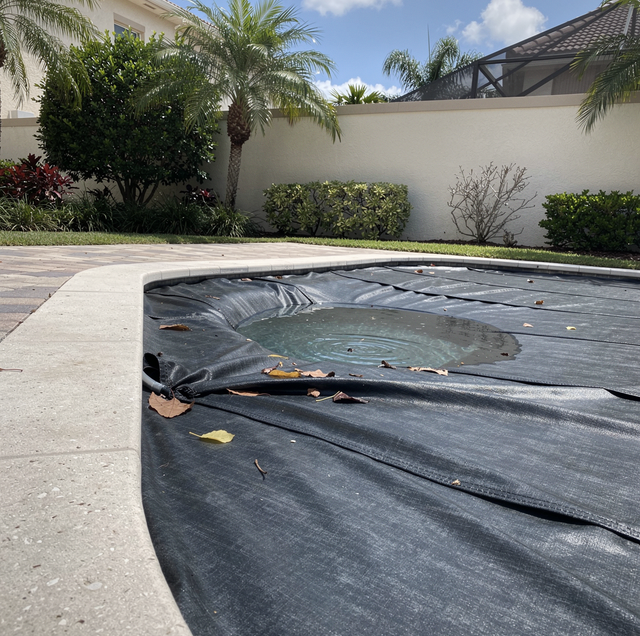
A cover pulled across your pool between uses is a flat surface until it is not. Fabric and vinyl covers sag at their attachment points and at any spot where the underlying support has weakened, and a sag holding even a shallow layer of rainwater does not drain the way a taut cover does. From the deck, it can look intact, since the sag is often only visible from directly above or from a ladder at the pool's edge.
What separates a cover that is pooling water from one doing its job is the crown. A taut cover with a slight crown sheds rain to the edges. A cover with a low spot in the middle, or one that has stretched unevenly after a season of use, holds a puddle in that exact spot for as long as the cover stays on. Because the cover sits directly over treated pool water, it is easy to assume the pool's chemistry extends to it. It does not. The layer of water on top of the material is untreated rainwater, isolated from what is happening in the pool below.
A cover partly pulled across your pool, with water pooled on top and open water still visible beneath the edges, is a drowning hazard for small children and pets and should be corrected by whoever services the pool, not left as-is.
Deck Drains Collect What the Rain Leaves Behind
Most pool decks slope slightly toward a drain channel or a series of point drains set into the hardscape, and those drains exist to move rainwater off the deck before it pools against the coping or seeps under the pool shell. A functioning drain does that job quietly. A drain packed with leaves, seed pods, or windblown mulch does not, and the water that should have moved through the grate instead sits in the channel beneath it. That standing water is easy to miss because the grate on top looks clear even when the channel below it is not; a quick glance across your deck rarely catches it, while looking straight down through the grate does. Deck drains near mature planting or under a covered lanai tend to clog faster than drains in open sun, simply because they catch more organic debris and take longer to dry between rain events.
The Equipment Pad Sits in a Recessed Pocket of Its Own
The pad holding your pump, filter, and heater is usually set slightly below the surrounding grade, both to contain any leaks and to keep splash and backwash discharge away from the house foundation. That same low point is exactly where water collects when the equipment cycles, when a fitting weeps, or when rain runs off an adjacent roofline and lands on the pad with no gutter to carry it away.
Because the equipment runs on a timer and the pad often sits against a wall out of your daily sightlines, standing water there can persist for days without anyone noticing. Hoses, valve housings, and a stack of spare fittings around a working pad create surface area where small amounts of water sit in the shade and never fully evaporate.
Walk your equipment pad with a flashlight, not just a glance from the yard, since the space directly under the pump housing and behind the filter tank rarely gets direct sun and holds water longer than the open deck around it.
A Spa or Hot Tub Goes Quiet Between Uses
An attached spa with jets running shares the pool's circulation and stays inhospitable the same way the pool does. The trouble starts when your spa sits idle between uses, especially one used seasonally or one taken offline while the pool itself stays in service. Once the jets stop cycling water for an extended stretch, the shell stops functioning as an extension of the pool and starts functioning as a standalone basin.
A spa cover complicates the picture further, since many spa covers use a foam core wrapped in vinyl that can absorb water through a torn seam and sag under its own weight, opening the same kind of low pocket a pool cover develops. Give a sagging spa cover a direct look before assuming the shell underneath is dry, since the nearby pool is running.
Skimmer Lids and Autofill Housings Hide Small Volumes
Skimmer boxes and autofill reservoirs are designed to hold small amounts of water, which is exactly why they are easy to overlook on a deck walk.
A skimmer lid that sits slightly ajar, is cracked, or is missing its gasket lets rainwater into the housing around the basket, in addition to the pool water the skimmer is meant to pull in. That extra volume is untreated and separate from what your pump is actively cycling through the basket.
An autofill housing works the same way. It holds a small reservoir meant to automatically top off your pool as water evaporates, and that reservoir is closed only when its lid seals properly. A warped or missing lid turns the housing into a small open container that collects rain independently of the autofill mechanism. Neither the skimmer box nor the autofill housing gets much of your attention during a normal pool day, since both are built to be walked past without a glance.
A Remodel or Resurfacing Resets the Picture for a Few Weeks
A pool taken offline for resurfacing, replastering, or a deck renovation stops behaving like a pool the moment the water is drained or lowered. An empty or partially filled shell holds rain the way any open basin does, and a construction site around your perimeter adds its own collection of buckets, tarps, and equipment cases that were never part of the yard before the project started.
This window is temporary, typically running from the start of draining through the point where the pool is refilled and circulating again, but it is also the period when a property that normally has one dominant risk factor, the surrounding hardware, temporarily gains a second one in the empty shell itself. Your pool contractor is the right person to keep the site covered or drained between work sessions; that scheduling sits outside a pest inspection's scope.
Frequently Asked Questions
Your saltwater pool still generates its own chlorine, so the chemistry is no different in any way that matters here, and the salinity in it is far too low to trouble a larva. Your run time matters more. A pump scheduled for a few hours a day leaves your surface still for the remaining twenty hours, and if your sanitizer has drifted low over a stretch of light use, the water starts to resemble the untreated pockets you just walked past on the deck.
If your cover came paired with a small submersible pump, it sits in the cover's lowest point specifically to pull accumulated rainwater off before it can stand long enough to matter. That pump depends on a float switch to start it, and a stuck or fouled float switch lets your low spot fill right back up while nobody notices the pump quit. Put eyes on it directly. A pump that has stopped working looks exactly like a pump waiting for its next cycle.
Your deck drains and channel drains typically tie into a buried line carrying the water to a French drain, a dry well, or a discharge point away from your pool structure, and that downstream connection can silt in or collapse without a single visible sign at your grate. When the connection backs up, the water has nowhere to go and sits in the channel under your deck while the surface drain you can see still looks clear.
Your sand or cartridge filter vents a small amount of water through an air relief valve during every backwash or cleaning cycle, and that discharge lands on the slab a few inches from the tank. Over repeated cycles, the same low corner of your pad takes the brunt, which is why one spot can stay damp while the rest of the concrete around it reads bone-dry.
If your spa was taken out of regular use, its jet lines may have been purged or flushed during shutdown. That process clears the plumbing. It leaves the shell alone, so your basin can still be holding standing water afterward. The cover keeps new rain out but does nothing about water that was already sitting in there the day it went idle.
Your autofill line probably routes through a backflow preventer or vacuum breaker housing before it reaches the pool, and that housing carries its own small internal chamber, separate from the autofill reservoir. You have almost certainly never opened it because, from the deck, it reads as a fitting. A cracked or unseated housing holds water the same way any small box left outdoors does.
Have the deck read drain by drain, cover to equipment pad — before assuming the pool itself is the source of an ongoing mosquito problem. Buggify Pest Solutions serves Boca Raton, West Boca, and communities across Palm Beach and northern Broward. Call Tyler: (561) 672-0200.
