

Rats after a Hurricane: Why the Call Comes Later than the Storm
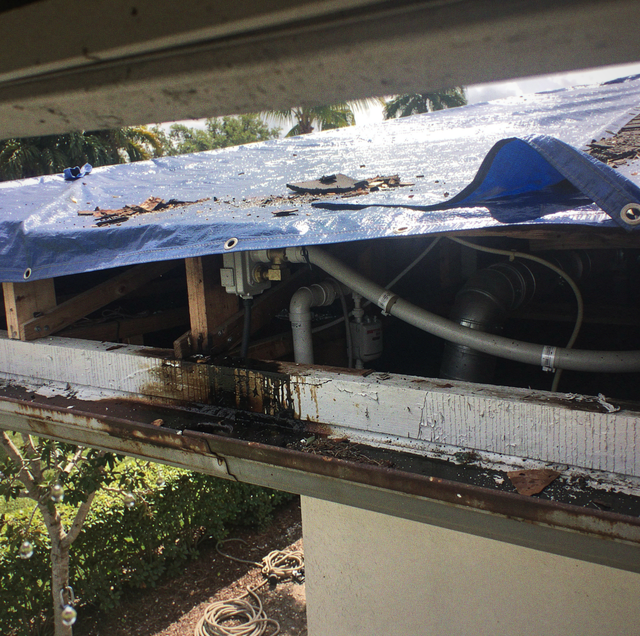
Quick Answer: A storm changes a roofline before it changes what is living near a house, and the two rarely move on the same schedule. The gap opens first, gets found and used sometime after, and the activity turns up later still.
A tarp goes up over the section that failed, fastened down at its edges, and from that moment until a permanent repair is scheduled and finished, that sheet is the roof over that part of the house. It is doing one job in that stretch, and doing it correctly does not make it the assembly it replaced. Everything that happens at the roofline in between happens under a cover built to hold water off decking, and the rat that eventually uses something on that run is not working to the repair schedule. It moves on its own. That interval, and the second one that follows it between an animal getting in and anyone noticing, is what most homeowners never connect back to a storm at all.
The Storm-Selected Failure
Wind does not test a roofline at one point and leave the rest alone. It loads the whole plane at once, tile, panel, fascia, and flashing together, and whatever gives first is usually the section that was already closest to failing before the storm arrived. A joint holding on marginal fastening can lose its grip at the same moment a whole panel tears free somewhere else on the same run, even though only one of those two failures is obvious from the ground once the storm passes.
That is what makes storm damage selective rather than general. Which run gives more to do with how the house was built and detailed than with how the storm tracked, which is why two houses on the same street, under the same exposure, come out of the same night with damage in completely different places.
Water follows a related but separate path. Wind-driven rain gets behind materials that shed an ordinary rain shower without issue, working into gaps that stay dry the rest of the time: under a fascia edge, behind a section of flashing, along a seam that has never taken water from that direction before. None of that requires visible failure. A section of roof that has never lost a single tile can still experience water intrusion.
Why Activity Does Not Show Up Immediately
A new gap at the roofline does not announce itself to anything nearby. It exists, but nothing about a fresh opening tells a rat or mouse it is there before that animal happens to cross that exact stretch of eave again on its own. Something already working in a different section of the same house, or in a different house on the same street, finds the new route on its own schedule, not the storm's.
The same lag runs through food and shelter. A storm changes what is available near a structure: downed material, standing water, and anything staged in a yard before it gets hauled away. What is living near that structure does not shift to a new option the moment it appears. It shifts once the old option is gone or the new one gets tested and found workable, and that can trail well behind the storm itself. What reads, from indoors, as a problem that arrived out of nowhere is usually the tail end of a sequence that started with the storm and took its own course working through every step in between.
The Interval a Tarp Covers
A tarp or a sheet of plywood over a damaged section is doing one job: keeping water out of the house until a proper repair can happen. That is the right priority immediately after a storm, and for as long as the cover stays up, it is what stands between the weather and the decking underneath. The interval it defines is the part worth naming: through it, the house has a roof over that section in the functional sense, and it lacks the assembly that was there before; those two are not interchangeable at the edges.
What a temporary cover is not doing is reading the roofline around it. It addresses the failure that got noticed, on the timeline that failure demanded, and everything next to it stays exactly as the storm left it, open or closed, until somebody looks at it on purpose. A joint loosened on the same run, a length of fascia that moved, a vent housing that shifted: none of that sits inside what the cover was put up to handle, and none of it necessarily sits inside what the permanent repair gets scoped to handle either.
That is a matter of standards rather than of effort. A repair is built and inspected to a wind and water standard, which is the standard it was scoped to. A rodent standard is a separate read, and nobody on that job was asked to take it. The crew that got a cover-up in bad conditions and the crew that comes back to rebuild the section are both doing exactly the work specified for them, and neither leaves anything undone by not answering a question nobody put to them.
Closure on the Run the Storm Picked
Because the failure was storm-selected, whatever closure happened to be sitting on that one run comes off with the material being replaced, which puts the question on a single stretch of roofline rather than across a whole roof the way a full tear-off does, a case worth taking up on its own terms.
When the Call Finally Comes
By the time a call comes in that traces back to a storm, the lags above have usually already run their course. What shows up is rarely a single animal testing a new gap for the first time. It is evidence of a route already in steady use rather than one just discovered.
That is part of why the storm connection gets missed. Nobody is thinking about a roof repair from a while back when the noise starts overhead, and the two events feel unrelated because of everything that happened in between. Tracing an active route back to what actually opened it- a storm-loosened joint versus ordinary wear versus something else on the house entirely- is what a trap-out and monitoring visits sort out once an animal is confirmed present. Roof rats run four to six weeks in a typical trap-out, Norway rats three to four, house mice two to three, regardless of what originally opened the route.
Debris Staging and the Wall Line
The stretch between a storm and a finished repair is not a blank period. From the ground, a homeowner can watch for the same signs that matter any other time of year, none of which requires getting onto the roof or into the attic to check.
The debris itself is worth the same kind of attention. Whatever came down in the storm and is now staged in the yard waiting for pickup is exactly the kind of cover an animal will use, and where that pile sits relative to the exterior wall matters more than how it got there.
Debris that shows gnaw marks or has nesting material tangled into it is a gloves-and-bag matter, not a bare-hand cleanup job, and none of this calls for climbing onto a damaged roof or a ladder to get a closer look.
Frequently Asked Questions
A tarp is fastened through sound material outboard of the damage, because there is nothing intact to fasten to inside the failed section itself. That puts the fastening line on the undamaged roof, with every fastener along it a penetration through material that was whole before the storm. When the cover comes off, the fastening line is what has to be re-read, not the hole it covered, since the hole is being rebuilt anyway and the line around it is not.
Wet insulation and water staining occupy the same areas of an attic as rodent sign does: near penetrations, along the underside of a failed run, and at the low edges where material collects. The separation is in how the mark sits on the material. Storm water soaks through insulation and darkens it in a patch that follows where the water ran, while rodent staining and matting sit on the surface, along a line of travel, repeating at the same points. An attic that took water reads as busier than it is until those two are told apart.
The distinction that matters is whether that house's own roofline changed. On a house that sustained damage, the route in question can be new: something that was not open before has opened. On a house that came through untouched, nothing about its roofline changed at all, so anything getting in is using an opening that was already there and had simply not been carrying traffic. That is why an undamaged house needs a different answer than its neighbor: the first needs a new failure closed, the second needs a pre-existing gap found, and the storm did not create the second one.
Storm debris staged for bulk pickup is usually a larger, mixed volume, branches, fencing, damaged furniture, sitting together rather than in a routine pile, and it tends to end up at the curb or along a property edge rather than tucked into a back corner. That combination offers continuous cover across a wider stretch than a routine pile does, and it stays put until a bulk collection reaches it rather than going out with the next regular pickup.
The tarp or plywood weathers the same way any exterior material does, its edges lifting and its fasteners working loose under sun and wind, so a fix installed to hold a hole shut on a short-term basis stops functioning as a repair and starts functioning as an unrepaired gap again. If it is holding water against the decking by then, it also creates a moisture problem the original damage never had on its own.
Often. A joint that works loose over time opens along a line, with the surrounding material aging at the same rate, so the opening and its surroundings read as a single continuous condition. A storm-opened joint is a discrete break: fastening pulled rather than worn, edges still sharp where material separated, and loose pieces of that same material sitting nearby on the roof or in the yard below. That difference is what ties an entry back to the storm rather than to ordinary wear, and it is read from the ground or from the account of whoever did the repair.
Book an inspection while the temporary cover is still up — have the roofline read during the interval, before the permanent repair is scheduled. Buggify Pest Solutions serves Boca Raton, West Boca, and communities across Palm Beach and northern Broward. Call Tyler: (561) 672-0200.
