

Rats after Heavy Rain: Why Ground-Level Activity Spikes
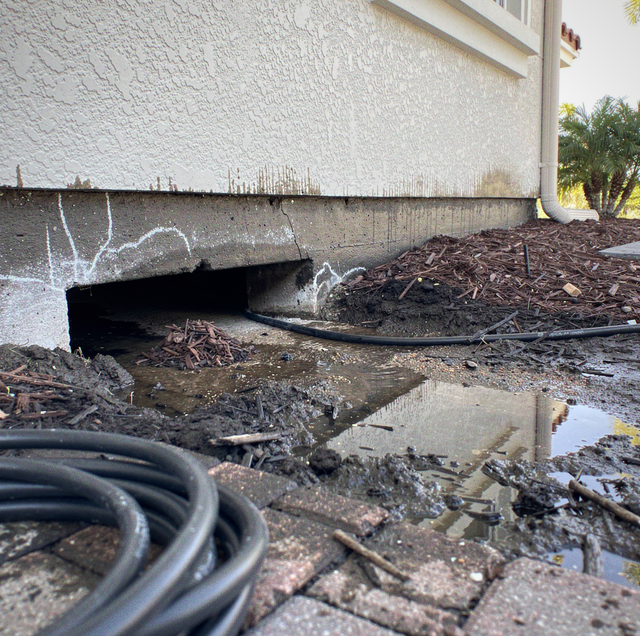
Quick Answer: An ordinary heavy rain event floods ground-level burrows and voids and pushes Norway rats and house mice toward the nearest dry structure. The same rain does little to a roof rat's above-grade nest, so this pressure runs at grade.
Most of what a Norway rat or a house mouse uses near a house sits below grade: a burrow in a mulch bed, the loose fill around a buried line, the void under stored material at a fence line. None of that space needs to start out dry, only stable enough to hold its shape and quiet enough to go unbothered. An ordinary heavy rain event changes both conditions at once, on an afternoon when nothing else about the property has changed, and what moves afterward shows up as a sound at floor level behind a wall that had never made one before.
What Saturation Does to a Below-Grade Space That Was Dry
A burrow or void at grade holds its shape because the material around it, packed soil, mulch, loose fill, is dry enough to stay put under its own weight. Heavy rain removes that condition directly. Water follows the path a burrow already offers, since a tunnel is easier for runoff to enter than undisturbed ground, and once it starts filling, the air space that made the burrow usable goes with it.
Any low, moisture-holding pocket at grade behaves the same way once enough water reaches it. Slab-on-grade construction without a basement means the ground itself is doing the job a below-house cavity would do elsewhere, and there is no lower level indoors for a displaced animal to reach, which turns a flooded burrow into a forcing event rather than a passing inconvenience.
Standing water near a foundation or a bed saturated after heavy rain is not a spot to check by hand or step into. Note the location in a dry part of the yard, and leave a closer look for inspection.
Where a Displaced Ground-Level Rodent Goes Next
A rat or mouse pushed out of a flooded burrow does not wait for conditions to improve. It moves while the water is still standing, toward whatever ground nearby stays dry and offers cover: a raised bed, a stack of stored material, the base of a wall. The animal is usually already living within easy reach of a structure, and that same building becomes the most immediate option once the ground becomes unusable.
The route it takes in was already there before the rain. Heavy rain does not create the opening; it creates the reason to use one that had been sitting there unused.
What a Building Offers That a Flooded Yard Does Not
A house provides a dry, stable space at the same grade level the animal already uses outside. None of the ground-level voids a house has are new; heavy rain simply adds a reason for something already close by to test one it had been ignoring.
Indoors, the animal lands in the same class of space it was using outdoors: low, dark, close to a wall, away from routine foot traffic.
Dryness alone does not resolve anything once the animal is inside. A temporary refuge from flooded ground becomes a route used again next time when conditions outside make it worth using, unless the opening it came through is found, held while the animal is trapped out, and closed last.
Why a House with No Prior History Can See Activity for the First Time
A house with no rodent history is not unusual, even if it has gone this long without a call. Most ground-level openings on an occupied home sit unused for long stretches, tested but never used, because there was never a reason strong enough to push an animal through one instead of past it. Heavy rain is that reason. The ground nearby flooded, and whatever was living in it needed somewhere dry immediately.
Two houses can see different outcomes from the same rain event. One with a flooded bed against the foundation offers the shortest trip to an opening; a house set back from standing water, or graded so the ground slopes away from the slab, may see nothing from the same afternoon. The difference is proximity to standing water at grade, not whether either house has had a rodent problem before.
A Mostly Norway Rat and House Mouse Event, Not a Roof Rat One
Roof rats live and move above grade, in canopy, soffit voids, and roofline gaps, and heavy rain does not touch that space the way it touches a burrow. An above-grade nest can get damp in a hard rain, but a roof rat is not displaced from the roofline by a flooded yard the way a Norway rat is displaced from a burrow.
House mice belong here too. They den at grade, in the same low voids a Norway rat uses, and fit through a gap under a quarter inch, smaller than almost anything else at that level. A flooded yard displaces mice the same way it displaces rats, often through the same opening, which is why a single rain event can produce mixed evidence near the same threshold: two species, two sizes of sign, one route.
What Changes Once the Ground Dries Again
Ground drying out does not undo anything that happened at the building while it was wet. The opening used during a heavy rain event does not reseal on its own, and dry weather does not make a Norway rat or a house mouse give up an indoor space it already found workable. What changes is outdoors, not at the entry point itself.
The yard's own evidence gets harder to read the same way. A worn rim at a burrow opening can fade or get reworked by ordinary yard maintenance once the ground dries enough to walk on, so a spot that looked active during a wet stretch can look unremarkable soon after. Note what a flooded yard shows while it is showing it, rather than assume a dry yard afterward means nothing happened there.
Floor-Level Signs Inside the House
Where a sign sits inside the house matters as much as the sign itself. A ground-level entry keeps an animal near the bottom of the wall rather than up in the ceiling, so the evidence that follows a heavy rain event tends to sit low: a sound at floor level rather than overhead, droppings along a baseboard run, or a gnaw mark on a low cabinet edge. Those are signs worth noting rather than handling, and anything showing gnaw damage is a gloves-and-bag matter, not a bare-hand one.
That floor-level pattern is also what separates this from a roofline call, which is worth knowing before any work gets scheduled, since the two run on different clocks. A trap-out for Norway rats typically runs three to four weeks and for house mice two to three, with monitoring visits roughly every seven to ten days, activity dropping sharply by the second week and most jobs quiet by the fourth.
Frequently Asked Questions
Often not in the same room. The first flooding pushes an animal through an opening it still has to find, so the earliest signs sit close to that opening, at the nearest baseboard or cabinet run. A route already used once gets run without hesitation the second time, and the animal moves further in on the same trip. Droppings or gnaw marks after a later rain can turn up in a room away from the entry point while the entry point itself shows nothing new, which is why a second round of evidence in an unexpected part of the house does not mean a second opening.
A site that floods repeatedly stops being worth re-digging, and a population eventually abandons it rather than rebuilding there each time. That shifts pressure on a nearby structure from an occasional event to a standing pattern, where the building stops being the emergency option and becomes the reliable one.
It changes how often the specific low spot near the foundation floods, not whether flooding can happen elsewhere on the property. A French drain or graded swale routes water away from one collection point, so a bed that used to saturate with every heavy rain may stop flooding once the water has somewhere else to go. Other low spots on the lot stay unaffected.
A raised bed built on fill drains faster than compacted ground soil, so the space underneath can stay usable through a rain event that floods a burrow dug into native soil nearby. A paver field on a stone base behaves the same way, since water moves through the base layer rather than pooling in it, and either can end up the one dry spot on a flooded property.
Heavy rain is a single, widespread event that recedes across the whole yard on roughly the same timeline. An over-watering irrigation zone keeps one fixed spot near a head or valve chronically damp on a repeating schedule instead. A burrow in that zone does not get a displacement event and a chance to dry out; it stays wet on the irrigation schedule.
In a different way, yes. Ground that has gone a long stretch without rain hardens, so an existing population stays with tunnels already dug rather than start over. What changes is where it goes to drink: a condensate line dripping from an AC unit or an irrigation head on schedule becomes a more reliable water source than the yard itself, a pull that can bring activity toward a structure for a reason unrelated to flooding.
Find out which grade-level opening a recent heavy rain actually put to use — an inspection names the route before it turns into a habitual one. Buggify Pest Solutions serves Boca Raton, West Boca, and communities across Palm Beach and northern Broward. Call Tyler: (561) 672-0200.
