

How Roof Rats Are Getting Into the Attic at the Roofline
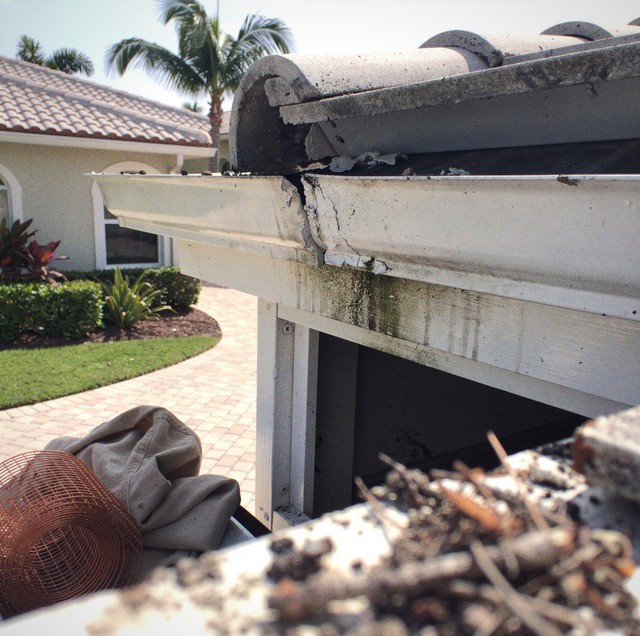
Ask where a roof rat got into an attic and the answer is rarely a hole punched through something solid. Concrete tile does not get chewed through. Neither does a fascia board. What gets worked open is a seam. A tile roofline is built as a stack of separate materials: concrete or clay tile, batten strips or foam adhesive, synthetic underlayment, plywood deck, fascia board, soffit panel, each cut and fastened against the next piece, and every place two of those materials meet is a joint that is never as tight as the material on either side of it.
That changes where anyone should be looking. The roofline is a sequence of built joints rather than a wall with a hole in it somewhere, and on a tile roof in South Florida, a handful of joints account for most tile-roof entries, and they get checked in a consistent order.
Quick Answer: Roof rats exploit joints between materials, not holes punched through them: the tile field, the birdstop closure at the eave, the void behind a boxed roof return, the chimney chase, and vent collars. Each fails for a different physical reason.
The Roof Plane Itself
Start with the field of tile, because it covers the largest area of the roofline and is what most homeowners assume is the sealed part. On a tile roof, individual tiles are set over batten strips or foam adhesive pads, which sit over a synthetic underlayment sheet, which sits over the plywood deck. The tile itself sheds water. The underlayment is the actual moisture barrier underneath it. Neither layer was engineered as a pest barrier, and that distinction matters once a tile cracks, slips out of alignment, or gets lifted by wind and never reset correctly.
When that happens, the gap does not open onto open sky; it opens onto exposed underlayment or an exposed batten gap, and underlayment is not a structural material. A rat that reaches that exposed point at deck level can work through the edge of the underlayment sheet or through the batten gap it exposes to reach the void beneath.
Ridge caps and hip caps are the other weak spot in the roof plane. Those capping pieces are set in mortar or adhesive foam where the two roof planes meet at the top, and the same weathering that eventually cracks mortar anywhere else on the house cracks it here too, usually first at the seam where the cap meets the flat field tile rather than in the middle of a mortar run. A hairline crack at a ridge or hip does not look like much from the ground. It is still a joint between two materials, and it still connects down to the same attic void as every other gap on this list.
Where the Tile Meets the Edge
The lowest point on the roofline is also one of the most exploited, and the reason is a detail of how barrel and profiled tile actually terminates at the eave. Tile is curved or ridged in cross-section. A straight fascia edge is not. Where the first course of tile meets that straight edge, there is a gap built into the geometry itself, one that has to be closed with a separate piece rather than left to the tile profile to handle on its own. That closure piece is called a birdstop, and it comes in a few forms: a foam closure strip, a mortar bead troweled by hand, or a formed metal closure set under the tile course.
Each fails a different way. Foam closure strips compress and degrade with UV and heat exposure over years, and a rat can gnaw through softened foam quickly once it finds the edge. Mortar beads crack as the roof structure moves seasonally and as the mortar itself ages, and a crack at the birdstop line runs along the entire eave rather than staying contained to one spot. Metal closures hold up the best of the three, but barrel tile varies slightly from piece to piece along a run, and a metal closure that does not seat flush against every tile in the course leaves small gaps wherever the fit is imperfect.
This point sits at the lowest, most accessible height of the entire roofline, which is part of why it shows up so often on tile-roofed homes across Boca Raton and West Boca, where barrel- and flat-profile tile is the dominant roof type rather than the exception.
The Roof Return
Move along the eave to where it ends, and on a hip-and-gable tile roof the roofline often does not run all the way to a full gable rake. Instead, the fascia and soffit terminate in a boxed detail called a roof return, a short mitered box that closes off the end of the eave run against the wall rather than continuing the roof pitch down to grade. It is a common trim detail on the hip-and-gable massing found in much of the Boca Raton and Parkland-area construction, and it looks finished from the ground.
Behind that mitered corner is a hollow triangular void, and that void frequently has no solid backing tying it into the framing below. It exists as an enclosed pocket connected to the same soffit and vent airspace that runs into the attic, the same airspace the soffit-fascia seam opens onto further along the eave. A gap at the mitered seam, whether from original construction tolerance or from years of expansion and contraction working the joint loose, opens directly into that connected void. Once a rat is inside the return, it is already inside the roofline's internal airspace, not still on the exterior working toward it.
A closed gap at one roof return does not rule out an open one elsewhere on the same roofline. Hip-and-gable tile roofs have several roof returns, and one active gap is all a rat needs to reach the void behind it.
The Chimney Chase and Its Cap
Most chimneys on newer South Florida construction are not masonry stacks. They are framed chases, a plywood-and-stucco or plywood-and-siding box built around a metal flue and closed at the top with a sheet metal cap or a shrouded cap assembly. That construction creates two separate joints, at the bottom and at the top, and they fail independently of each other.
At the bottom, the chase meets the tile field through counterflashing, which is metal set against curved tile and bedded in mortar or sealant. Metal, tile, mortar, and the framing behind them all expand and contract at different rates through Florida heat cycles, so the joint is under constant working stress in a way a flat run of tile is not. Barrel tile makes it worse, because the flashing has to follow a curved profile it was not formed to match, and the gaps between the metal and each tile crown get filled with mortar or sealant rather than closed by the fit itself. When that fill cracks out, the resulting opening sits at deck level under the tile, which is exactly the depth a rat needs to reach the void beneath the roof plane.
At the top, the chase is hollow. A framed chase is a vertical shaft, and in many builds it is open to the attic or connected to the same framing cavity, which puts it in the same category as the roof return: a void that reads as solid trim from the ground. A cap that has lifted at a corner, lost fasteners, or separated from the storm collar around the flue leaves the top of that shaft open. A chase is also frequently the highest point on the structure with a textured surface to climb, which puts it well within reach of a rat already traveling the ridge.
The two ends have to be read separately. A chase re-flashed during a re-roof can be tight at the tile line and still open at the cap, or capped correctly with the counterflashing left cracked underneath. Closing one end while the other is open does nothing to the route.
Vent Stacks and Other Roof Penetrations
Anywhere that something passes through the tile field and the deck beneath it, the roofing material has to be built around the object rather than laid flat, which is inherently harder to seal permanently than an unbroken plane. Plumbing vent stacks are the most common example. Each one emerges through the roof with a boot collar, usually rubber or lead, fitted around the pipe and sealed to the surrounding tile. Years of direct UV exposure dry out and split a rubber collar, or work a lead collar loose from the pipe it was formed around, and the resulting gap sits at deck height, tucked under the tile profile where it is not visible from the ground or even from a casual look across the roof plane.
Static roof vents, turbine vents, and attic fan housings cut a larger opening through the deck to move air, and that opening is normally screened rather than left bare. Hardware cloth is the material used for that screening. When a screen has rusted through over time, or was simply left off during a re-roof or a vent replacement, the vent throat itself becomes an open route into the attic, no gnawing required. Gable vents, decorative and functional alike, fail on a pattern of their own and are covered separately.
Which Joint Is Actually in Use?
A tile roofline that has been up for years can accumulate more than one of these aged joints at once, and only one of them may currently be in use. That is the practical problem with sealing the first gap that gets noticed: it can be the wrong one, and the actual route stays open.
From the ground, the useful signals are which section of the roofline shows repeated travel rather than occasional, and whether debris or staining is collecting below one consistent spot instead of being scattered evenly along the eave. Those patterns narrow the list before any repair decision gets made. Final confirmation of which joint is actively used is made by inserting a borescope into the suspect gap, rather than assuming the most visible opening is automatically the active one.
Do not climb a ladder to inspect these joints yourself. They sit at roofline height on an angled surface, and confirming which one is active does not require getting that close. Watch travel patterns and staining from the ground instead.
Frequently Asked Questions
Because a mortar bead is one continuous element, not a series of individual pieces. It was troweled in a run, and it ages as a run, so the same UV exposure, seasonal movement, and shrinkage act on every foot of it at once. A rat that finds one soft or cracked section is standing on a line of identical weak points, and closing the single spot where droppings appeared leaves the rest of that eave in the same condition it was already in.
Barrel tile is a cast product with piece-to-piece variation in curve and height, whereas a formed metal closure has a single, repeated profile. Along a course of thirty tiles, some seat tight against the closure and some sit a fraction high. Each of those imperfect seats is a small opening at the eave line, which is why a metal birdstop is checked tile by tile along the course rather than treated as closed, since the closure is present.
It usually removes it. Tearing off tile takes the birdstop line, vent screening, and chase counterflashing with it, and the new roof gets whatever closure the roofing crew installs as standard rather than the rodent-rated detail that was there before. A house that went years without attic activity can start producing noise a few months after a re-roof for exactly that reason, which is why an exclusion check after a roof replacement is worth scheduling rather than assuming the new roof carried the old protection forward.
Exclusion work done at gnaw-prone joints, such as a tile edge or a roof return, typically carries a 30- to 90-day warranty period, because those specific repairs are exactly where renewed gnawing pressure lands first if there is still pressure on the house. A full sealing job, once everything is closed and holding, typically holds for 10 or more years.
Yes. House mice fit through gaps under a quarter inch, well below what a roof rat needs to get through the same joint. A tile edge or roof return tightened enough to stop rats is not automatically tight enough to stop mice, and that gap may need a separate check.
Less often, but it happens. Construction across Boca Raton and the surrounding area is almost entirely slab-on-grade, with no basements, so there is no below-grade void feeding into the attic the way a basement or deep crawlspace might connect further north. For a local home, the roofline is the dominant route, with ground-level exceptions worth checking: worn garage door corner seals and the sealant collar around an air conditioning line set where it enters the wall.
Walk your roofline's weak points with a trained eye — get the tile edges, roof returns, and vent collars checked before the next roof rat finds the one that is still open. Buggify Pest Solutions serves Boca Raton, West Boca, and communities across Palm Beach and northern Broward. Call Tyler: (561) 672-0200.
