

Gable Vents and the Rodent Screen They Actually Need
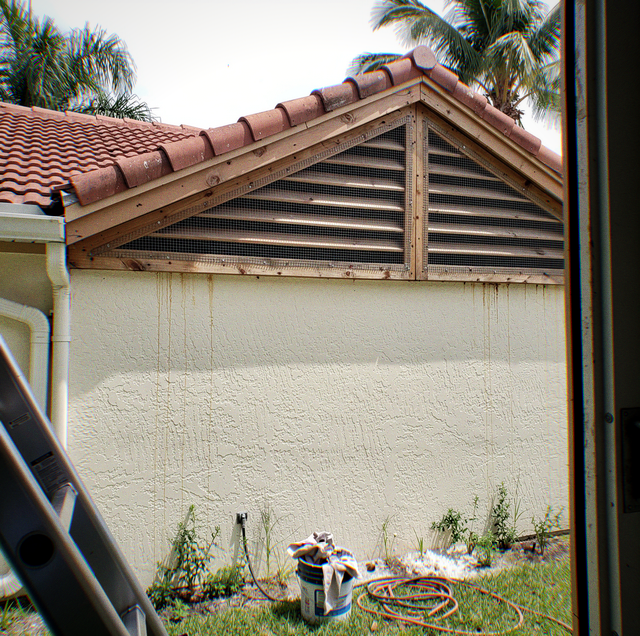
Quick Answer: A gable vent gets screened rather than sealed. Most already carry a screen, but it is insect mesh, not one designed to resist gnawing. Rodent-rated hardware cloth holds where that mesh gives, and the airflow trade-off gets managed rather than ignored.
Most of the roofline openings a rodent uses were never meant to be openings at all. A cracked ridge cap, a gap at a soffit seam, a lifted vent boot: each one is material that was supposed to stay closed and did not. A gable vent starts from the opposite brief. Its job is to move air through an open face of the house, on purpose, day and night, and screening it can never mean closing it. The louvers, the screen behind them, and the frame holding both to the wall are separate parts of a single assembly, and a rodent screen has to work with all three without shutting any of them down.
The Louver or Slat Array
The angled slats across the face of a gable vent serve one purpose: to shed wind-driven rain while air still moves through the gaps between them. Wood, vinyl, aluminum, and molded foam vents all use the same stacked geometry for that. It works as a weather baffle and was never built to stop anything smaller than rain. The same angled gap that lets air pass also lets a rat work through it, because the array's job is not to keep an animal out. Intact, unbroken louvers can reasonably read as sound from the yard, but the array was never the barrier, whether or not a slat is out of place.
The Screen Behind the Louvers and How It Is Retained
Most gable vents already have a screen behind the louvers, which is exactly why a vent reads as protected from the ground. Manufacturer listings for louvered gable vents show a built-in screen as standard equipment, and what they specify is an insect screen: fiberglass cloth or a fine aluminum weave, chosen to keep insects out. That is a different specification from the one chosen to withstand a rodent working at a single spot. The question at a gable vent is rarely whether a screen is there, but what it was specified against and how it stays put. A rodent-rated cloth pressed loosely against the back of the slats moves the day the wind gets behind it, and a shifting panel opens a gap along whichever edge worked free. It has to be secured at the frame around its full perimeter rather than held by friction, because wind load on an exposed gable wall and sustained gnawing at one spot both act on any edge that is not captured.
Mesh sized to stop a rat is not mesh sized to stop a mouse. Published rodent-exclusion guidance from the Cooperative Extension Service specifies hardware cloth rather than insect screening for this work, and splits the spec by animal: a half-inch woven mesh to exclude rats, a quarter-inch mesh where mice are the concern, since mice fit through gaps under a quarter inch. The same guidance is direct about what the finer weave gives up, noting that hardware cloth below half-inch significantly reduces air flow, and that where ventilation is already marginal that restriction may not be acceptable. A gable vent lives inside that trade-off, which is why the spec gets set against the vent's own opening and the attic it feeds rather than picked off a shelf.
The Frame-to-Wall Junction
Behind the louvers and the screen sits a point that has nothing to do with either: the frame holding the whole assembly into the opening cut for it. That frame meets siding, stucco, or exterior trim around its full perimeter, and that seam is a separate joint from the mesh behind it. A vent screened perfectly at the louvers can still sit in a frame that has gapped from the wall, and that opening sits outside the screen. The seam moves the way any frame-to-wall joint does, through the wall material's own expansion and settling, tied to the vent's frame rather than a fascia board or J-channel.
When a Gable Vent Is Purely Decorative
Not every gable vent connects to the attic air behind it. Plenty carry a vent shape to match a roofline's massing, mounted over solid sheathing with no opening cut behind the louvers. While that sheathing is intact, there is no route through the vent and no airflow riding on it, so nothing behind the face needs a screen. What makes a vent like that worth checking anyway is that the same shape gets used both ways on the same street. A vent installed decoratively over a wall that was later cut, or over sheathing that has since failed behind it, reads identically from the ground to one still sitting on sound board: same louvers, same frame, same size. Telling them apart means checking what sits behind the face rather than assuming from the shape. Treating a functional vent as decorative leaves a route unscreened. Treating a decorative vent as functional means worrying about airflow that was never there.
What the Ground View Can and Can't Tell You
For a homeowner, everything useful about a gable vent has to be read from the ground.
A gable vent sits well above reach from the ground on most homes. Do not use a ladder to inspect one closely. Watch for staining below the vent, debris in the louvers, or daylight through gaps, and leave confirmation to a technician.
From that distance, several things are still visible. A streak running down the wall from the base of the vent usually means water or waste tracking out through a gap. Louvers darker or matted in one section, against a clean run elsewhere on the same vent, often mark where something passes repeatedly rather than rests. A section of mesh that reads a different color or texture than the rest may indicate a prior repair that patched one spot rather than the full opening. None of that confirms what is happening behind the louvers. It narrows where a closer check starts.
Closing a Gable Vent to a Rodent Standard
Closing a gable vent to rodent standards means backing it with a material chosen for gnawing rather than for insects, without eliminating the reason the vent exists. Hardware cloth fitted to the vent's own opening and secured at the frame does that: it holds where an insect mesh gives, with a weave coarse enough to keep the vent moving air while it does its job. The trade-off gets managed rather than wished away, which is why the mesh spec and the vent's opening are read together. What it cannot mean is covering the vent face with something solid, or packing the vent core the way a gnaw-prone gap elsewhere on the roofline gets packed, since either one trades an entry point for a ventilation problem. A vent screened correctly still does its installed job, behind a layer specified against a different animal than the factory screen was.
Some of what a gable vent needs falls outside that scope. A rotted vent frame, a louver assembly cracked or missing pieces, or a vent that needs replacing rather than screening is carpentry and roofing work rather than exclusion work, and it sits outside a pest control scope. Screening an intact vent is the job; rebuilding one is the job of a different trade.
Frequently Asked Questions
Both hold at first, and the difference shows up in what corrodes. Staples driven through the back of a louver assembly put a line of fasteners through the mesh at its weakest point, the cut edge, and a galvanized cloth's coating is thinnest exactly where it has been cut and pierced. Humidity works on those points first, so a stapled screen tends to give way along the fastening line rather than mid-panel. A screen captured around its full perimeter spreads that load instead, and specifying stainless rather than galvanized matters more here than the mesh dimension does, because the same humidity that makes caulk fail at a joint is working on every cut wire in the panel.
Stucco gets troweled up against the vent frame's exterior trim, so that reveal ends up a rigid joint rather than a flexible one, with no sealant bead to accommodate movement. That is why a hairline crack there is worth reporting as soon as it appears: a rigid joint has no give to absorb the movement that opened it, so a surface crack is a reasonable proxy for something having shifted behind it. When the same frame is trimmed in wood or vinyl, that movement usually appears as a visible separation at the trim.
Enough that it stops being the same question. A powered gable vent is a different assembly with a different opening, and it carries a powered component the passive version does not. Anything fitted to it has to leave the equipment working as it was installed, which is not judged from the shape of the vent, so a powered unit gets confirmed on site rather than assumed to take the same closure a louvered vent takes. That is also where it gets settled whether the closure is exclusion work at all.
A round or octagonal gable vent is typically set with a flush trim ring rather than a rectangular frame. Its perimeter seam runs as one continuous line against the wall instead of meeting itself at corners, so there is no mitered joint to check the way a rectangular vent's corners need checking.
Because a tall gable end often has nothing horizontal underneath it. A single-story gable frequently sits above a soffit run, a porch roof, or a return, and those surfaces catch and hold what falls from an opening in use. A second-story gable end commonly runs straight from the vent down bare wall with no such shelf in between, so the wall face below is the only surface carrying evidence, and a vertical face sheds what a horizontal one would keep. That is a real difference in what a ground read can produce, separate from the distance.
None. Paint bridges the weave visually, so a painted screen reads as solid and continuous from the yard while offering nothing extra to a rodent working at it. Coats built up over successive repaints also close down the open area of the weave, so a painted-over screen carries the drawback of a finer mesh without the protection a finer mesh would give. It is one of the few conditions where the version that looks better from the ground performs worse than before.
Ask for your gable and decorative vents to be added to a rodent exclusion inspection — get each one confirmed functional or decorative, and screened to a mesh spec matched to the vent's own airflow. Buggify Pest Solutions serves Boca Raton, West Boca, and communities across Palm Beach and northern Broward. Call Tyler: (561) 672-0200.
