

German vs. American Cockroach: Tell Them Apart in Ten Seconds
Quick Answer: Under an inch with two dark stripes behind the head, found in a kitchen: that's German, an indoor colony needing bait and follow-up. Bigger and plain reddish-brown near a drain or outdoors: that's American, an exterior source managed ongoing.
You just found a roach on the kitchen counter, under the bathroom sink, or skittering across the patio at night, and you need an answer before you decide what to do next. You do not need a magnifying glass or a pest ID app for this one. Three quick checks, taken in order, tell you which species you are looking at. That answer decides almost everything about what happens next: whether this is an indoor colony that needs weeks of targeted bait work, or an outdoor population that needs ongoing perimeter management. Get the species wrong, and you end up treating the wrong problem entirely.
The Ten-Second Check: Size, Stripes, Location
Run through these three questions in order. Each one narrows the answer, and by the third you should have it.
How big is it: A German cockroach tops out at around 1/2 to 5/8 inch as an adult, small enough to disappear into a cabinet hinge gap or a utensil drawer track. An American cockroach runs 1.5 to 2 inches or more, close to three times the length, and looks substantial enough that most people's first reaction is that it is too big to be a roach at all.
Does it have stripes behind the head: Look at the shield-shaped plate directly behind the head, the pronotum. On a German roach, that plate carries two dark, parallel bands running front to back against a light tan background, like two racing stripes. An American roach's pronotum is reddish-brown with a pale yellowish margin ringing the edge instead, no parallel stripes.
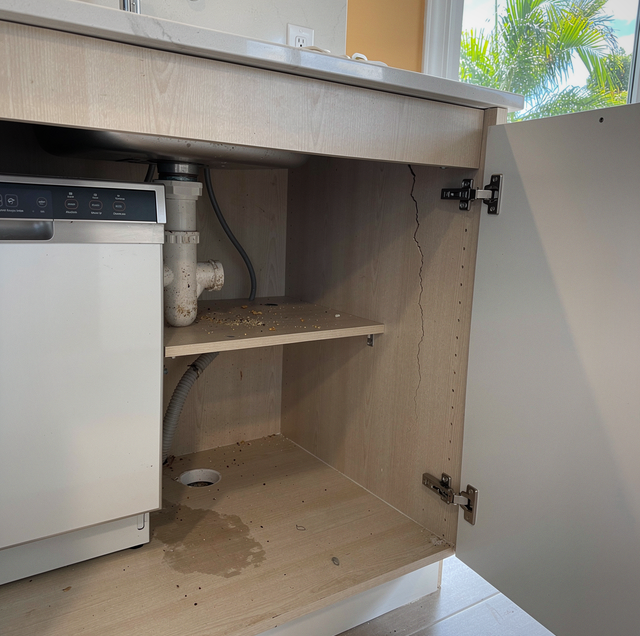
Where did you find it: German roaches rarely establish outdoors in South Florida's climate; if you are seeing one repeatedly in a kitchen or bathroom, especially near a dishwasher, under a sink, or behind an outlet plate, that points to an indoor colony. American roaches are usually wanderers, coming from a storm drain, a mulch bed, a plumbing chase, or a canal bank, and a single sighting on a patio or in a garage does not, by itself, confirm that anything is living inside your walls.
Small, striped, and indoors point to German. Big, plain, and near a drain, mulch line, or garage door points to American. If two of the three markers disagree, the section below on edge cases covers what to do.
Small and Striped: What a German Answer Means for the Job
A German cockroach infestation is an indoor harborage problem, and it gets treated as one. A single female carries an egg case, an ootheca, containing roughly 30 to 40 eggs until just before they hatch. Because generations overlap, a kitchen can go from a few sightings to a real population in a matter of weeks. Broadcast-spraying the counters does not fix this. It scatters foragers without touching the colony living in the cabinet hinge voids, the appliance motor housing, or the gap behind an outlet plate, and a stressed colony sometimes splits and spreads to new hiding spots rather than dying off.
The actual fix is placement, not volume: gel bait set directly into the crack-and-crevice harborage points where the colony is living, paired with an insect growth regulator that interrupts a nymph's ability to molt into a reproducing adult. Because the population includes overlapping generations and egg cases that have not hatched yet, breaking a German infestation takes several weeks and at least one return visit to catch the next generation as it emerges. This is not a same-day fix, and any treatment that promises otherwise is skipping the part of the biology that actually matters.
Big and Plain: What an American Answer Means for the Job
An American cockroach usually does not live in a well-kept house at all. It is an outdoor species that wanders in from an external source: a storm drain grate, a dried-out floor drain trap, an irrigation valve box, a mulch bed against the foundation, or a gap under a garage door or around a utility penetration. Because the population lives outside, indoor bait placements do little for it. The work is exterior: locating and sealing the entry gaps, and running a perimeter treatment around the foundation and known harborage zones to reduce how many roaches are close enough to wander in.
That outdoor population is never fully eliminated; it is part of the yard and the surrounding neighborhood, not a colony you can bait out of existence. That is why American cockroach pressure is managed on an ongoing cadence in South Florida, typically alongside a bi-monthly exterior service, rather than resolved with a single treatment. A single American roach after a heavy rain is often just that: one roach displaced from a flooded harborage and wandering toward a lit doorway. It becomes a pattern worth acting on when you see them repeatedly, not after one appearance.
When the Answers Do Not Line Up
Most sightings sort cleanly, but a few situations blur the line in practice. A young American nymph is smaller than an adult and can momentarily read as German-sized at a glance; check the pronotum pattern rather than size alone if the length is ambiguous. A German roach can also hitchhike into an outdoor trash enclosure or garage in a delivery box, but a single roach in a garage does not establish an outdoor colony the way it would establish an indoor one, since German roaches need the humidity and warmth of an indoor microhabitat to reproduce and rarely survive to build a population outside. When the stripe pattern and the location disagree, trust the pronotum stripes first: they are the most reliable single marker of the three.
One Look, Two Very Different Jobs
The two-second glance that separates these species is not a party trick. It decides whether the visit that follows targets a handful of cabinet voids with bait and an IGR, or walks the exterior looking for the gap, the drain, or the mulch bed that is letting roaches in from outside. Treat a German colony like an outdoor wanderer, and you spray a foundation that was never the source. Treat an American wanderer like an indoor colony, and you bait a kitchen that has nothing to bait. The identification is the first ten seconds of the job; everything that happens after it depends on getting it right.
Frequently Asked Questions
Only as a hitchhiker, and what matters is which hitchhiker. One wandering male changes nothing. A single mated female arriving with an ootheca already attached to her abdomen is a whole starting population, which is why one insect in a delivery carton can turn into sightings six weeks later with no second introduction. The places worth checking on anything used or delivered are the motor housing and kick panel of a secondhand appliance, the corrugated flutes of cardboard, and the underside of a drawer in used furniture, since those are the tight, dark voids a female picks to drop a case.
Yes, in South Florida, "palmetto bug" is a common regional nickname for the American cockroach, and it sometimes gets applied to the smoky brown cockroach as well, since both are large, reddish-brown, and outdoors-sourced. The name refers to size and habitat, not a separate species.
They have wings but rarely use them, preferring to run and disappear into a crack the instant a light comes on. American cockroaches can lift off and cover a short, clumsy burst of flight, especially on warm, humid nights, which is often what startles someone into thinking a roach just flew at them.
German nymphs are tiny, dark brown to nearly black, with a light stripe running down the back, and they are frequently mistaken for a completely different bug. American nymphs are larger and uniformly reddish-brown, with no stripes. Either kind, seeing nymphs at all confirms active breeding nearby, not just a passing adult.
Not necessarily on its own. Sliding glass door tracks and the weep holes built into a door frame for drainage are common single-entry gaps, and a lone roach can wander through one without any colony behind it. What confirms harborage is a repeated pattern, sightings in the kitchen or bathroom on multiple nights, especially with the lights off, rather than one appearance at a threshold.
Yes, and in South Florida it is not unusual. The useful part is telling which population is producing which sighting, because the answer changes what gets scheduled. Sticky monitors placed flat against the wall in a few candidate spots, under the sink cabinet, behind the refrigerator, inside the garage near the door threshold, will separate them within a week: German nymphs and adults accumulate on the indoor monitors near the harborage, while American captures cluster on the monitors closest to an exterior opening and stay sporadic rather than building.
Get the species confirmed and the right protocol started — Tyler inspects, identifies what's actually in your home, and treats accordingly. Buggify Pest Solutions serves Boca Raton, West Boca, and communities across Palm Beach and northern Broward. Call Tyler: (561) 672-0200.
