

Roaches in Kitchen Cabinets? What Their Location Tells You
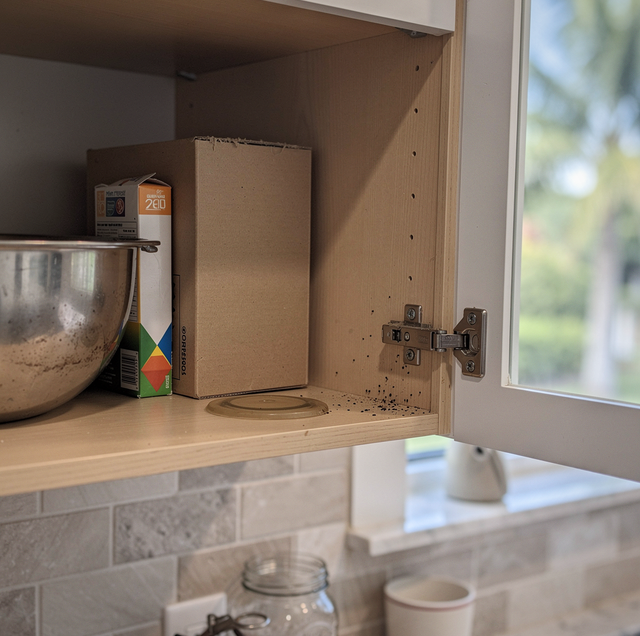
You open a cabinet door to grab a box of pasta, and something skitters back into the dark corner behind the mixing bowls. The instinct is to spray whatever is closest and shut the door fast, but before you do that, look at exactly where the roach was. A kitchen is not one space to a cockroach. It is a dozen or more separate cabinets, each with its own temperature, moisture level, and access point, and roaches do not spread themselves evenly across all of them. Where the activity is concentrated tells you which species you are dealing with and where it is actually coming from, which matters more than how many you saw.
Walk Every Cabinet in Order
Before you treat anything, do a full pass of the kitchen. Open every cabinet once, not just the one where you spotted movement, and work in a fixed order so you do not skip one.
Check for live or dead roaches first: Note whether you see full-grown insects, small nymphs, or both, since a mix of sizes usually means an established population rather than a single hitchhiker.
Look for droppings and egg cases: Dark specks along the back corners or hinge lines and any small capsule-shaped cases tucked into a seam are signs of harborage, even when nothing is moving.
Feel for grease film or dampness: Run a finger along the cabinet floor and the underside of the shelf above it. A tacky residue points to a food source; standing moisture or a musty smell points to a water source.
Mark the cabinet's position: Is it above the counter or below it, and does it sit next to the stove, the dishwasher, and the sink, or is it part of a dry-goods run away from any plumbing?
Pull each drawer all the way out of its runners instead of just sliding it open. The back face of the drawer box and the runner channel behind it are harborage that stays completely hidden while the drawer is closed.
Once you have been through every cabinet, you will usually see one of two patterns emerge, and each one points in a different direction.
What Upper Cabinet and Pantry Activity Usually Means
Activity concentrated in the upper cabinets, especially dry-goods storage, cereal and cracker boxes, or shelving near the stove, most often means German cockroaches. These are the small tan-to-light-brown roaches with two dark parallel stripes just behind the head, and they are the species most commonly found living inside a home rather than just visiting it.
German roaches favor warm, tight harborage: the hinge line of a cabinet door, the crack where a shelf meets the cabinet wall, the gap behind a cabinet that backs onto the stove or refrigerator motor. Heat from an appliance keeps that microclimate warmer than the rest of the kitchen, which is exactly what this species looks for. They feed on crumbs, grease film, and the glue and starch in cardboard packaging, which is also how they usually arrive in the first place, riding in on a grocery bag, a delivery box, or a case of canned goods from a store that already has a low-grade infestation.
This is an indoor-harborage problem, not a moisture problem. Sealed jars and cans are not a concern, but cardboard boxes stored in these cabinets are both a food source and a hiding place, which is why activity often traces back to the pantry shelf that holds cereal, pasta, and pet food rather than the shelf with plates and cookware.
What Under-Sink and Plumbing-Area Activity Usually Means
Activity concentrated in the cabinet under the kitchen sink, next to the dishwasher, or along any cabinet run that shares a wall with plumbing is more likely to indicate American cockroaches. These are considerably larger, reddish-brown, and capable of flying short distances when temperatures are warm. Unlike German roaches, they are primarily an outdoor species that comes inside in search of moisture.
American roaches travel indoors through the same openings the plumbing itself uses: the gap around a drain pipe where it passes through the cabinet floor, an under-sized escutcheon around a supply line, or a floor drain that has dried out and lost its water seal. Once inside, they stay close to that entry point because it is also their moisture source. A slow drip under the sink, a sweating P-trap, or a dishwasher line with a slow seep is often enough to sustain them even without a food source nearby.
Standing water under a fixture is the single strongest signal in this location: If the under-sink cabinet floor is damp, warped, or shows a water stain even when nothing is actively dripping, that moisture is very likely what is drawing roaches in from outside, not anything you left out on a counter.
When Cabinets on Both Sides of the Kitchen Show Signs
Sometimes the walk-through turns up activity in the pantry and under the sink at the same time. That does not necessarily mean one giant population; it can mean two separate ones sharing the same kitchen, a German roach colony in the dry-goods cabinets and an American roach entry point at the plumbing, running independently of each other.
It can also mean the same colony has spread through a shared void. Upper and lower cabinet runs are sometimes connected behind the wall by the same chase that carries the sink's supply and drain lines up to a soffit near the ceiling, and a gap at either end lets roaches move between them without ever crossing open floor. If you find a greasy, dark smear along a seam in the back panel, a stained section of wall behind the cabinet, or a gap where the panel has pulled away from the wall, that is worth noting specifically, since it usually indicates where the void is breached.
Spraying a visible trail the moment you see it tends to make this harder to read, not easier. A repellent contact spray scatters roaches away from the treated area into cabinets and wall voids you have not checked yet, which is part of why a spot-treated kitchen sometimes looks better for a few days and then shows activity in a new cabinet the next week. Finishing the full walk-through before treating anything keeps that scatter from hiding the real picture.
Match What You Found to the Right Response
Once you know which pattern you are looking at, the response follows the source rather than guessing at it. Dry-goods and upper-cabinet activity calls for gel bait placed directly into the cracks and hinge lines where German roaches are harboring, paired with an insect growth regulator that interrupts the next generation rather than just knocking down what is visible today. Under-sink and plumbing-area activity calls for finding and correcting the moisture first, sealing the pipe penetration or fixing the drip, since bait alone does not stop roaches that are simply passing through an open gap toward standing water.
Mixed activity across both zones usually means both approaches are needed at once, and it is worth having someone check the shared wall void rather than treating each cabinet as an isolated problem.
Reading the Kitchen as a System
A single roach sighting tells you almost nothing on its own. The cabinet it came from tells you a great deal, because German and American roaches are chasing different things in a kitchen and leave different footprints behind. Treat the location as your first piece of evidence, not an afterthought, and the rest of the inspection gets a lot faster.
Frequently Asked Questions
It can, and it is one of the more commonly missed harborage points in a kitchen. An adhesive liner that has lifted at a corner or bubbled along a seam creates a flat, dark void close to the depth a German roach prefers, and both the paper backing and the adhesive itself are edible to them. Peeling old liner up during a cleanout, rather than smoothing it back down, removes harborage that wiping the shelf surface will never reach.
It can, particularly in older cabinetry where the back panels are thin or where a shared plumbing chase runs floor to ceiling. An adult German cockroach can flatten enough to pass through a gap of roughly a sixteenth of an inch, about the thickness of two credit cards stacked. A first-instar nymph needs considerably less, so a small breach at either end of that chase is enough for a population to shift location over a period of weeks even without any obvious new entry point appearing.
Roach droppings typically look like coarse black pepper or coffee grounds, sometimes with faint ridges visible under a light, and they cluster in fine piles along a crack or corner. Mouse droppings are larger, roughly rice-grain sized with tapered ends, and tend to be scattered individually across a shelf rather than piled in one spot, which is often the faster way to rule mice in or out before assuming roaches are the only issue.
A heavy, established German roach population often produces a distinct musty, oily odor from the aggregation pheromone the insects leave on surfaces they travel, and it is usually most noticeable in the first second or two after opening the cabinet door, before it dissipates into the room air. A faint version of that smell with no visible roaches can still mean an active harborage tucked further back than you can see.
Unopened cans, glass jars, and rigid plastic containers are generally fine to keep and wipe down. Cardboard boxes, paper bags, and anything with an unsealed liner should be treated differently, since roaches feed on the glue and starch in the packaging itself, not just the food inside, and a box that has been sitting in an active cabinet is worth transferring to a sealed container or discarding rather than being reused on the shelf.
Not necessarily on its own, but it is a useful data point. Both German and American roaches are primarily nocturnal, so an insect crossing an open shelf in daylight usually means its normal night harborage is overcrowded and it has been pushed out to forage during hours it would otherwise avoid, which is a sign the population in that specific cabinet has grown past what the hidden space can support.
Get a cabinet-by-cabinet cockroach inspection — so the actual source gets treated, not just the cabinet you found them in. Buggify Pest Solutions serves Boca Raton, West Boca, and communities across Palm Beach and northern Broward. Call Tyler: (561) 672-0200.
