

Cockroach Droppings: What Size, Shape, and Location Reveal
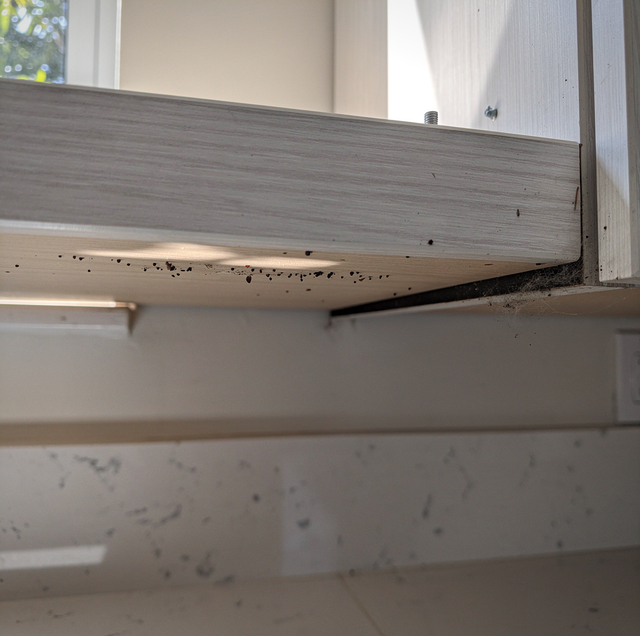
Before you reach for a spray can or call anyone, look at the dropping itself. The width of its digestive tract shapes a cockroach's fecal pellet, so different species leave behind physically different waste, and where you find it is not random. Cockroaches favor tight, enclosed spaces where their body touches a surface on several sides at once, and they tend to rest and feed in that same small area night after night. That habit means droppings accumulate almost exactly where the insect is living, not scattered evenly across a room, as loose crumbs or an ant trail might be. Read the specks correctly, and you can identify the species, locate the harborage, and get a sense of how long it has been active, all before you ever see the insect that made them.
Why Droppings Cluster Exactly Where the Roach Lives
Cockroaches are thigmotropic, meaning they seek out surfaces that press against multiple sides of their body at once. That preference is why a roach settles into the underside of a cabinet shelf, the seam behind a dishwasher's kick plate, or the gap around a switch plate screw rather than sitting out in open floor space. A harborage crack like that does double duty: it is where the insect rests during daylight hours and, because a resting roach defecates repeatedly in the same spot, it is where the waste piles up.
This is the opposite of how you would track, say, a wandering pantry moth or a stray ant. Those insects leave sparse, spread-out evidence because they are foraging the whole time you see them. A cockroach, by contrast, spends the overwhelming majority of its time tucked into harborage and only comes out briefly to feed, often at night and typically not far from where it rests. The droppings you find are a record of where the animal actually lives, not just where it happened to pass through, which is why one dense patch inside a single hinge line is worth more to you than a dozen specks scattered across a whole floor.
What the Droppings Themselves Tell You
Size, shape, and surface texture narrow the species before you even factor in location. The table below compares the patterns a technician actually looks for in a South Florida home.
| Appearance | Size & Texture | Likely Species | What the Location Usually Means |
|---|---|---|---|
| Loose, gritty specks with no defined shape, like ground pepper or coffee grounds | Under a millimeter, crumbles under light pressure, no ridges | German cockroach | Concentrated in a single hinge line, behind one appliance, or against one switch plate; the harborage is within a few feet, often the exact crack |
| Firm, cylindrical pellets with blunt, rounded ends and fine ridges running the length | About 2- 3 mm, roughly an eighth of an inch, holds its shape when nudged | American cockroach | Found near a floor drain, an AC condensate outlet, a laundry standpipe, or a water heater closet, meaning a plumbing penetration is the likely entry route |
| Cylindrical pellets similar to the American roach's, but found higher up | Same 2- 3 mm size and ridging, sometimes mixed with shed skins or wing fragments | Smokybrown cockroach | Found in attic insulation, soffit vents, or top kitchen cabinets near the roofline, meaning the harborage is outdoors or in the attic, entering at the roof edge |
| Dark smears or streaks on a vertical surface instead of discrete pellets | Sticky or shiny residue rather than dry, separate pellets | German cockroach, high-moisture harborage | Found on a cabinet wall or backsplash near a slow leak or condensation line, meaning the crack behind it is holding excess moisture |
A quick note on tools: a phone flashlight held at a raking angle across the surface, rather than straight on, makes the ridges on a cylindrical pellet far easier to see, and a macro photo lets you zoom in afterward without disturbing the site.
Photograph the cluster where you find it before cleaning anything up. Note the exact surface (cabinet hinge, drain, soffit vent) since that detail is often more useful for pinpointing the harborage than the dropping itself.
Matching the Cluster's Location to a Real Harborage
Species identification narrows the list; location confirms it. German cockroach clusters cling to warmth and moisture indoors: The motor housing under a dishwasher or refrigerator, inside a cabinet toe-kick, behind a wall-mounted oven control panel, or in the voids around a kitchen or bathroom plumbing chase. These are small, warm, humid spaces near a food or water source, and the German roach rarely strays far from one once it finds one.
American cockroach clusters point outdoors and downward: This species moves between yard debris, storm drains, and irrigation valve boxes and enters through a floor drain, a foundation gap, or a laundry room's exterior door threshold. A cluster along a baseboard near a floor drain or inside a rarely opened utility closet usually means the roach is commuting in from outside rather than breeding deep in the structure yet.
Smokybrown cockroach clusters run high, not low: This species is a stronger flier than the other two and favors attic spaces, soffit vents, and the tree canopy near the roofline before working down into upper cabinets or a garage rafter. Tile-roof construction, common across South Florida, creates soffit-fascia gaps and tile-edge penetrations that give this species a direct route from the roofline into the attic, which is why a smoky brown cluster often appears well above eye level before it appears anywhere near a kitchen.
What Accumulation Tells You About How Long It Has Been Active
Volume and layering are the honest indicators here, not a precise timeline. A handful of loose specks in one corner is a different situation than a caked, quarter-inch layer built up along an entire cabinet shelf. That kind of buildup does not happen in a single week; it reflects a harborage that has been occupied and reused through multiple feeding cycles.
Color adds a second layer of information. Fresh droppings look darker and slightly more defined; older ones lighten and lose that crisp edge as they dry out. Finding a mix of both in the same cluster indicates the harborage has been in continuous use rather than the result of a single recent event, even without pinning down an exact date. A single fresh patch with nothing older around it, on the other hand, points to a roach that arrived recently or is passing through rather than an established colony.
Do not dry-sweep or blow out a caked dropping layer. Cockroach frass carries proteins recognized as common asthma and allergy triggers, and disturbing a buildup dries those particles out, putting them into the air you are standing in.
When to Stop Guessing and Get an Inspection
Identification from droppings gets you most of the way, but it is a starting point, not a diagnosis you should treat as final. A German cluster inside a cabinet and an American cluster at a floor drain call for different approaches: German cockroach control leans on crack-and-crevice gel bait placed directly into the harborage, paired with an insect growth regulator (IGR) to interrupt the next generation, while an American roach problem usually needs the outdoor entry point itself addressed, not just an indoor treatment. Reading the evidence correctly before that visit means the technician spends less time re-finding what you already found and more time closing the actual gap.
The specks on a shelf or the pellets by a drain are not the problem; they are a record left by whatever is living in the wall, the cabinet void, or the soffit nearby. Trace them back to that source, and the droppings stop reappearing on their own.
Frequently Asked Questions
Yes, but by shape and pattern rather than by size, since the two overlap by about an eighth of an inch, and guessing by size alone is how people get this wrong. Mouse droppings taper to a point at one or both ends and scatter in a loose trail along a travel route such as a baseboard or a pantry shelf edge. Roach droppings have blunt, rounded ends, carry fine lengthwise ridges that you can pick up with a raking light, and stay concentrated at a single harborage crack rather than strung out along a path.
The reliable way to actually see one, rather than just the evidence, is to time it: check the suspected crack with a flashlight within the first minute or two after turning off the kitchen lights at night. That narrow window, before the insects fully retreat into harborage, is when a technician actually counts live activity rather than relying on droppings alone. Daytime searching rarely works, no matter how active the harborage is.
The useful version of this question comes after a treatment rather than before one. Gloss never identifies a species, because a German and an American dropping can both read wet or dry depending on how humid that particular crack is. What gloss does track is whether anything is still depositing. Clean a treated site down to the bare surface, then check it again two or three weeks later: if what has reappeared is only a little dry, uniform material with nothing wet or glossy mixed in, that is one of the better signs, short of a follow-up inspection, that the site has gone quiet.
Not necessarily. A handful of scattered droppings with no caked cluster often means an occasional wanderer rather than an established indoor harborage, and in a townhome, condo, or HOA community with shared walls, that wanderer may be coming from a neighboring unit's plumbing chase rather than breeding on your side of the wall at all.
Yes. German cockroaches will harbor near any source of warmth, including a TV, cable box, dishwasher motor, or refrigerator compressor housing, and will forage a short distance away to feed before returning. Finding a cluster near warm electronics with no crumbs or food source in sight does not rule out an active harborage.
Leave one representative cluster undisturbed so the technician can inspect the exact site and confirm the species and the entry point. Clearing the rest is worth doing for a reason beyond tidiness: roach frass carries aggregation pheromones, chemical signals that tell other roaches a crack has already been tested and found safe. A buildup left in place keeps advertising that harborage to whatever arrives next, which is why a site that has been treated and then wiped down tends to stay quiet longer than one that was only treated.
If you keep turning up new clusters, one habit makes the next few weeks legible: after you clean a site, stick a strip of tape beside it and write the date on it. A cluster that rebuilds in the same spot inside two weeks says the harborage behind it is still occupied, and that is a question no amount of squinting at the specks themselves can settle.
Get the harborage identified and treated at the source — not just the droppings cleaned up. Buggify Pest Solutions serves Boca Raton, West Boca, and communities across Palm Beach and northern Broward. Call Tyler: (561) 672-0200.
