

Spider Webs Back on the Porch Within Days? What That Tells You
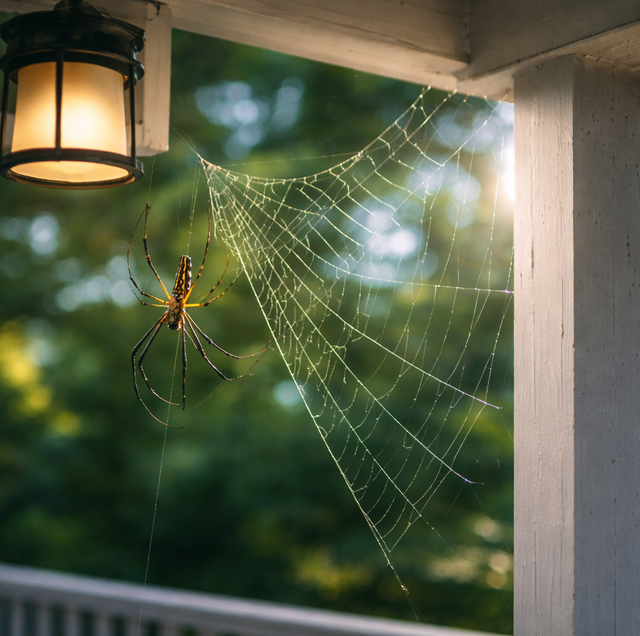
Quick Answer: Webs rebuilding in the same porch corner within one to two weeks of a paid visit often means the technician cleared visible silk without treating the prey insects and harborage feeding it, not that the treatment failed outright.
You paid for a spider treatment a few weeks ago. The porch corner by the front light got sprayed, the webs came down, and for a handful of days the space looked clean. Then a new strand showed up in the same corner, on the same post, at almost the same height as the one that got wiped away. If that turnaround took two weeks or less, the fastest and cheapest explanation, "the spider came back," probably isn't what happened. A new spider claiming an open, well-lit corner within days of the last one being removed is common. What matters more is whether anything about that corner actually changed between visits.
What Fast Web Return Actually Tells You to Check
Spraying a strand off a post kills nothing and closes nothing; it removes the silk and leaves whatever put that corner in play- an entry gap, a light pulling insects in, a void behind a fascia board- exactly as it was when the technician's truck pulled away. So the useful question isn't why spiders build webs in general; it's whether anything about that specific corner changed between the last visit and the one before it. That's a diagnostic question, not a biology one, and it has a fairly short list of concrete answers to check against what actually happened on your porch.
Same Corner, Same Week: The Clearest Sign of a Surface-Only Visit
A handful of details, taken together, point toward a visit that reached the webs and stopped there:
The web reappears in the exact same spot, not a new one nearby: A treatment that changed the conditions at that corner usually pushes activity to a different, less favorable location before it disappears altogether. A web rebuilt in the identical spot suggests nothing about that spot changed.
The visit took ten minutes or less and covered only open, visible surfaces: A walk-and-spray down a porch rail or door frame treats what's easy to reach, not the corner voids, screen seams, or eave gaps where a spider that built a web there is actually sheltering.
Nobody mentioned lighting, moisture, or nearby insect activity: A visit scoped to spiders specifically usually asks at least one question about what's drawing insects to that part of the house, since the web-builder followed the food supply there first.
The invoice or work order says something generic, like "exterior pest treatment": That phrasing is common for a general service built around ants and roaches, not one scoped to identify and treat spider harborage.
Photograph the web's exact location the day it reappears, post, doorframe, or light fixture. A pattern of the same three or four spots refilling points to unaddressed harborage, not random new spiders.
What a Knockdown Spray Does and Does Not Reach
Pest control products generally fall into two categories, and naming them explains a lot about why webs return on a predictable schedule. A pyrethrin-based contact spray, the workhorse of a fast perimeter pass, is built for speed: it affects insects on contact within minutes to hours and breaks down quickly once applied, which is useful for clearing what's visible in the moment but leaves little residual behind by the next day. A microencapsulated pyrethroid residual works differently: the active ingredient is sealed inside microscopic capsules bonded to the treated surface, and those capsules release slowly as insects cross them, which is what gives a residual its multi-week working life instead of a multi-hour one. A visit that leans entirely on the pyrethrin side clears what's in front of the technician and stops there; nothing about it changes what happens to the corner over the following weeks.
Surface type changes how long even a correctly applied residual holds, and it's a detail worth asking about directly. A porous, unsealed surface- raw stucco, unpainted masonry, weathered wood fascia- absorbs product into the material itself and depletes the active deposit faster than a smooth, painted, or sealed surface does. A painted soffit or a sealed aluminum frame tends to hold a residual closer to its full label life, while bare stucco under the same South Florida humidity can burn through the same product noticeably sooner. That's not a flaw specific to any one company; it's a known limitation of relying on a single product category or ignoring what the treated surface is made of when a job requires both fast clearing and a longer-acting layer underneath.
What a Treatment Built to Last Covers
A treatment scoped to hold has to do two things a five-minute spray-down skips: it identifies where the spider is sheltering, not just where the web is hanging, and it treats the insect activity feeding that shelter, not only the spider itself. In practice, that means product goes down at entry points, eave lines, and the harborage a spider is using, sized to last across the weeks between visits rather than the hours after one. Reducing the prey supply matters as much as the shelter does; a corner with plenty of shelter but nothing to eat nearby stops being worth building on. None of that shows up in a five-minute perimeter pass, which is the practical reason a fast visit and a real one produce different results at the same porch corner three weeks later.
Reading Your Own Timeline Against What's Normal
Rather than walking back through the general die-off math (existing webs clear same-day, sheltering spiders die off over one to two weeks as residual contact adds up), the more useful move is comparing what's actually showing up on your porch against two patterns that look alike at a glance but mean different things.
A web that's thin, incomplete, or missing its usual anchor lines, one spanning half the normal distance, or built low and hurried near a baseboard rather than up at the original anchor height, suggests a spider still working through a treated zone: it's rebuilding in a hurry because contact with residual product is disrupting normal web-building behavior, not because nothing was ever applied. A full, symmetrical, properly anchored web at the exact same height and spot as the one that got swept away reads differently. That's closer to the signature of an untouched corner, a spider building without any interference at all, which points harder toward the harborage point never having been reached in the first place.
Location pattern is the second tell. Die-off activity during that one-to-two-week window tends to show up scattered across a few nearby spots, an adjacent post, a foot to the left, as displaced spiders settle wherever's open nearby. A web that returns to the identical anchor point, same nail head, same corner bracket, every single time points more toward a void or gap that was never closed, since that's the one spot on the porch that never actually stopped being usable.
Questions Worth Asking Before You Rebook Anyone
Before scheduling another visit with whoever did the last one, or switching providers, it's worth asking a few direct questions: what specifically was treated beyond the visible web, whether the technician identified a moisture source or entry point, and what changed between this visit and the last one if the same corner needed attention twice. A provider who can answer those specifically, by naming the corner, the product category, and what's different this time, is describing a real diagnosis. A vague answer about spraying again is a sign the second visit will look a lot like the first.
Frequently Asked Questions
Not necessarily, and it doesn't need to be for the pattern to matter. Many web-building spiders, orb weavers especially, consume and rebuild their web roughly every 24 hours as part of normal behavior, so a single new strand the morning after a visit isn't unusual on its own. What's more telling is a full web reappearing in that identical spot, day after day, for a week or two straight: that points to the corner still being usable as a retreat, whether it's the original spider or a new one that moved into the same open geometry.
The bait detail is the part worth knowing. Ant and roach control leans heavily on bait placement, and spiders don't forage on bait the way those insects do, so a bait-heavy general visit can leave spider activity almost untouched even though pest control technically happened at the house that day. A ticket that names specific target zones, soffits, eaves, screen seams, and entry points is a better sign the visit was actually scoped for a web-builder rather than routed through a standard ant-and-roach service.
Yes, and it's a useful way to narrow down the cause without waiting on a full re-treatment. Switching the porch or entry light off, or to a motion sensor, for four or five nights and watching whether new web activity slows down isolates how much of the problem is prey-driven versus harborage-driven at that specific spot. A sharp drop points toward lighting and the insects it draws; little change points more toward an unaddressed gap or void nearby.
Not on its own, since that interval aligns with normal residual wear in South Florida humidity. What's worth paying more attention to is when the timing ISN'T predictable: webs returning inside three weeks one cycle, then holding for seven the next, with no change in season or provider. Irregular return timing like that usually points to a variable outdoor factor doing more of the work than the treatment's own consistency, a sprinkler head that got redirected, a new porch light, plant growth that came in bushy after a wet stretch. A provider who can trace an off-pattern week to one of those changes is diagnosing correctly; one who just re-sprays on schedule regardless isn't accounting for what's actually driving the variation.
That's worth raising directly. A visit that repeats the same product and the same treatment zone every time, with no escalation, no mention of sealing a gap, no lighting recommendation, after the first attempt already failed to hold, suggests that nobody re-diagnosed the corner after it came back. A second visit to the same trouble spot should look at least somewhat different from the first: a different product category, a physical exclusion step, or a specific harborage point named that wasn't addressed before.
Judge the answer by how specific it gets, not just whether they push back. "Everything was treated correctly" on its own isn't a diagnosis; a provider standing behind the visit should be able to name the exact zones they treated and, if pressed, walk the property with you and point to them in person. Watch for that same vague, general answer repeating itself when you ask a follow-up question; that's a stronger signal than the first answer alone. If two follow-up questions in a row receive the same nonspecific response, a fresh inspection by a different technician is a normal next step, not an overreaction.
Ask them to name the difference up front, before anything gets sprayed: will this visit apply a residual product to harborage points, voids, seams, entry gaps, in addition to clearing visible webs, or is it a knockdown spray across open surfaces only? A provider planning source-first treatment can usually, before stepping onto the porch, name which two or three zones they expect to check first based on what you describe: a corner joint, a specific light fixture, a screen seam. One who can only commit to "we'll take a look and spray" is describing the same kind of visit that didn't hold the first time, just from a different truck.
Get a second opinion on what your last spider treatment actually covered — a source-first inspection checks the harborage and prey insects a knockdown spray leaves behind. Buggify Pest Solutions serves Boca Raton, West Boca, and communities across Palm Beach and northern Broward. Call Tyler: (561) 672-0200.
