

Why Rat Traps Can Stay Empty the First Week of a Job
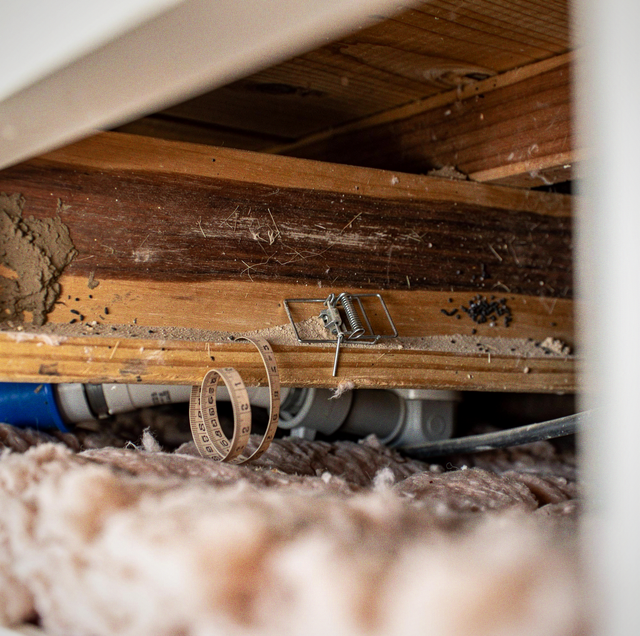
Quick Answer: A trap with nothing in it after week one usually reflects rat behavior, not a failed setup. Established rats treat any new object on a route they already use with caution, so first contact can take longer than a single check.
Why a Familiar Route Suddenly Has Something New on It
A rat traveling the same joist or roofline gap night after night is not moving carelessly. Survival to that point has depended on noticing when something along a known path is different, and reacting to that difference with caution rather than walking past it without a glance. A trap set onto a beam a rat has crossed dozens of times is new mass, a new shape, and a new scent sitting in a spot that used to be clear. That gets treated as worth investigating from a distance first, not as something to cross over on the first pass.
This is not a smarter-than-average rat outsmarting a standard device, and it is not the trap doing anything wrong. It is closer to how a cautious animal already behaves toward anything unfamiliar on territory it considers known. An established adult that has been working the same route for a while typically shows more of this hesitation than a rat that has only recently moved into the space, simply because it has more history with how that path is supposed to look. Nothing about that hesitation shows from the floor below, which is part of why the first week is such a hard stretch to interpret from the ground.
Whether the Trap Sits on the Line the Rat Walks
Placement follows what the inspection found on the run itself, so a station sits on ground a rat is already crossing rather than somewhere convenient to reach. That matters for reading week one, because it keeps two questions from getting tangled together.
A station on the line asks only whether the animal has gotten comfortable with a new object. A station slightly off the line asks the animal to alter its path as well, which is a separate ask entirely, and one that an empty count cannot tell apart from ordinary caution.
Whether That Route Is Still Getting Used
A route that looked active during the inspection isn't guaranteed to stay that way for the length of a job. Rats shift which paths they favor for reasons that have nothing to do with a trap appearing on one of them, following whichever route currently gets them to food and shelter with the least friction. A line that goes quiet because the animal simply isn't using that particular joist anymore this week reads identically, from the outside, to a line that's quiet because a cautious rat still hasn't committed to the new object on it.
Telling those two situations apart is why fresh droppings, new grease, and gnaw marks get read at every stop rather than judging a station purely by whether it produced a catch. A trap with no new sign anywhere nearby is telling a different story than one sitting in the middle of fresh activity that hasn't reached the device itself yet.
Reading a Sprung, Empty Trap
A trap that has fired without holding anything is not the same finding as a trap that's sat completely untouched. Contact, even contact that didn't result in a catch, means an animal came close enough to trigger the mechanism, which puts that station past pure avoidance and into physical approach. Early in a job, a sprung-but-empty trap is often closer to progress than to failure, marking the point at which caution about the object has begun to give way to investigation.
What separates that finding from a weaker one is what sits around the device. A station that has fired with fresh sign running right up to it places the animal at the spot. A station that has fired with nothing new anywhere near it says less on its own, since a mechanism can be set off by something other than the animal the line was built for. Either way, a station that has been contacted has moved past the stage where the object itself is the obstacle, and that is a different starting position for the following week than an untouched one.
A sprung or reset trap is read and handled on the scheduled monitoring visit, not before. Do not touch, reposition, or reset a trap between visits, even one that looks like it fired for nothing.
Where Week One Sits in the Curve
Monitoring on most jobs runs every 7 to 10 days, which means the first scheduled check is an early read rather than a late one. Set against the usual shape, a sharp drop by the second week and most jobs quiet by around the fourth, a flat count at that very first stop sits comfortably inside the curve rather than outside it.
When a Slow Start Is Worth Flagging
None of this means that every quiet week one is automatically fine, or that every job resolves itself on schedule. There is a version of a slow start that does mean something is off, one where signs of activity keep showing up elsewhere in the attic, fresh droppings, new gnawing, continued noise overhead, while every trap along the mapped route sits completely untouched, no sprung mechanisms, no near-misses, nothing. That pattern suggests the map itself may need a second look rather than more patience with the current one.
Sorting an ordinary cautious start from that second pattern depends on reading the whole picture across visits, not on watching one trap from below and guessing. That read stays with whoever is running the line, working from what the inspection found and what each stop since has actually shown, rather than something a homeowner can settle by checking how a single device looks on any given day.
Frequently Asked Questions
Not in the same way. A catch confirms that a location sits on real travel, so once a station has produced, the area around it is treated as proven ground rather than an unknown still being tested, and it typically stays exactly where it is rather than getting second-guessed the way an untouched station does.
Moving a station early forces a rat's caution to start over at a location it has never encountered, rather than letting whatever exposure it has already logged at the original spot carry over. The reason for the move is what makes the difference. The evidence shows that a station that stays untouched while fresh sign keeps running past it is on the wrong line, and that one gets moved. A station moved because a week felt slow gives up exposure it had already built and gets nothing back for it.
Whether a device runs armed from day one is a placement decision, settled when it goes in from what the inspection found at that location. It is not something a homeowner manages, and nothing is left sitting on a property in a half-finished state for them to keep track of. On rat work in an occupied attic, the line generally goes in ready to work, since anything that delays that adds a step before a route can produce.
Snap traps trap and hold what they catch, so whatever the line produces between stops is still in place when the next one comes around. A rat working its way up to contact does that across separate passes on the same night and the nights after, and none of it has to be witnessed for the outcome to survive until the check. It is also why a count at a scheduled stop is a real total for that stretch rather than a partial one, and why an empty line is an actual zero instead of a gap in the record.
Roof rats reproduce every 21 to 25 days, so a single careful week falls inside one breeding interval rather than across several. That interval runs on its own, regardless of what the trap line is doing, which is why the timeline on a rat job gets measured against the biology rather than against how patient anyone feels.
Mice show the same caution toward new objects in principle, but because they range across a much smaller area and investigate whatever is in it more constantly, they tend to work through that caution faster than rats sharing a similar kind of route. That's part of why a mouse-focused line often shows engagement sooner than a rat line set up the same way.
Talk to Tyler about what your first week has actually shown — know whether a quiet line is on track or whether the map behind it needs a second look. Buggify Pest Solutions serves Boca Raton, West Boca, and communities across Palm Beach and northern Broward. Call Tyler: (561) 672-0200.
