

Why Spiderwebs Pile Up in Coral Springs and Delray Beach
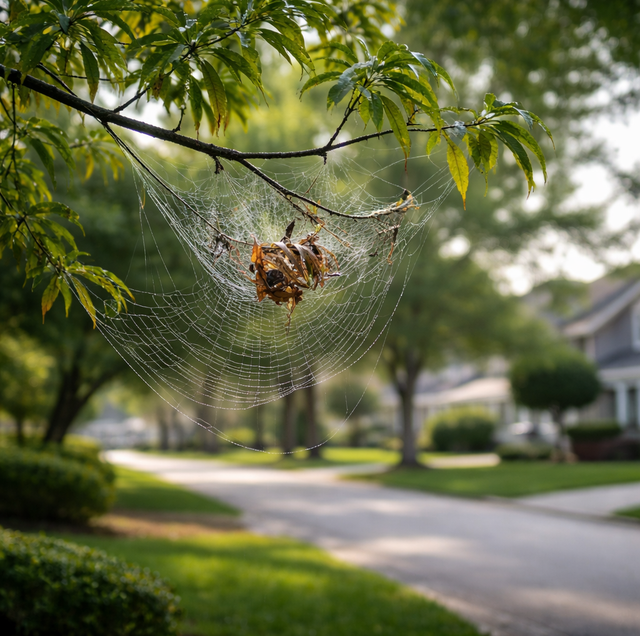
Quick Answer: Heavier web activity in Coral Springs and Delray Beach traces to decades-old tree canopy, not the neighborhood itself. Coral Springs grew a uniform canopy through planned 1970s-80s development; Delray Beach's older sections grew a more irregular one, lot by lot.
If your last address was a newer development with young trees and a fresh sod yard, and you've since moved into an established Coral Springs or Delray Beach neighborhood, you've probably noticed something odd: there are just more webs. Corner webs under the eaves. Funnel webs tucked into the hedge line. A golden orb weaver strung between two trees over the driveway that wasn't there a month ago. It's tempting to assume the new neighborhood just has "more spiders," but that's not quite the mechanism. Spiders build where the food and the anchor points are, and two things separate an established neighborhood like these from a newer one: how much prey a mature canopy supports, and how much usable web-building structure that canopy actually offers at different heights. Both point straight back to canopy age, which is also why the two cities got there on different timelines, and that's what drives the web count up.
Decades of Tree Canopy Change: What's Available to Eat
A tree planted five years ago and a live oak or gumbo limbo that's been growing since a neighborhood was built out in the 1970s or 80s don't host the same insect population, even if they're the same species. Older canopy has more bark texture, more leaf litter underneath, a more shaded and humid microclimate at ground level, and more time for scale insects, aphids, and other sap feeders to establish on the branches. Those sap feeders in turn draw the moths, gnats, and small flies that spiders are actually after. A 2023 forest experiment reported in the journal Ecology found denser canopy cover and greater tree species diversity tracked with measurably higher arboreal spider abundance; the setting was a managed forest experiment rather than a South Florida residential yard, but the same basic driver, more canopy supporting more prey, is at work here too. Locally, that logic holds too: scale and aphid populations that build up over years on a mature tree's branches support the predators, spiders included, feeding on them from below, a relationship a five-year-old sapling simply hasn't had time to build.
Coral Springs was largely built out with heavy tree planting in the 1970s and 80s, and many of Delray Beach's older sections, Del-Ida Park and the Marina Historic District among them, have tree-lined streets that go back even further. That's forty-plus years of uninterrupted canopy growth in some yards. Compare that to a newer HOA community with three-year-old crape myrtles and open sod, and the older neighborhood is simply running a bigger insect buffet at spider height. Golden silk orb weavers, the large banana spiders residents notice most, build their webs in the flight paths between that canopy and a porch light or open yard, exactly where flying insects funnel through on their way to feed or breed.
Canopy Structure Adds a Second Layer of Anchor Points
Tree canopy isn't only about how much insect life it supports; it's also about how much usable web-building space it offers at different heights. A young, single-trunk tree with a handful of scaffold branches gives an orb weaver almost nowhere to anchor a large web except low, near eye level. A live oak or gumbo limbo that's spent decades filling out branches at multiple levels- low limbs near the trunk, a mid-canopy layer, and an upper crown- gives that same spider wide, unobstructed spans to work with at several heights, plus more places to retreat during the day. More structure means more anchor points, and more anchor points at more heights is part of why an established yard can carry visibly more webs than a young one even before insect density gets factored in.
Waterfront lots in the service area carry a separate, water-driven insect source that works differently from canopy, and that mechanism gets its own coverage in Buggify's water-adjacent spider and mosquito content rather than here; canopy age is the driver in play for these two neighborhoods.
Mature landscaping accumulates more than canopy. Brown widows favor tight, undisturbed voids: palm boot gaps, the underside of a raised planter, a stacked-pot nursery pile kept in shade, so check those spots with a flashlight before reaching in by hand.
Coral Springs and Delray Beach Got There on Different Timelines
The two neighborhoods this article is about didn't get their canopy the same way, and that difference is worth spelling out rather than lumping them together as simply "older neighborhoods." Coral Springs was largely built out in a single wave of planned development through the 1970s and 80s, with street trees planted under a fairly uniform development pattern across whole subdivisions at roughly the same time. In broad terms, that produces a canopy that tends to be more even: similar tree age, a similar species mix, and a closed canopy that arrived at roughly the same pace block to block. Delray Beach's older neighborhoods grew up differently. Districts like Del-Ida Park and the Marina Historic District trace to individual, lot-by-lot development going back to the 1920s through the 1940s in parts of the city, well before any single planned build-out, and the canopy reflects that: more variation in tree age and species from one lot to the next, planted by individual owners over decades rather than a developer on one schedule.
Treat the exact decades as a general historical pattern rather than a precise timeline for every block, records vary by neighborhood, but the practical effect holds: a Coral Springs street is more likely to show one consistent canopy-age reading yard to yard, while a Delray Beach street in one of the older districts is more likely to show a wider spread, a much older tree next to a lot replanted more recently. That's the real comparison behind the two cities showing up together in this article: not that one has more spiders than the other, but that they built their canopy on different timelines and with different lot-by-lot consistency, which shows up as a different pattern of where the heaviest web activity concentrates within each city.
Newer, Sparser-Landscaped Communities See a Different Insect Load
None of this means spiders in a newer HOA development are less capable or that the builder did something wrong. It means the food base and the web-building structure haven't yet developed. Young trees haven't grown the bark texture or canopy density that scale insects and aphids need to establish in real numbers, turf-heavy or xeriscaped yards hold less leaf litter and understory moisture, and irrigation-controlled landscaping gets trimmed and mulch-turned on a schedule that doesn't let insect habitat accumulate the way an older, more mature yard does. A young, single-trunk tree also doesn't have the multiple branch layers a web needs to anchor at several heights yet, so there's simply less usable web-building space and less prey moving through the property at any given time, and fewer spiders find it worth building there.
That gap tends to close with time. As trees in newer neighborhoods mature over ten to twenty years and the canopy closes overhead, the same mechanism that drives web counts in Coral Springs and Delray Beach today starts to show up there, too. A homeowner who moved into a brand-new build with a bare yard often sees web activity climb gradually as the landscaping around them ages, not because anything changed about pest pressure in the area, but because the trees finally caught up.
Reading Web Height as a Canopy Clue
Under a mature canopy, where a web shows up vertically is worth almost as much attention as whether it's there at all, because it points to which layer of the canopy is generating the insect traffic. A web strung low, at knee height in leaf litter or mulch near the trunk, usually means ground-hunting spiders in that layer are working the decomposer insects, springtails, small beetles, and other litter-dwelling species that break down leaf drop under a shaded, humid canopy. A web at shrub height, three to five feet up in the understory, more often marks moths and small flies moving between the shaded understory and the open yard. A web strung high, between mid-canopy branches or across a gap at eave height, is typically an orb weaver working the flight path insects use to move between the crown and a light source or open area. None of this means the web itself is the problem in that spot; it's a marker of which vertical layer of the canopy is producing the most insect traffic right now, and that layer shifts somewhat through the year as canopy density and leaf litter volume change.
That's also why removing a web without addressing what's feeding that layer, thinning ground litter, correcting irrigation overspray higher up, tends to produce the same webs again within a week or two.
A Canopy Age Difference, Not Something Wrong With Your Yard
The takeaway for anyone comparing notes with a friend in a newer part of the service area is that the difference in web counts is a reasonably accurate read on how much outdoor insect activity, and how much web-building structure, two properties are actually supporting, not a reflection of how well either yard is maintained. A property with decades of mature, multi-layer canopy is going to run a bigger insect base than a young, sparsely landscaped lot a few miles away, and the spider activity simply follows the food and the structure. Understanding that mechanism is useful because it points toward the part of the problem that's actually fixable: the insect supply and the anchor points the yard is generating, not the spiders themselves.
Frequently Asked Questions
Location doesn't change which species are venomous; canopy age does. The concern species across the whole service area is the brown widow, which has largely displaced the southern black widow in South Florida. What does shift with an older, more established property is how much accumulated harborage it offers: decades of ownership tend to leave behind more of the stacked pots, folded patio furniture, garden statuary, and storage clutter that a brown widow prefers over an open web site, so a mature-canopy yard usually has more of those hiding spots than a newer build with a still-sparse patio, not a different risk level than a widow anywhere else.
Yes, along the shared line specifically. Insects moving off a mature canopy next door don't stop at a property line, so a newer lot bordering an established Coral Springs or Delray Beach neighborhood can see noticeably more web activity along that one shared edge years before the rest of its own young trees mature enough to support the same prey base. The rest of the yard, further from the older canopy, typically stays at the lower newer-development baseline until its own landscaping catches up.
It helps, but the type of pruning matters. Thinning, opening the canopy's interior to more light and airflow, reduces the shaded, humid microclimate scale insects and aphids favor and cuts down the number of vertical layers a web can anchor at, which is the mechanism actually driving the count down. Simply raising the canopy, removing lower limbs for clearance, does much less, since it doesn't touch the density higher up where most sap feeders and their webs concentrate. Homeowners who have a canopy thinned rather than just raised typically see web counts ease over the following few weeks as the existing webs age out and aren't replaced at the same rate.
Golden silk orb weavers and other harmless web-builders spin large, symmetrical spiral webs in open air, between eaves, shrubs, or trees, positioned to intercept flying insects. Brown widows build irregular, tangled cobwebs tucked into dark, enclosed voids rather than open air, and the web itself looks messy rather than geometric. Web shape and location are a faster field check than trying to spot the spider itself.
Yes, and the canopy itself is part of why. A fixture under mature branches sits against a darker background than the same fixture in an open sod yard, which sharpens the contrast night-flying insects key in on and concentrates them more tightly around that one light rather than spreading out across an open space. Switching a canopy-shaded fixture to warm-spectrum or motion-activated lighting cuts that draw and, over a few weeks, tends to reduce the number of webs that reappear at that spot.
A few zones only build up once a property has years of canopy and accumulated landscaping behind it: gutter corners sitting under heavy branch overhang, the underside of large potted plants clustered in shade near mature trunks, and storage areas, sheds, stacked mulch bags, folded furniture, that an established yard tends to accumulate over time in ways a newer build hasn't yet. None of these show up on a young, sparsely landscaped lot simply because the canopy and the clutter haven't had time to build up.
Have a mature-canopy yard in Coral Springs or Delray Beach where the webs keep coming back — schedule a spider inspection that checks the canopy line, not just the eaves. Buggify Pest Solutions serves Boca Raton, West Boca, and communities across Palm Beach and northern Broward. Call Tyler: (561) 672-0200.
