

What "Sealed" Means on a Rodent Proofing Scope of Work
You are holding two scopes of work for rodent proofing on the same house, both from licensed companies, both using the same word. One says the roofline will be sealed. The other says entry points will be sealed. Set side by side, they look like the same job described twice.
They are not. "Sealed" on its own is not a specification. It is a claim about an outcome with no work written underneath it. A scope of work is a description of labor, readable months later by someone who was never on the ladder and specific enough that a second technician would know exactly what was closed and what was not.
The difference between a scope worth accepting and one worth handing back is not length. It is whether each of the following appears as its own line, in writing, before anyone starts work.
Quick Answer: On a rodent proofing scope, "sealed" should never stand alone. A usable scope names each opening by its location on the building and states the closure material for that opening type. Anything left out should be named as excluded.
What the Scope Says Was Found, and Where
The first line item is findings, and it carries every line after it. A scope that opens with "rodent activity observed" and moves straight to sealing has skipped the part that makes the rest verifiable.
Findings should be written by location, not in summary. Not "gaps at the roofline," but the specific run: the soffit-to-fascia gap along the rear eave, the open tile course ends on the west slope, the gable vent on the north wall face, the plumbing vent boot above the primary bath. Each opening should be tied to a named side of the house or a room below it.
Findings should also separate what was seen from what was inferred. Droppings, rub marks, and gnawed edges are evidence. "Rats are entering through the attic" is a conclusion, and a conclusion without the observations behind it cannot be checked later.
"All accessible entry points will be sealed" is the phrase to question. It reads as thorough and specifies nothing, because "accessible" is defined by whoever shows up with whatever ladder is in the truck. A findings section that names openings individually converts that phrase into work someone can be held to.
Ask for the written scope before the work day, not as a summary of the walkthrough afterward. Verbal findings compress fast, and the openings that quietly disappear are usually the awkward ones.
What Closes Each Type of Opening
The second line item is material, and it belongs per opening rather than once at the top. A scope that names a closure material in a general note and then lists eight openings underneath it has specified nothing about any of them.
Which material goes where is settled trade practice, argued in full elsewhere. What belongs on your paper is the pairing of each named opening with the closure material and the fastening method for that opening.
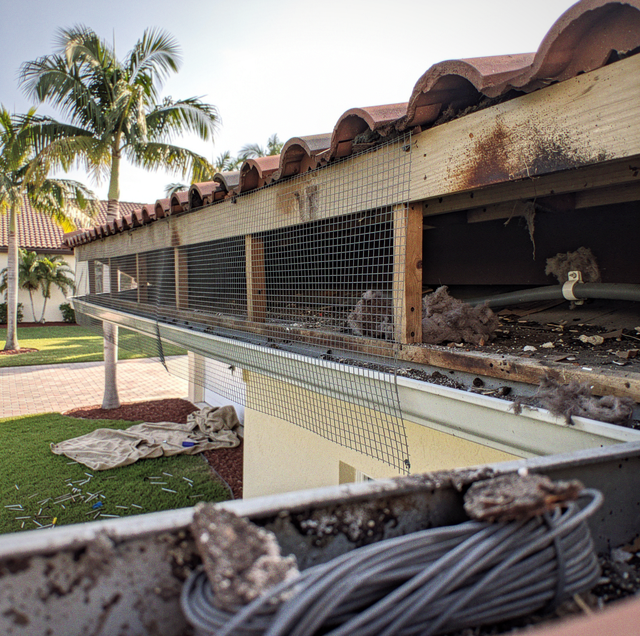
The tile roofs common through Boca Raton, West Boca, Parkland, and Coral Springs make this line matter more than it does on a shingle roof. Barrel and S-tile leave an open void at every course end and along the ridge by design. A scope that says "seal roof gaps" without specifying a closure at each open course end describes work nobody can perform correctly.
Which Openings Are Included and Which Are Left Out
The exclusions line is the one most homeowners never think to ask for, and the one that decides every disagreement that happens later.
Some openings get left out for legitimate reasons: a second-story dormer that cannot be reached safely without different equipment, a vent that is failing and needs a roofer before anything can be fastened to it, a run of soffit too soft with rot to hold a fastener, a detached garage or pool cage that was never part of the walkthrough. Those are not problems on their own. They become problems when they are absent from the paperwork, and the homeowner assumes the whole envelope was handled.
A credible scope lists them out loud: this opening is not included, and this is why. Every opening written up at the start should end with a matching record, closed or named as not closed. When an exclusion is left blank instead, you find out the following month, from the ceiling. If the scope covers the main house only, it should say so in a line rather than leaving you to infer it from what is missing.
Sequence belongs in this same list because the scope has to specify the order in which you are buying: closures before the trap-out, during it, or after it, and which opening is held open as the last exit. A roof rat trap-out commonly runs four to six weeks, and a scope that lists sealing on a single visit with no removal phase attached is describing half a job.
What Happens to What the Rodents Left Behind
Closing openings and cleaning up after an infestation are two separate bodies of work, and the scope should make clear which one it describes.
Droppings, urine staining, nesting debris, and compressed or soiled attic insulation do not disappear when the last opening is packed. A rodent-proofing scope ends at the closures: insulation removal and attic sanitation are separate trade work and are not included in a pest control scope; they are referred out to a remediation contractor who performs them.
Ask any scope you are handed the same question before you sign: does it end at the closures, or does it carry through the cleanup, and if it carries through, which areas are named?
Rodent droppings and dried urine become airborne once the material is disturbed. Attic cleanup calls for respiratory protection, containment, and controlled disposal handled by a remediation contractor, not a shop vacuum and a dust mask on a Saturday.
The Warranty Line and What It Names
A warranty on rodent proofing work attaches to specific openings, not to a house in general. The scope should state which openings the warranty names: these closures, at these locations, performed with these materials.
Limited-term exclusion warranties in this trade commonly run in the 30- to 90-day range. Read what yours says, and ask the company that wrote it what it applies to before you sign.
Who Actually Performs the Listed Work
A scope describes the work and who has to perform it, so the paper should say who. The person on the ladder makes dozens of small judgment calls that never appear in any write-up, such as how deep to pack a soffit void or whether a tile end is truly closed or just visually filled. A scope that names the technician performing the work, and names the same person for the follow-up visits, is a different commitment from one that assigns a route and a date range.
Ask for the license on the paper as well. Florida pest control operators are licensed through the Department of Agriculture and Consumer Services, and that number belongs on the scope alongside the company name.
Frequently Asked Questions
It should. Mice fit through gaps under a quarter inch, so a mouse scope has to name openings a rat scope can reasonably skip: utility chases, gaps behind cabinet toe kicks, the annular space where a pipe passes through a wall plate. It also carries more interior line items because mice nest in living space rather than exclusively in the attic, and the removal phase is shorter, typically two to three weeks.
By interval and by exit condition, not by count alone. Monitoring visits during the removal phase typically fall every seven to ten days, and the scope should say what happens at each one: traps checked and reset, activity recorded, any newly found opening added to the list in writing. It should also state what "finished" means. Activity commonly drops by week two, and most homes are quiet by week four, so a scope ending with a fixed visit count, with no reference to declining activity, is scheduling appointments rather than describing an outcome.
Ask whether the findings get re-verified before work begins. Roof rats reproduce roughly every twenty-one to twenty-five days, so an attic population that was small at the inspection is not the same population a month later, and new gnawing opens new access. A scope that requires a recheck of the opening list at the start of work helps protect its accuracy.
Substantially. A Norway rat problem moves the entire findings list downward: weep holes in block walls, the corner gaps at the bottom seal of a garage door, utility and irrigation penetrations near grade, and gaps under exterior door thresholds. Slab-on-grade construction concentrates most of that work within a foot or two of the ground, and the removal phase is usually shorter than a roof rat job, commonly three to four weeks.
Correctly installed exclusion on a sound building typically holds for ten years or more, far longer than any limited service period attached to it. That gap is normal and not a contradiction: the closures are permanent construction work, and the service term is a service term. The practical consequence is that the material and installation details for each opening deserve more attention than anything else on the page, since that is the part still working a decade from now.
It should say something, because later trades routinely reopen closed lines. A re-roof lifts and resets every tile; solar and satellite mounts create new deck penetrations; a replacement air-conditioning line set opens the wall entry again; and insulation crews disturb soffit packing from the inside. Ask for a line stating whether re-inspection of affected runs after other trades is included or handled separately. Where a roof project is already scheduled, sequencing the exclusion after the roofers rather than before them often saves the entire closure list.
Request a written rodent proofing scope that names every opening — so you know exactly what will be closed, and what will not, before anyone starts. Buggify Pest Solutions serves Boca Raton, West Boca, and communities across Palm Beach and northern Broward. Call Tyler: (561) 672-0200.
