

How Rats Get Under a Garage Door That Looks Sealed
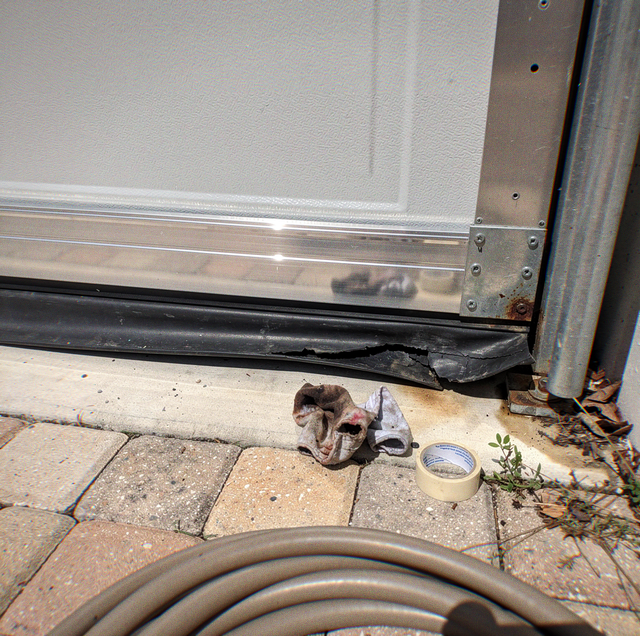
The opening in the garage door at the floor is continuous and runs the full width of the slab. That separates it from every other way into a house. A soffit seam, a vent throat, a pipe penetration at grade: each is a point, findable and closable at one spot. The base of a closed garage door is a line as long as the door is wide, all of it at ground level, and any part of that line can be open while the rest is not. The strip meant to close it is also the part a homeowner rarely inspects, because a door that operates normally reads as a door that is shut tight from anywhere else in the house.
Quick Answer: A closed garage door depends on several parts to block the base: the bottom seal, the slab it meets, the track corners, and the side weatherstripping. Any one can fail on its own and leave an opening a rodent can use.
The Bottom Seal and How It Loses Its Shape
The strip running along the bottom edge of the door sits in a retainer channel fastened to the bottom bar, shaped to flex against the floor as the door lands. The seal is compressed along the same line every time the door closes, and a strip held compressed at the same points for long enough can take a set: a flattened profile that no longer returns to its original shape between closings. A flattened seal can look fine from a standing position and still meet the floor along less of its width than a rounded one would.
Material condition works in the same direction, though it is the better-known half, and not the part that gets missed. Rubber and vinyl are chosen for flex, and both stiffen with sustained heat and sun exposure, at which point the strip stops bending into the small variations in the floor that a supple one follows. Either way, the gap that opens is not usually a torn strip or a piece that fell off. It is a seal still in place, still shaped correctly, that has lost the give it needs to follow the floor.
The Slab Surface It Has to Meet
The seal is only half the contact. The other half is whatever surface it meets, and a garage slab is rarely a perfectly flat plane across the full width of the opening. A shallow crack near a control joint, a patch worn more severely than the surrounding concrete, or a change in level along the line the door lands on all change what the seal is actually pressing against. None of that needs to be dramatic. A seal built to flex into ordinary surface texture can still fail to close over a change in level, and because it lands on the same line every cycle, a change along even a short stretch of that line is enough to hold a gap open where the rest of the run looks fine.
A buildup of leaves, mulch, or grit along one stretch of the bottom seal, more than the rest of the opening, often means that section is held slightly open. Note where it happens rather than clearing it.
The Corners Where the Seal Meets the Track
The horizontal seal at the bottom of the door does not support the entire opening on its own. At each end it meets the weatherstripping running up the vertical track on that side, and that lower corner is a fitted joint rather than one continuous piece of material: the horizontal seal ends at the point the vertical strip begins, and the two are matched to each other on site rather than molded as a single run.
That changes what holds the corner closed. Along a straight section, the seal is engaged with its retainer channel above and the floor below across its whole length, and material is doing the work everywhere along it. At a corner, closure depends on the fitted overlap between two separate pieces staying where it was put, with less material contact holding it than the flat run has. Movement in the door, in its track, or in the frame the vertical strip is fastened to acts on that overlap rather than on the body of either seal.
A garage door operates under spring tension, and its track, cables, and springs are not inspection points for a homeowner. Observe the base of a closed door from a standing position only, and leave adjustment or repair to a licensed garage door company.
None of that has to look broken. Both pieces can be present and intact and still not be meeting each other the way they did when they were fitted.
The Side Weatherstripping Along Each Jamb
Running up each side of the opening is a separate strip, fastened to the door frame rather than to the moving door, sealing the gap between the panel's edge and the jamb it closes against. Because it is fixed to the frame, it is not compressed and released on a cycle, as the bottom seal is. It holds one position, and the panel arrives at it, so what it closes depends on where the panel sits laterally in its tracks rather than on how far the door travels down. The two strips in one opening also age at different rates, unevenly with exposure, so one can still be pliable while the other has stiffened and pulled away from the frame.
A gap along the side runs vertically, which puts most of its length above where a rodent would be moving at ground level, except at the very bottom, where the side seal ends at grade and meets the same low corner the bottom seal's ends are already working.
What a Seal That Looks Fine Still Lets Through
None of the parts above have to be visibly broken to stop working. A seal can hold its shape, show no cracking, and still not touch the floor evenly along its run, because it has rotated slightly within the retainer channel that holds it, presenting a different edge of its profile to the slab than the one it was shaped to seal with. From a standing position, that kind of twist is not something a visual check catches.
A door not seating fully at the bottom of its travel is a separate possibility, and one outside a pest inspection entirely, since the stopping point is set by the equipment that runs the door rather than by anything at the base. The opening looks the same as a worn seal from the ground, for a different underlying cause.
Confirming What Is Actually Open at the Base
Because several separate parts can fail independently, a seal that passes a glance at one section of the opening does not clear the rest of it, and none of these parts is meant to be tested or flexed by hand to find out. Reading the base from a standing position, in daylight and again near dusk, and noting where debris collects along one stretch and not another, or where the seal's profile changes from one stretch to the next, is the extent of what a homeowner check should involve.
Replacing a bottom seal, a threshold strip, or side weatherstripping is not pest control work; a garage door company handles that hardware, the same way it handles the spring and track behind it. The exclusion side of it is confirming whether an opening at the base is already an active route, and closing the openings around it that are pest-exclusion work rather than door hardware, once the door company has the seal itself right.
Frequently Asked Questions
Standing inside a closed garage and checking for daylight along the floor line is a common way to spot a continuous gap, and it reliably shows one running any real distance. What it misses is a gap that opens only under wind pressure against the panel and remains closed in still air, and a section pinned down by trapped debris that blocks light at that one spot while the seal on either side has already lifted.
They are two separate pours finished to two different requirements: the driveway pitched to carry rainwater away from the opening, the garage slab inside finished level, because a level floor is what the space is for. The joint between them is where those requirements get resolved, commonly as a lip, a slight step, or a seam that has opened as the two sections moved independently. The bottom seal has to close over whatever that joint produced, at the one line where the door lands, so a seal meeting clean level concrete along most of the opening can still be crossing a step where the joint runs under it.
A door-mounted seal has to match the floor along the single line where the door closes, compensating for the slab's irregularities on its own, cycle after cycle. A threshold strip glued directly to the slab fills those low spots and levels the transition itself. Hence, the seal above it meets a surface already evened out rather than doing that leveling work with flexible material alone. It also stays fixed rather than traveling with the door, so its wear comes from foot and vehicle traffic rather than repeated flex.
A door left partway up takes the bottom seal off the floor entirely, so the base is not partly closed during that stretch. It is open the full width of the opening, at whatever height the panel is sitting, and the side weatherstripping stops contributing below the bottom of the panel as well, since it is sealing against a panel edge that is no longer there. A garage left open for ventilation or for a pet is in that condition for as long as it stays that way, regardless of the seal's condition.
A side-hinged or carriage-style door swings rather than traveling up into a horizontal track, so its base is a panel meeting a sill rather than a panel guided between two vertical tracks. That removes the track-corner joint as a failure point, but it adds a gap along the hinge side where the panel meets the frame and, on a two-leaf door, a center seam where the panels close against each other, each needing its own seal rather than sharing a single bottom-seal-and-track arrangement.
Seals sold as rodent-resistant are built to put a gnaw-resistant layer between a rodent and the opening while still closing against the floor. What any given product is rated to do is a question for its manufacturer. The distinction worth holding onto is that the material of a seal and the fit of a seal are two different things: a strip rated against gnawing still has to meet the floor along its whole width to be doing anything, and it is the fit, not the material, that a base check is reading.
Schedule a base inspection — know whether the opening under your garage door is already carrying rodent traffic. Buggify Pest Solutions serves Boca Raton, West Boca, and communities across Palm Beach and northern Broward. Call Tyler: (561) 672-0200.
