

Rodent Monitoring vs. Control: What Each One Proves
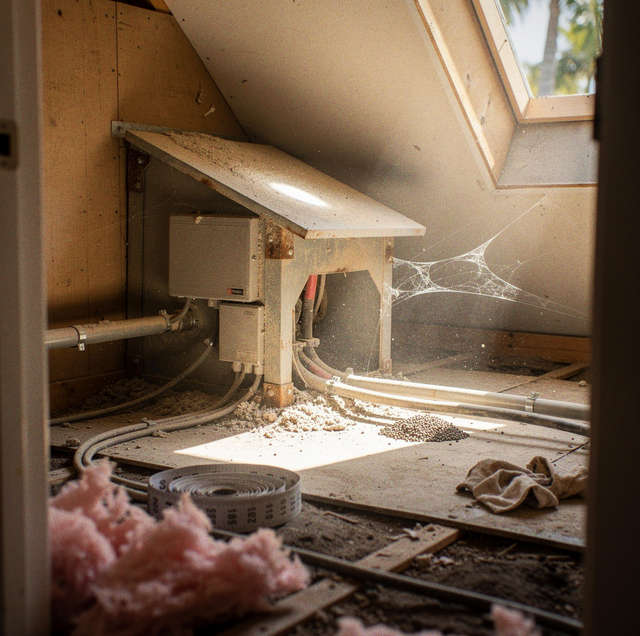
Quick Answer: Monitoring observes whether rodent activity is present at a fixed point; it does not remove anything. Control resolves an active population by trapping the active route out and closing it last. Monitoring produces evidence; control produces a change at the property.
A monitoring point is a small, fixed object placed in one specific location: a marker, a station, or a piece of material, left undisturbed between visits and read on a schedule. Every check produces one result and only one. Something crossed this spot since the last look, or nothing did.
That "yes" or "no" is the entire output. It is also where most of the confusion between monitoring and control begins, because both get described as work on a rodent problem, and only one of them changes what is living in the building. The question worth asking is not which of the two is better. It is what a yes or a no can prove.
The Fixed Point and the Single Result It Produces
A monitoring point holds still, which is most of what makes it useful. It goes to where a route is suspected and then stays in that exact position, so each read it produces is comparable to the previous one. On an active job, those reads come around every 7 to 10 days.
Each read carries three things and no more: a place, the stretch of time since the last look, and a yes or a no. The narrowness is deliberate, not a shortcoming of the method. A point was never meant to describe a property, and the moment it's asked to, it starts producing conclusions it has no basis for. Everything a homeowner actually wants to know beyond those three things has to come from somewhere other than the point.
What a Yes Actually Establishes
An active read is the strongest thing monitoring produces, and it is worth being exact about what it is. It establishes that something used that path inside that window. That is real evidence, and it is enough to carry a decision: a confirmed route is a route worth working, and the question of whether there is anything at all to work on has been settled.
What it does not do is grow into a larger claim on its own. A confirmed route is a confirmed route. Nothing about the crossing has changed because it was recorded, and nothing living in the building is any less there for having been recorded. Monitoring answers the question it was pointed at, and the answer stays the size of the question.
What a Quiet Read Cannot Establish
A no behaves differently from a yes, and the difference gets missed constantly. An active read is evidence that something happened. A quiet read is the absence of evidence at one place across one window, which is a weaker thing.
Two unrelated situations produce identical quiet records. A point sitting on a path nothing has ever used reads quiet. A point on a real route the animals did not cross this week reads quiet too. The record cannot separate them, because a record of nothing looks the same regardless of why there was nothing.
What gives a quiet read meaning is the same point's own earlier reads. Quiet following active is a change, and a change is information. Quiet following quiet is still just quiet. The unit that carries evidence over a run of visits is the shift between reads at one location, not any single read pulled out of the sequence.
A Monitored Attic Can Still Be an Uncontrolled One
This is the practical consequence of the two being separate activities. A property can be monitored on a schedule for an extended period while an active population lives in it the entire time, and the monitoring can work exactly as designed throughout. A point that reads active at every check has observed a population. It has not reduced one. Observing and reducing are different outcomes, and only one of them is produced by looking.
The reverse mistake runs the other way. A property where trapping and sealing have already happened can look, from the outside, indistinguishable from one that was never worked on, because both go quiet. What separates them isn't how often someone visits. It's what the visit is actually for. A visit built around reading a fixed point for evidence is a monitoring visit. A visit built around removing something confirmed to be there, or closing the opening it was using, is control.
Why a Record Cannot Reduce a Population
Control starts from the other side of the same situation. Something is confirmed active; the job is to bring what is living there to zero and keep it there, and the sequence runs trapping-first: the active route gets worked with a trap line until catches stop, roughly four to six weeks for roof rats, three to four for Norway rats, two to three for house mice, with the opening that route was using closed last.
Recording that a spot is active does nothing to what is at that spot. A point can confirm, check after check, that a route is in use. Every one of those confirmations can be accurate. The population is exactly where it was. This is the limit no amount of careful observation gets around. Evidence describes a property. Control changes one.
What Monitoring Is Built For That a Trap Line Is Not
Monitoring's real use sits on either side of an active job rather than in place of one. Before anything is confirmed, a fixed point is a way to test a suspected route without committing to full control work on a hunch. After a job closes out, a point keeps the question open instead of letting the last day of work stand as a permanent answer.
A trap line was not built for that kind of open-ended duty. It is aimed at a specific, resolvable event: an active population expected to reach zero inside a defined stretch, with activity typically dropping sharply by the second week and most jobs quiet by around the fourth. Equipment left running indefinitely against a route showing nothing has stopped doing the job it was placed to do. Open-ended watching is monitoring's assignment, and it was never an assignment a trap line was given.
The Point Where Monitoring and Control Work the Same Job
Most real jobs use both. During an active trap-out, monitoring reads are how progress is measured, and after the last opening is closed, a stretch of quiet reads confirms the seal held rather than leaving it assumed. Both are ordinary uses of the same yes-or-no.
The part worth more attention is what a growing stack of reads gets asked to support. A record kept carefully over a long stretch starts to feel like something was accomplished, because effort went into it. What accumulated is a description. A property with a thorough record and no control work behind it is in the same physical condition as a property with no record at all, and the record does not become work by being longer.
Which of the two a property needs starts with which question is actually open. If it has not been established that anything is there, a fixed point settles that. If it has already been established, another confirmation adds nothing the first one did not already give.
A trap on an active line, or any material showing gnaw damage, is work for whoever services the property. Snap traps trap and hold what they catch, so anything found in one is removed at a scheduled visit, not before.
Frequently Asked Questions
A block with material worked off it records a feeding event: something stayed at that spot long enough to remove part of it with its teeth. A scuffed or disturbed marker records passage only, and passage can be produced by a body brushing past, by a lizard, or by loose material settling. Feeding evidence places an animal at that point with a reason to come back to it. Transit evidence does not.
It brackets it. An active read says the crossing happened somewhere between the previous check and this one, which is a window rather than a night. Two points that both read active in the same window cannot be ordered relative to each other, so a record cannot establish that one route went active before another. Anything finer than the interval between checks sits outside what the method can produce.
No. A point sits on a travel route, and travel routes run through the inside of a structure well away from wherever the animals are getting in. Evidence that something crossed a beam is not evidence about a hole. Locating an opening is an inspection finding, reached by examining the building itself, not something a yes-or-no at a fixed point can provide.
Because gnaw damage stays. A chewed edge is a standing mark: it reads the same at the next check and the one after, whether or not anything has been back to it. Unless it is noted and dated the first time it is seen, it keeps registering as new. The results that carry a window are the ones that reset between checks, which is why a damaged edge is treated as history rather than as this visit's answer.
No. A crossing has no direction recorded in it. Two points that both read "active" establish that both paths are in use; they do not connect into a line of travel, and neither one indicates whether the animal was heading toward a food source or away from one. Direction is something other evidence along a route can suggest, but it is not contained in the result of an individual point.
Not on its own. A crossing establishes that a path is being used, which fits an animal nesting inside the structure and an animal that comes in, moves along, and leaves again. Residency is established by nesting evidence, which is a separate class of finding: material gathered into a cavity, staining, and use concentrated in one spot instead of spread along a line.
Tell Tyler what you have actually seen at your property — he will say whether this warrants a monitoring point at all or is already control work. Buggify Pest Solutions serves Boca Raton, West Boca, and communities across Palm Beach and northern Broward. Call Tyler: (561) 672-0200.
