

Why Boca Raton's Tile Roofs Create a Roof Rat Problem
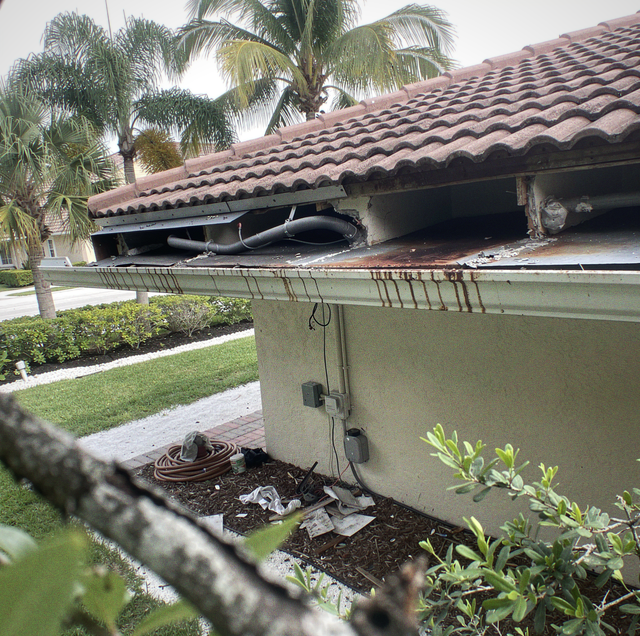
Quick Answer: Concrete and clay tile sit above the roof deck rather than flat against it, leaving a continuous run of dry, shaded void under each course. Roof rats nest above grade, and that void gives them somewhere to do it.
Set a barrel tile on a roof deck, and it does not lie flat. The profile curves, each course overlaps the one below it, and battens or adhesive pads hold the piece clear of the deck surface. What that leaves, repeated the length of every course on the roof, is a run of enclosed air between the tile and the deck: dry, shaded, and sheltered from the weather hitting the tile above it. Nothing about that space was built to be occupied. It works as harborage anyway, and it is the reason a roof rat problem on a tile-roofed house concentrates where it does.
The Air Gap a Tile Course Leaves
Concrete and clay tile are set over batten strips or foam adhesive pads, which sit over an underlayment sheet, which sits over the deck. That stack keeps water moving down the roof and off the edge, and it does that job well. It also means the tile is a shell held clear of the surface underneath it rather than a skin bonded flat to it.
The space that shell encloses runs in the same direction as the course, parallel to the eave, across the width of the roof plane. A curved profile encloses more of it than a flat one, though a batten grid holds either kind clear of the deck. Either way, the volume is there before anything cracks, slips, or ages, because holding the tile clear of the deck is how the assembly was meant to work in the first place.
Why That Void Reads as Harborage
Harborage and entry are two different things, and on a tile roof the same feature does both jobs, which is why they get treated as one problem far more often than they should be. An entry point is an opening an animal passes through. Harborage is somewhere it can sit, rest, and raise young without being exposed.
The void under a tile course is dry, because the tile above it is doing exactly what it was made to do. It is shaded, and the mass of the tile moderates a temperature swing that a shingle surface passes straight through. It is enclosed at the sides. It sits well above grade, away from most ground-level pressure. And it runs continuously enough that an animal inside it can move without stepping into the open. A ground-burrowing Norway rat has no use for any of that. A roof rat, which nests above grade by preference, will use it as soon as it can reach it, and the ends of the courses are open where they terminate.
Where the Nest Settles Once the Void Is Occupied
The void and the attic are separate spaces with the deck between them, and a roof rat using one usually finds its way to the other. Attic insulation is better nesting material than bare underlayment, and an attic is quieter than a surface that heats and cools with the sun. So the nest tends to settle inside the attic, close to whichever point on the deck connects to the void the animal was already using, rather than out in the middle of the attic or down in a wall void mid-house.
Travel from the void to the nest stays short by preference rather than by accident. The animal already had shelter overhead and no reason to cross the open attic in search of more of it.
Roof rats reproduce every 21 to 25 days, so the weeks between a first night noise and a placed call are not cosmetic. They are another litter in the same tile void, working the same entry point.
That reproductive pace is why nest location matters for planning, not just for description. Weeks of activity along one edge of a ceiling while sets sit somewhere else entirely is the ordinary version of a job that runs long.
How Trap Placement Follows the Void
The tile void itself is not trappable space. It sits above the deck, outside the attic, on an angled surface at roof height, and nothing gets set into it. What the void does is tell placement where to concentrate within the attic, which is the space that can actually be worked on.
Sets concentrate along the attic perimeter, at the points where the deck meets the top plate and where the connection from the void into the attic actually lands, rather than spaced evenly across the insulation field the way a general sweep of an attic would put them. That perimeter is where travel is, because it is the shortest line between the void and the nest. Snap traps trap and hold rather than release, so kills are found during monitoring visits rather than left to be found later, and those visits run every seven to ten days. Activity typically drops sharply by the second week when placement matched the actual route, and most jobs read quiet by around week four. A roof rat trap-out generally runs four to six weeks start to finish, longer than a job at grade takes.
When placement misses the route, the schedule shows it before anything else does. Untouched sets visit after visit, while the noise overhead keeps coming from one consistent stretch of ceiling; is placement working the wrong end of the building?
Do not climb a ladder or walk the tile looking for gaps or activity. Watch instead for droppings, grease marks, or chewed material visible from the ground, and leave the roofline itself to a licensed technician.
Ground-Level Routes the Same Roof Does Not Rule Out
A tile roof overhead does not completely close the ground-level path. Slab-on-grade construction is standard throughout this part of Florida, with no basement offering the burrow-friendly void that older housing stock elsewhere in the country provides to a ground rodent, so the option at grade starts out thinner here than in other markets. West Boca and Parkland do both include stretches of canal-adjacent lots, and canal corridors put a parallel pressure in play closer to grade, a pattern that plays out on its own terms and is covered separately.
Away from canal frontage, the harborage above the deck is simply better than anything on offer at grade, and the animal that ends up resident is the one built to reach it.
Boca Raton, West Boca, and Parkland Share One Roof Detail
Concrete and clay tile were carried across a long run of residential growth in this part of Palm Beach and northern Broward for reasons unrelated to rodents: appearance, wind rating, longevity. Established Boca Raton sections, West Boca's mid-generation subdivisions, and Parkland's newer developments do not share a build generation, and they do differ in fascia and soffit detailing, in underlayment, and in how much movement and patchwork has accumulated at the eave.
What they share is the void, because the void comes from holding tile clear of a deck, and that part of the assembly has not changed. It is why the same harborage argument holds on a recent Parkland build and an established Boca Raton one alike rather than stopping at a city line.
Closing a tile-roofed house means closing the connections between that void and the attic, one confirmed opening at a time, with copper mesh packed in and sealed over with polyurethane. The void stays where it is. It was part of the roof before anything moved into it and it will be there afterward; what changes is whether it still opens onto the attic.
Frequently Asked Questions
A shingle roof does not hold a shell clear of the deck the way tile does, so a single shingled home standing inside an otherwise tile-roofed section can go untouched by a resident nest even while roof rats stay active two doors down. The population is following the roofing material, not the street.
It changes the shape of the void more than its existence. Adhesive-set tile is bonded to pads placed along each course, so the space underneath is broken into pockets between those bond points rather than left as a single clear channel. Batten-set tile leaves a channel running parallel to the eave with the batten as the only interruption. One practical consequence: an opening found at one end of an adhesive-set course says less about the rest of that course than the same finding on batten-set tile does.
Yes. A second-story roofline sits above where most canopy actually makes contact, so on a two-story home an attached structure such as a garage roof or a utility line carries more weight than tree contact does. Older single-story sections of Boca Raton, built close to mature canopy, put tree contact back into the picture in a way a newer two-story property usually does not.
A screened pool enclosure features an aluminum frame that runs continuously from the perimeter planting to a beam near the main roofline, functionally extending the roof edge outward. That attachment beam gets treated as part of the roofline to account for it, even though the space underneath it is screened rather than living space.
It is the layer between the void and the deck, and its condition decides whether harborage overhead stays overhead. A sheet still lying tight to the deck keeps the void a feature of the roof surface. A sheet gone brittle and lifted at its seams or fastener lines gives an animal already inside the void an edge to work at, and an edge is all it takes for a space above the deck to connect to the space below it. Newer tile roofs generally go down over a synthetic sheet that stays flexible longer than older felt did, which is a real difference between two roofs carrying the same tile profile.
It changes the shape of the activity more than the location. Barrel or mission profile tiles tend to support one long stretch of use along a course, so signs concentrate in a single continuous band. Flat-profile concrete tile more often produces shorter, interrupted stretches spread across a plane rather than tracking a single line, which makes narrowing down to a single suspect run harder on flat tile than on barrel.
Schedule a roof-rat inspection — find out which openings between the tile void and your attic are still connected. Buggify Pest Solutions serves Boca Raton, West Boca, and communities across Palm Beach and northern Broward. Call Tyler: (561) 672-0200.
