

How German Cockroaches Actually Get Into a Clean House
Quick Answer: German cockroaches almost always arrive as hitchhikers, not from a dirty home. Cardboard, secondhand items, moving boxes, and shared plumbing walls are the common carriers. Matching when trouble started to what recently entered the house usually points to the source.
You didn't leave food out overnight. You keep the counters wiped down and the trash on schedule, and you still walked into the pantry, flipped on the light, and watched a light brown roach with two dark racing stripes behind its head disappear behind the cereal boxes. The instinct that follows is almost always the same: it must be something you did. Usually it isn't. German cockroaches are one of the few household pests that rarely walk in on their own. They ride in, hidden inside something that came through the front door, and figuring out which something it was has a lot less to do with your housekeeping than with a short list of recent events in your house.
Think of it less as a mystery and more as a handful of usual carriers, each with its own timing and its own tell. A German cockroach infestation almost never arrives with an obvious entry event the way a moth flying through a screen door does. But when you first noticed activity, and where in the house you noticed it, usually lines up with one route more than the others. Walking through the real routes one at a time, and checking each against your own last month or two, gets you closer to an answer than guessing does.
Start With the Timeline, Not the Kitchen
American and smokybrown cockroaches, the two species most people in South Florida picture, keep colonies outdoors in mulch beds, palm thatch, and storm drains, and they wander in on their own when the weather or the yard pushes them toward a house. The German cockroach doesn't operate that way. It's built for indoor life: it needs the steady warmth and humidity a kitchen or bathroom provides, and it doesn't survive long stretches outdoors the way its outdoor cousins do. Because it can't establish itself in a yard and then migrate inward, nearly every German cockroach in a home got there attached to, or riding inside, something a person carried across the threshold.
That reframes the question. Instead of hunting for a gap in the exterior wall, the more useful question is what came into the house in the weeks before you first saw activity. A grocery run, a piece of used furniture, a move, a load of laundry from a shared facility, and a shared wall with another unit are the routes that show up again and again, and each one leaves its own timing signature behind.
The Grocery and Delivery Route
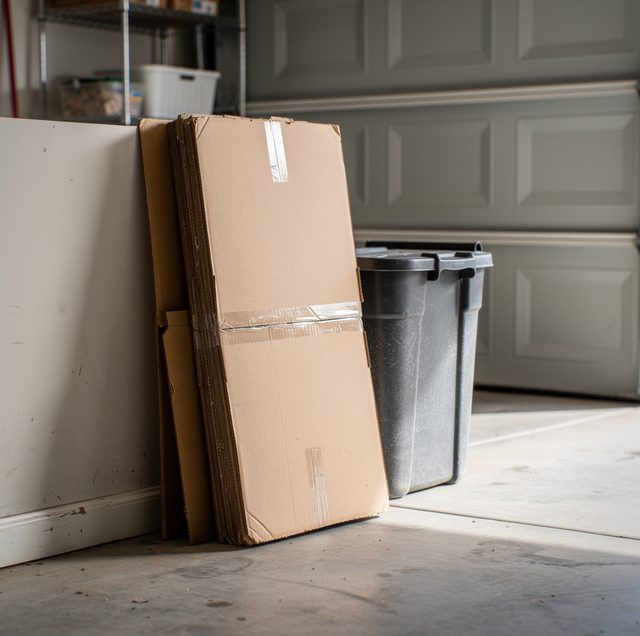
Corrugated cardboard, the fluted layer sandwiched between two flat liners, is close to ideal roach habitat: dark, insulated, and able to hold humidity longer than open air. A German cockroach egg case, or a live nymph, can end up wedged into that fluting at a grocery distribution warehouse, a big-box store's stockroom, or a restaurant's kitchen long before the box ever reaches your kitchen. Wholesale-club flats, cereal and cracker cartons, and the shipping boxes that come with an online order all pass through the same kind of high-traffic storage before they get to you.
The riskiest moment usually isn't the delivery itself. It's what happens to the box after: flattened cartons stacked in a garage awaiting recycling day, or empty delivery boxes left in a laundry room or pantry corner instead of broken down and taken out promptly, give anything that traveled in the fluting time to walk off the cardboard and into a nearby crack. Activity started within a week or two of a grocery stock-up, a bulk online order, or a habit of stacking flattened boxes for later use: that timing points squarely at this route, especially if the first sighting was in the kitchen or pantry, near where boxes are opened.
The Secondhand Route
A used refrigerator, window air-conditioning unit, microwave, or toaster oven bought off a marketplace listing or picked up at an estate sale carries risk in places you wouldn't think to check: the compressor housing and rear coil compartment on a fridge, the wiring bundle behind a microwave's control panel, the crumb tray void under a toaster oven's heating element. Any of those stay warm, dark, and undisturbed, which is exactly the profile a German cockroach looks for, and an appliance that sat idle in someone's garage or a resale warehouse for weeks before you bought it had plenty of time to pick up a hitchhiker.
Secondhand furniture carries a parallel risk. Particle-board pieces with hollow leg and frame cavities, and upholstered furniture with a stapled dust cover on the underside or a recliner's mechanism housing, all give a roach somewhere to ride that isn't visible at a quick glance. The first sighting was on or right next to a specific used appliance or piece of furniture, not scattered around the house: that's the strongest sign this is the route, and it's worth mentioning that item specifically if a technician comes to inspect.
The Moving Route
Moving reintroduces the cardboard problem at scale. Boxes that get reused from a liquor store, a previous move, or a friend's basement carry whatever picked up a passenger in their last life. Boxes staged in a garage for the weeks leading up to a move sit exactly where a roach population already established there can climb in before the truck ever arrives. A rented moving truck or a self-storage unit adds another layer: neither one gets cleaned out between renters, and a unit or truck that carried a previous customer's infested boxes can pass that population on to the next load without anyone noticing until weeks later.
This applies whether the home you moved into is new or decades old; it's a different mechanism than the construction-phase pressure a brand-new build carries in its first year, which comes from a different set of sources entirely. Activity started within the first few weeks after moving in, or right after unpacking boxes from a storage unit or a rented truck: that timing points to this route regardless of the house's age.
The Shared-Building Route
Two carriers here don't involve any object crossing your threshold at all. A shared laundry facility, whether it's a coin-op room in an apartment or condo building or a laundry area attached to a clubhouse, puts a hamper or laundry cart on the same floor as the warm, humid machines dozens of other households use. A German cockroach can climb into a laundry basket or ride in the folds of clothing pulled from a shared washer, particularly one with a front-load door gasket that stays damp between cycles.
The other shared-building carrier is structural, not something anyone carries. Townhomes, condos, and duplexes across the region's HOA and master-planned communities share plumbing chases behind back-to-back kitchen and bath walls, shared electrical conduit runs, and in some layouts a common attic above an entire row of units. A German cockroach population established in one unit can move through those shared voids into a neighboring one without a single box, appliance, or delivery involved, and a well-kept unit next door to a problem unit gets no protection from that path just for being tidy. No clear starting event, a gradual buildup instead of a sudden sighting, and you live in a building with shared walls, a shared laundry room, or a shared attic: that combination points here more than any of the routes above.
Matching the Timeline to the Source
None of these routes are mutually exclusive, and more than one can line up at once. Someone who moves into a townhome and furnishes it partly with secondhand pieces in the same month is stacking two carriers on top of each other, and there's no way to rule one out just because the other is also plausible. What matters more than landing on a single confirmed cause is narrowing the list enough to know where to start looking, and to know that a search is worth doing at all rather than assuming the answer is something wrong with how the house is kept.
That narrowing also has practical value beyond your own peace of mind. Telling a technician which route seems most likely- a specific used appliance, a recent move, a shared laundry room- gives an inspection a starting point instead of a blind walk-through, and it usually shortens how long the visit takes to find the actual harborage.
Frequently Asked Questions
A German cockroach can flatten its exoskeleton enough to pass through an opening of about 1/16 inch, roughly the thickness of a dime standing on its edge. Plumbing and electrical penetrations through a shared chase almost never seal that tightly on both sides, even in a well-built home, which is why the shared-wall route doesn't require any visible gap to work.
Yes, and faster than most people expect. Under the warm, air-conditioned conditions typical of a South Florida kitchen, a German cockroach nymph can reach reproductive maturity in as little as six to eight weeks rather than the several months it might take in a cooler climate, so a single mated female that rode in unnoticed has time to become a visible problem well within a season.
The quarantine matters more than the inspection. Park the piece in a garage, a carport, or on a lanai for a few days first, on a hard floor rather than carpet, with a couple of sticky monitor traps set flat against its base. A monitor catches what a flashlight pass misses, because a nymph wedged in a wiring cavity will not walk out while someone is standing there looking at it. Anything that had to come apart for transport, a recliner mechanism or a refrigerator kick plate, is worth leaving apart until that window has passed.
A vehicle is the more realistic host of the two. An attached garage swings too dry between door cycles to hold a colony for long, but a car parked in one holds warmth, dropped food, and tight upholstery and trim seams, and a vehicle that regularly hauls groceries or a work cooler is a route almost nobody checks. If activity keeps restarting weeks after an indoor treatment with no other explanation, the car in the driveway is worth a flashlight pass under the seats and along the trunk liner.
Not permanently, and not elaborately. Two habits carry most of it. Open boxes at a table or out in the garage instead of on the kitchen floor, so anything riding in the fluting does not land next to a toe-kick. And decant pantry staples into rigid containers rather than leaving cereal, cracker, and pasta cartons on the shelf in their original packaging, since the corrugated carton is the part that holds humidity and offers harborage, not the food sealed in the bag inside it.
The vector doesn't always trace back to your own household. In a resale home or a rental, a previous occupant can leave behind a population that goes dormant during a vacancy, especially if the air conditioning was off or set high while the home sat empty, and it resurfaces once the house is reoccupied and warms back up. If nothing on this list fits, that older, pre-existing source is worth asking about.
The shame that follows a roach sighting doesn't match the actual mechanics of how this species operates. A German cockroach isn't judging your kitchen; it's following a ride, the same way it always has, into whichever house happens to receive the box, the appliance, or the shared wall next. Treat the sighting as a logistics question with a real answer, not a verdict, and the next step becomes much more useful.
Trace the entry point instead of guessing — a source-first German cockroach inspection finds where they got in and treats the harborage directly. Buggify Pest Solutions serves Boca Raton, West Boca, and communities across Palm Beach and northern Broward. Call Tyler: (561) 672-0200.
