

Huntsman Spiders in Florida: Startling, Not Dangerous
Quick Answer: A huntsman spider is a large, fast, flattened brown spider that can move sideways almost as easily as forward. It looks alarming on a garage wall, but it rarely bites, and repeated sightings usually mean roaches or silverfish are nearby.
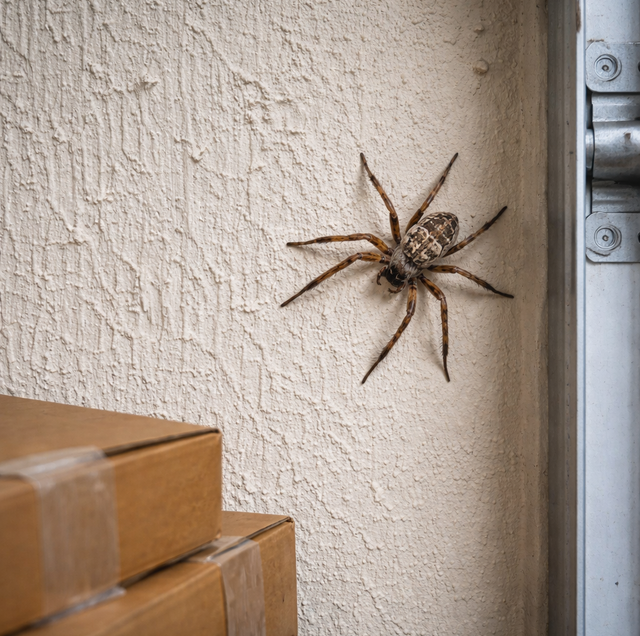
You flip on the garage light and something the size of your open hand is flattened against the wall by the door, legs splayed out at an angle no other spider quite manages. It doesn't scurry away in a straight line the way most startled bugs do. It slides sideways, fast, and disappears behind a stacked box or into the gap around the door track before you've fully processed what you saw. That combination, the size, the speed, and the sideways glide, is close to a signature. In South Florida, it almost always means a huntsman spider.
The huntsman's whole reputation rests on that first jolt of seeing one. It is one of the larger spiders actually likely to turn up inside a home here, and it moves faster and more unpredictably than almost anything else that shares the space. None of that makes it dangerous. What it does mean is worth fifteen minutes to understand, both to stop dreading the garage after dark and to catch what a huntsman on the wall is usually trying to tell you about what else is living there.
What a Huntsman Spider Actually Looks Like
The species most commonly behind a Florida garage sighting is *Heteropoda venatoria*, the pantropical huntsman spider, a member of the family Sparassidae. Body length runs about an inch (2.2 to 2.8 cm), but the leg span is what does the visual damage: 3 to 5 inches (7 to 12 cm) tip to tip, according to the University of Florida's IFAS Entomology and Nematology department. That's roughly the width of a coffee mug lid, spread across a wall in the dark.
Color and shape: brown, sometimes with mottled or slightly banded markings, and distinctly flat. The flattened body isn't incidental; it's what lets a huntsman squeeze into gaps most spiders can't reach, behind picture frames, into screw holes, under stacked cardboard, and into the narrow void behind garage shelving.
Speed and leg posture: rather than building a web to trap prey, a huntsman relies on raw speed and strong chelicerae (jaws) to run insects down. Sparassid legs are also rotated forward at the joint, a trait of the huntsman family more broadly, which lets the spider move sideways or even backward almost as fast as it moves forward, closer to a crab's gait than a typical spider's straight-line scramble. That sideways burst off a vertical wall is usually the single most disorienting part of an encounter.
Behavior: huntsman spiders are nocturnal hunters that spend daylight hours tucked into a tight, shaded gap and become active after dark, which is why one seems to appear out of nowhere the moment a garage light comes on. Outdoors in frost-free parts of Florida, they're established year-round in groves, mulch beds, and under loose bark; indoors, IFAS lists furniture undersides, cabinets, wall hangings, closets, and garages as the typical hiding spots.
A wolf spider hunts open ground and can't move sideways off a wall. A huntsman's rotated leg joints let it dart sideways across a vertical surface almost as fast as forward, the faster tell indoors.
Is a Huntsman Spider Dangerous?
No, not in any medically meaningful sense. IFAS describes the pantropical huntsman as not dangerous to people, despite its size and speed, which can make it feel otherwise. The venom it carries exists to subdue the insects it chases down, not as a defense built around anything human-sized.
A bite is uncommon and typically occurs only if a huntsman is handled carelessly or gets trapped against skin, inside a shoe, a folded towel, or a glove left on a workbench overnight. When it does happen, IFAS characterizes it as a locally painful bite, sometimes with noticeable swelling, comparable in most cases to a bee sting rather than anything requiring emergency care.
Verdict: the size and the sideways speed are doing all the emotional work here. A huntsman spotted once on a garage wall, even a big one, is not a hazard to treat like an emergency. It's a startle, not a threat.
The Real Reason It's on Your Wall
A huntsman spider doesn't come inside a garage looking for a person to bother. It comes in following food, and what it's hunting is the actual point worth paying attention to. IFAS lists cockroaches among its primary prey, and huntsman spiders are opportunistic enough to also take silverfish, moths, and other soft-bodied insects that turn up in the same cluttered, low-light spaces a garage tends to accumulate.
Cardboard boxes stacked on a bare slab, a door sweep with a gap under it, a little standing moisture near a water heater or washing machine connection: those are the exact conditions that let a roach or silverfish population establish itself quietly, and they're also exactly what draws a hunting spider that doesn't need a web to make a living. A single huntsman crossing the wall on trash night is unremarkable. A huntsman that keeps reappearing in the same section of the garage, night after night, is behaving like an animal with a reliable food source nearby, not one that wandered in once and got lost.
That's the piece most people miss while they're focused on the spider itself. Addressing the prey-insect source is part of a spider-control visit, not a separate service, because clearing the spider without addressing what's feeding it just means another one moves in behind it within a week or two.
What Repeated Sightings Usually Mean
One huntsman spider on a garage wall, even a startling, hand-sized one, isn't a structural problem. It's a fast, flat, nocturnal hunter doing exactly what it does outdoors, just inside a space that happens to give it easy cover and, more often than not, something worth eating. What separates a one-off sighting from a pattern worth acting on is repetition: the same wall, the same corner, multiple nights in a row. At that point the useful question stops being "how do I get rid of this spider" and becomes "what's it actually finding back there," because that second question is the one that keeps the answer from walking back in.
Frequently Asked Questions
Size and leg span are the fastest visual tell, but body length is the fair comparison: a huntsman's body runs about an inch (22 to 28 mm), close to the top end of the 10-to-25-millimeter body length typical of a wolf spider found indoors, not dramatically longer on its own. What actually makes a huntsman look so much bigger is the 3-to-5-inch leg span stacked onto that similar-sized body, a spread a wolf spider's shorter, more upright legs don't produce.
Not in the way a jumping spider does. A huntsman doesn't have the specialized muscular legs built for a true pounce; what it has is a burst of sideways-and-forward speed off a rotated leg joint, which can look like a lunge in the split second someone spots it. That speed evolved to close distance on fleeing insects across a wall or ceiling, not to cover ground toward a person.
The bite itself is rarely the real concern in a garage: roaches and silverfish, the huntsman's actual prey, don't bite at all, which makes the spider crossing the wall the least dangerous thing back there. If a bite does happen, wash it with soap and water, use a cold pack wrapped in cloth rather than ice straight on skin, and skip cutting, sucking, or tourniquet folk remedies, none of which do anything for a bite this mild. Redness that spreads or a fever over the following day points to a skin infection, not venom, and is the actual reason to see a doctor.
Females carry a flattened, disc-shaped egg sac tucked beneath the body rather than depositing it in silk, guarding it directly until the spiderlings emerge. That's a different strategy from a common house spider, which leaves its egg sac anchored inside the web itself, or a wolf spider, which tows its sac attached to the rear of the abdomen instead of underneath.
A huntsman that finds a productive hiding spot, a gap with steady access to roaches or silverfish, usually stays within that same general area for an extended stretch rather than moving around the garage night to night, since there's little reason to abandon a working food source and shelter. That's the practical difference between a fresh sign and an old one: repeated activity in the exact same corner points to one spider still working that territory, while a single sighting weeks apart, with nothing in between, is more likely to mean a different individual passed through once and moved on.
It helps more than most people expect, though it isn't the whole fix. Cardboard holds moisture and the starch-based adhesive in its corrugation, both of which are exactly what draws and sustains roaches and silverfish, so it's worth tackling in order: get cardboard up off the slab and onto shelving first, since it's the single biggest combined moisture-and-food source, then clear anything stacked directly against a wall where a spider can wedge in behind it, and deal with standing moisture last. Most homeowners who declutter this way notice fewer sightings within a few weeks, though it won't close an entry point a spider or its prey is already using elsewhere on the structure.
Get the huntsman activity on your wall identified, and the roach or silverfish source behind it addressed — Buggify's Spider Control includes assessing what's actually feeding an active population, not just what's visible on the wall tonight. Buggify Pest Solutions serves Boca Raton, West Boca, and communities across Palm Beach and northern Broward. Call Tyler: (561) 672-0200.
