

Are Roof Rat Droppings Dangerous? What Is Actually Known
Quick Answer: Public health agencies associate rodent droppings, urine, and nesting material with several illnesses, and the route CDC and the Florida Department of Health emphasize as occurring indoors is airborne. Their guidance agrees on one point: do not disturb the material.
Search the question and the answers arrive at full volume: disease names you have never heard of, worst-case outcomes, photographs of people in respirators. Read what public health agencies publish about the same material and the volume drops. Several illnesses on those lists reach people by routes that have nothing to do with an attic. What follows is what the CDC and Florida's health department actually say, and where the line falls between a pest problem and the material left behind.
What the Material in an Attic Actually Is
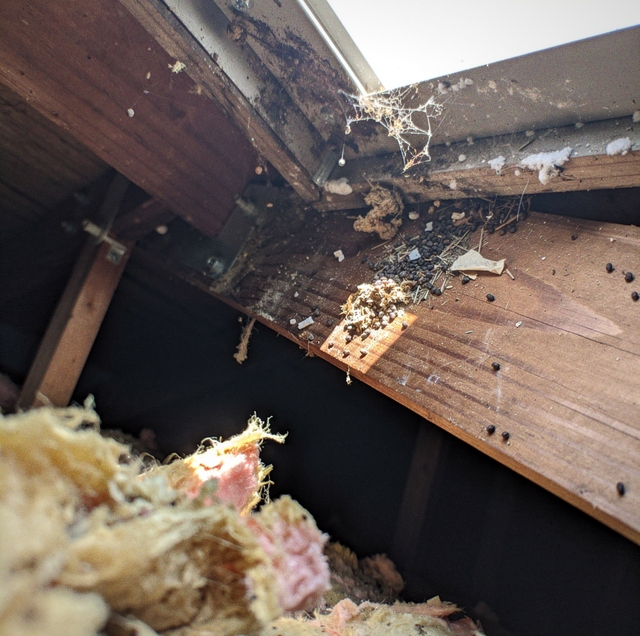
Droppings are the part a homeowner sees. Public health guidance treats them as a single item in a set: the CDC's rodent pages list droppings, urine, and nesting material together in nearly every sentence about exposure, and Florida's health department groups them the same way. Nesting material is shredded insulation, paper, and plant fiber that has been in contact with an animal for the life of the nest.
Accumulation concentrates along the runs rodents repeat night after night and is heaviest at nesting points tucked into insulation rather than out in the open, which is why a look from an open hatch understates what is there. (Reading which species left it is a separate question, and the species identification article covers it.) An attic is warm and enclosed, and nothing washes anything away, so older layers dry out. Florida's health department frames the precaution around dust, advising against activities that raise dust where rodent material is present.
What Public Health Agencies Associate with Rodent Droppings
Two lists are worth separating: illnesses associated with rodents, and what dried droppings in an attic are associated with.
The CDC counts breathing contaminated air and eating contaminated food among the direct routes: droppings, urine, and saliva "can spread by breathing in air or eating food that is contaminated with rodent waste." What CDC classes as indirect spread is a different thing — ticks, mites, and fleas that fed on a rodent, and intermediate hosts such as beetles or cockroaches. The illnesses listed on those pages include hantavirus, leptospirosis, lymphocytic choriomeningitis, salmonellosis, rat-bite fever, and plague; both the CDC and Florida's health department list rat lungworm.
Routes that do not run through attic droppings: Rat lungworm, in the CDC's wording, is something people get "by eating raw or undercooked snails or slugs." Leptospirosis spreads through the urine of infected animals, with the bacteria surviving in contaminated water or soil, which points to wet ground rather than a dry attic.
Routes that do involve droppings and urine: The CDC ties lymphocytic choriomeningitis to the house mouse and is specific about the condition: exposure to "fresh urine, droppings, saliva, or nesting materials from infected rodents." Salmonellosis is associated with contaminated food and surfaces. Rat-bite fever belongs here as well: alongside scratches, bites, and contact with saliva or urine, the CDC says it can spread "by having contact with contaminated materials... or eating or drinking contaminated food or drinks," and Florida's health department says people "may also become ill after eating food or drink contaminated with rodent droppings."
None of that makes an attic accumulation harmless. It does mean the accurate answer is narrower than the search results suggest.
Hantavirus, and What the Florida Picture Looks Like
The CDC states that people get hantavirus from contact with rodents, particularly their urine, droppings, and saliva, and that "the deer mouse spreads the most common hantavirus that causes HPS in the United States." Florida's health department states that hantavirus "is present in rodents throughout the U.S., and has been identified in cotton rats in Florida," says most human cases have occurred in the western United States, and, on its rodent pages, notes that only one human case has ever been diagnosed in Florida.
So the reservoir the CDC names behind US cases is not the roof rat, and the species Florida's health department reports it in is the cotton rat, which its pages describe as identified in Florida rather than as the animal typically found in a tile roof. None of which is a reason to handle attic material casually, since the guidance on disturbance is written for rodent material generally rather than for any one illness.
What Changes Exposure in an Attic
Public health sources do not treat every accumulation as equivalent, and the variables they distinguish are conditions rather than quantities.
Fresh against old: The CDC's wording on lymphocytic choriomeningitis specifies fresh material, while broader cleanup guidance is written for material of unknown age, the realistic case in an attic.
Enclosed against moving air: Every route the agencies emphasize for material in a space like this is airborne, so what the air is doing matters more than what the surfaces look like.
Whether the attic shares air with living space: Penetrations for wiring, plumbing, recessed fixtures, and duct chases all cross the ceiling plane, and how well each is sealed varies house to house.
What none of this supports is a probability figure. Agencies publish exposure routes and precautions, not odds for a given household. A question about an exposure that has already happened belongs with a clinician.
Why Disturbing Dried Material Is the Specific Concern
The most consistent instruction across public health sources here is not to stir the material.
The CDC states it directly: "Don't vacuum or sweep rodent urine, droppings, or nesting materials. This can cause tiny droplets containing viruses to get into the air." The same guidance notes these diseases "are mainly spread to people from rodents when they breathe in contaminated air." Florida's health department describes hantavirus infection as occurring when a person breathes in virus-containing particles "from rodent urine, droppings, or saliva that are stirred into the air."
The disturbances that matter are ordinary ones: stored boxes pulled out of an attic, a shop vacuum, an insulation crew or a roofer working in a space nobody warned them about, a ceiling fixture pulled down from the room below. None of those look like handling droppings, and all of them move air through the material.
Do not send anyone into a contaminated attic to tidy it before it has been assessed. Public health guidance makes it clear that disturbance, not contact, is what puts particles into the air.
Where a Pest Scope Ends and Remediation Begins
Two trades are involved here, and only one of them is pest control.
A rodent scope covers the animals and the building envelope: inspection to establish where they are getting in and where they are active; exclusion to close those openings; a trap line along the route, deliberately left open; and monitoring until the catches stop. Roof rats generally run four to six weeks from the start of trapping, with monitoring visits every seven to ten days and activity dropping sharply by the second week.
The material is still there. Removing it, sanitizing surfaces, taking out and replacing contaminated insulation, and dealing with affected ductwork: that is remediation, a separate trade that is not included in a pest control scope. Attic sanitation, insulation removal, and ductwork go to a remediation or HVAC contractor.
Order matters. Florida's health department states that "rodent infestations should be dealt with promptly by a professional pest control company," and that remediation carried out while the entry route is still open pays off, as it will be cleaned again. The rodent work runs first, the attic is confirmed quiet, and remediation follows.
Frequently Asked Questions
It changes what the air in that space is doing. A conventionally vented attic exchanges air with the outdoors through soffit intakes and a ridge or off-ridge exhaust, and is not built to share air with the rooms below. An unvented conditioned attic, created when foam insulation goes on the underside of the roof deck instead of at the ceiling plane, sits inside the thermal envelope and is designed to share air with the house. Same droppings, different relationship with the indoor air.
Public health guidance singles this case out. The CDC's rodent cleanup guidance directs people to contact a professional rodent exterminating service when there is evidence rodents have accessed heating and cooling ventilation systems. An air handler moves return and supply air through the house whenever it runs. Material found on or around one, in a return chase, or in duct insulation belongs in front of an HVAC or remediation contractor as well as the pest company.
It affects how much attic air ends up in the room below. A hatch or pull-down stair is a large penetration in the ceiling plane, and unlike a wiring or plumbing hole, it gets opened on purpose. A gasketed, weatherstripped, latched cover is designed to slow air exchange across it; an uninsulated panel resting loose in a frame is not. Opening a hatch into a contaminated attic also moves attic air down into the house.
It matters mostly to the remediation scope rather than to the exposure question. Fiberglass or mineral wool batts sit as discrete pieces and can be lifted and bagged as units, so an affected area can sometimes be addressed on its own. Blown loose-fill, whether fiberglass or cellulose, has no such boundaries, and contaminated material cannot be separated from material that is clean, which is why loose-fill attics more often lead to removing and replacing a whole area.
Different questions entirely. A pest technician establishes whether rodents are active, where they are getting in, and what has to be closed. A remediation assessment picks up there and looks at the material: how far it extends, how deep into the insulation it has worked, whether the insulation can be cleaned in place or has to come out, what replacement insulation and R-value are needed, whether ductwork or the air handler is involved, and how removed material is contained and disposed of.
Because the first instruction is about air rather than surfaces. The CDC's cleanup guidance opens by directing people to open all doors and windows for thirty minutes to ventilate the space before any cleaning begins. Nothing in that step touches the droppings. It exists because the concern is what is suspended in a closed space.
This article is general information about what public health agencies publish on rodent-associated illness. It is not medical advice and cannot speak to any individual exposure. If you have a health concern, speak to a clinician.
Get the rodent side settled first — the entry points found, the activity trapped out, and the attic confirmed quiet before anyone is brought in to deal with the material. Buggify Pest Solutions serves Boca Raton, West Boca, and communities across Palm Beach and northern Broward. Call Tyler: (561) 672-0200.
