

HVAC Found a Rodent Nest near the Ducts? What Comes Next
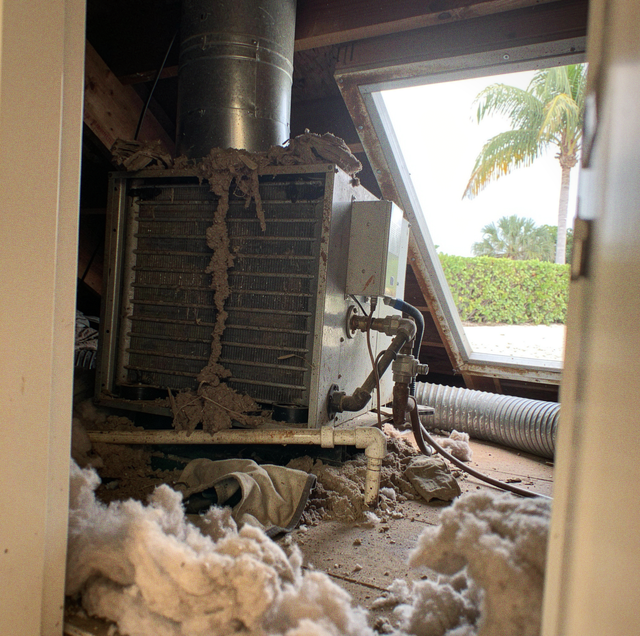
Quick Answer: An HVAC technician's nest-finding puts the pest side first: confirm activity, close the entry point, then ductwork follows once the population is no longer active. The HVAC company or a remediation contractor handles duct repair, cleaning, and remediation.
Nesting material pressed against an air handler, or gnaw marks along a supply boot, is usually seen first by whoever is servicing that equipment, since the area immediately around the unit gets looked at as part of the service and rarely otherwise. The attic itself stays off-limits to a homeowner: it runs hot, footing is limited to exposed joists, and wiring in a space with rodent activity can already be compromised. So the finding tends to arrive secondhand, mid-repair, on someone else's job.
What a Running System Changes about the Finding
A nest in open insulation is a static finding. It sits where it is until something moves it. A nest near ductwork sits next to equipment that runs on its own schedule, cycling on and off through the day regardless of what else is happening in that attic, and moving air through a network of ducts that reaches every room the system serves.
That connection is why the order of work carries weight here rather than being a scheduling preference. The question following this finding is not only about one attic corner. It is about a system already tied into the rest of the house, what the trade needs to know, and the order in which those two jobs are released. None of that means the duct system has to be opened up or inspected to establish what is going on. The read that settles the sequence occurs entirely outside the ducts, at the point where something got in.
Activity Status Comes before Duct Work
Duct work scheduled while a population is still active is scheduled against a condition that is still changing. The nest found during a service call establishes that something was there, not that it is gone, and not that it stays gone once a section of duct is opened up and put back together. What must be settled first is the activity status: whether this is an old, abandoned nest or a route still in use.
That determination is a pest inspection, not a duct inspection. It comes from finding where the entry point sits and whether droppings or damage nearby read as fresh or old. Once the activity is confirmed, closure follows the general order for rodent entry points: routes not in current use are closed first, the route still in use stays open long enough to trap it out, and that opening is sealed last. Only after the trap line goes quiet does the duct side have a stable condition to build against.
Repairs Made around an Active Population
Repairing or replacing a section of duct does nothing to a rodent population using that space. A run of flexible duct patched or swapped where gnaw damage was found gets repaired to a duct standard: sealed, connected, and moving air the way it should. None of that addresses what put teeth marks in it, and new material sitting next to the same still-open route carries the same exposure the old material did.
Disturbing or removing nesting material or gnaw damage found during a service call is not part of routine duct service. Leave it until activity has been read; removal itself is remediation work handled by a separate contractor.
Work sequenced this way can also compound rather than solve anything. A repair completed around an active nest can push activity into a section that had not been affected before, and what looks afterward like the repair holding is sometimes an animal working a different part of the same run.
Where the Pest Scope Stops and the HVAC Scope Starts
Two scopes are at work once a nest turns up near ductwork or an air handler. Duct repair, duct cleaning, duct replacement, sanitizing a system that shared air with a nest, and removing or replacing affected insulation are HVAC or remediation work. A pest scope does not include any of it, no matter how directly it connects to what a pest inspection found. Anything that does get moved is handled with gloves and containment rather than bare-handed, and by whoever holds the removal work.
What a pest scope covers is the rodent side: confirming whether a population is active, finding where it is getting in, trapping the active route until catches stop, and closing the entry point once trapping is done. Duct repair, duct cleaning, duct replacement, sanitizing, and insulation removal are separate trade work and are not part of a pest control scope; all of it is referred to the HVAC or a remediation contractor.
None of that reflects on the HVAC side. A duct system that needs repair due to gnaw damage is a legitimate repair regardless of which trade handles it, and an HVAC contractor who completes that repair correctly is doing exactly what the job calls for. The two scopes simply do not overlap.
What Each Trade Needs from the Other
An HVAC technician who finds nesting material is not expected to identify what left it or to say whether the attic has activity beyond that spot. What is useful to relay is where the material sat: against the unit, in a return chase, or along duct insulation, since that location changes how a pest inspection gets scoped.
If an HVAC technician mentions finding nesting material, ask where it sat relative to the unit. That one detail narrows where a pest inspection starts, rather than leaving the whole attic in play.
The reverse holds. A pest company is not in a position to say whether a section of duct needs replacing, which is a duct standard belonging to the HVAC side; what it can confirm, once monitoring wraps up, is that the route feeding that part of the attic is closed. Between the two, a homeowner needs a plain answer to three things: what was found and where, whether a pest inspection has confirmed current activity, and whether the duct repair is being held open until that confirmation comes back. That is enough to keep two halves of one job from being scheduled independently of each other by accident.
Frequently Asked Questions
A nest in open insulation is made from what is already there: batt or loose-fill pulled apart and packed together. A nest against an air handler often includes fragments of duct wrap or insulation jacket pulled from the nearest run instead. The mix of material is a rough marker of what was nearby when the nest was built, not of how long it has been there.
A return plenum pulls air out of the house and back toward the equipment, so anything drawn in through a breach there moves toward the unit first. A breach in a supply line runs in the opposite direction, pushing conditioned air and whatever rides with it out into a room. Which side of the system a breach sits on changes the direction in which air carries material, not whether it matters.
Flexible duct is built around a wire coil wrapped in insulation and an outer jacket, and that jacket is what is vulnerable to gnaw damage, so a breach usually shows as a torn or punctured section of wrap. Rigid metal duct does not offer the same target; damage there tends to show up at a joint or connection point instead, since the duct wall is not something a rodent can get through directly.
Whether it keeps running is a decision for the HVAC side rather than the pest side, because the run state does not move a single trap. Traps are set along the route an animal actually travels, on the equipment platform and the framing around it, rather than inside the airstream, so a blower cycling on and off changes nothing about where they sit or what reaches them. The trap line answers to the travel route; the equipment answers to the thermostat.
The finding moves into living space or to grade, which changes both who sees it first and what it points at. A closet unit sits behind an open door, so the material around it is usually noticed by the homeowner rather than by a technician on a service call. A garage unit sits at grade near a door opening directly outside, so the route behind it is more likely to be a ground-level gap than a roofline one, and the inspection scopes to the garage perimeter rather than the attic.
Sometimes. A duct run that passes close to a roofline chase or penetration is near the same features that create entry points on that part of the house, and damage on the duct side can be the first indication that something is open nearby, before it shows up anywhere else. That does not mean every duct issue traces to the roofline. It means a duct finding in that location is worth mentioning to whoever is looking at entry points, rather than being treated as an isolated HVAC issue.
Turn an HVAC finding into an activity read on that exact spot — one visit tells both trades whether anything up there is still active. Buggify Pest Solutions serves Boca Raton, West Boca, and communities across Palm Beach and northern Broward. Call Tyler: (561) 672-0200.
