

Your Home Is Brand New. So Why Does It Have Roaches?
Quick Answer: New-construction pressure comes from four sources: construction-phase cardboard and deliveries, a disturbed lot next door, fresh landscaping moisture, and gaps that haven't yet sealed. None of it means the house was built wrong.
You closed on the house eight months ago. The paint in the hallway is still that flat, unlived-in white, the sod out back hasn't fully knit together yet, and you're still finding the builder's blue painter's tape stuck to a window latch somewhere new every few weeks. Then, late one night, you flip on the kitchen light and something skitters under the cabinet toe-kick. You stand there for a second, more confused than anything, because this house is new. Nobody has ever cooked a meal in it besides you. How is there already a roach?
It's a fair question, and it has a different answer than the one that applies to an older home. A roach in a fifteen-year-old house usually points to something inside: a leak, a cluttered pantry, a crack that's been open for years. A roach in a house that's one, two, or three years old points somewhere else entirely. New construction carries its own set of introduction pressures, tied to the building process itself and to the year or so after move-in when the house, the yard, and the surrounding lot are all still catching up. Walking through those pressures one at a time is the fastest way to figure out which one applies to your house, rather than assuming the builder or a framing crew did something wrong.
The Boxes That Built the House
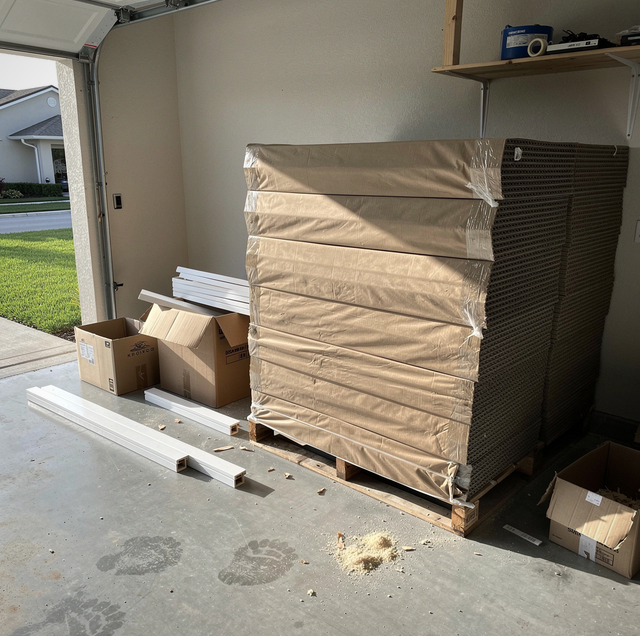
A move into an older home is usually a single event: a truck, a weekend, a stack of flattened boxes gone within a week. Building a house is not one event. It's months of separate deliveries, each arriving in its own cardboard, on its own schedule, from its own supplier. Cabinetry arrives boxed. Appliances arrive boxed, often shrink-wrapped over corrugated corner guards. Flooring arrives on pallets wrapped in cardboard sleeves. Fixtures, tile, and trim carpentry show up the same way, sometimes staged in the garage for days or weeks before a crew installs them.
What separates a build from a move is duration, not the cardboard: A move exposes a house to packaging once, over a weekend, and the boxes are gone by the following Saturday. A build exposes it repeatedly across months, and the riskiest stretch is not the delivery itself but the staging afterward. A cabinet run or a flooring pallet can sit in a closed, unconditioned garage for two weeks with its corner guards and shrink wrap still on, alongside jobsite debris and sawdust, with no reason for anyone to open it. A German cockroach egg case (an ootheca) glued into a fold at a supplier's warehouse has that whole window to hatch, and the nymphs have that whole window to walk off the cardboard into a wall cavity that is still open on one side.
What's Happening on the Lot Next Door
New construction rarely happens in isolation. If your house is one of the newer ones on the street, there's a decent chance much of the area nearby is still being cleared, graded, or built out. Land clearing strips away leaf litter, palmetto thatch, downed wood, and undisturbed ground cover, which is exactly the kind of harborage that outdoor cockroach species, American and smoky brown roaches in particular, already live in.
When that ground gets scraped, the insects living in it don't disappear. They move toward the nearest structure that offers shelter and a reliable source of moisture. In an established neighborhood, that pressure might spread across a dozen existing homes with mature exclusion and years of perimeter treatment behind them. Next to active construction, the newest, least-sealed house on the block is often the most convenient landing spot. The timing is what does it: your home became livable at roughly the same moment a population next door lost its ground.
Fresh Ground, Wet Ground
A newly landscaped yard is also a wetter yard than it will be in a year. New sod needs heavy, frequent watering to root, and mulch beds installed right up against the foundation hold that moisture close to the stem wall. Irrigation heads that haven't yet been walked and adjusted can throw water directly onto stucco or siding instead of onto the lawn, and a swale or yard grade that hasn't fully settled can leave water sitting at the slab edge after a storm instead of draining away.
Moisture at the foundation line does double duty: It's one of the strongest draws for American and smoky brown roaches, and it softens the same sealant and weatherstripping meant to keep them out. None of this is unique to South Florida, but the climate here eliminates any seasonal break. There's no dry stretch that gives new sod, new mulch, and a freshly graded yard a few months to settle before the next irrigation cycle starts again.
The House Hasn't Finished Settling
Every new house goes through a settling period, and the building envelope isn't entirely sealed on the day you get the keys. Stucco and drywall both develop hairline shrinkage cracks as they cure, usually concentrated at expansion and control joints. HVAC line-set penetrations, plumbing stub-outs, and low-voltage conduit runs for cable and security wiring are supposed to be spray-foamed or caulked at the exterior wall, but that pass sometimes lags behind occupancy as an open item on a punch list nobody's closed out yet. Garage door threshold seals and door sweeps can run slightly out of spec until a final walkthrough catches it.
Stucco weep holes are a normal drainage feature, not a flaw, but on a wall where nothing nearby is fully sealed yet, they can double as an entry point along with everything else. Cockroaches don't need a large gap to use one. Researchers who filmed American cockroaches running through crevices found adults compressing to roughly a quarter of their standing height to get through an opening about an eighth of an inch wide, which is narrower than a typical stucco weep hole and narrower than the gap a slightly out-of-spec door sweep leaves at the corners. A German roach nymph needs less room again.
Weighing These Four Against Your Own House
Not every new home experiences all four pressures at once, and they don't carry equal weight. A house going up in an already-developed, already-landscaped neighborhood skips the lot-next-door pressure almost entirely. A house that closed during a slower irrigation ramp-up carries less moisture pressure than one that closed heading straight into a wet stretch. Use the framework as a diagnostic, not a checklist: if there's an active build site within view of your house, that pressure is probably doing most of the work. If your yard was sodded and irrigated within the last few months, look there first. If you're past both of those and still seeing activity, the settling gaps in the building envelope are the more likely explanation, and they're worth having a technician trace rather than guess at.
Frequently Asked Questions
There's no fixed number of months that applies to every house, because the timeline follows the construction and landscaping process rather than the calendar. It eases as the sod fully roots in and needs less daily water, as the builder's punch list closes out the remaining sealing items, and as any nearby lot finishes its own construction. A good marker is your builder's final walkthrough sign-off; sightings that continue well past that point are less likely tied to new-construction pressure and more likely to mean an indoor source has already taken hold.
Those are separate things, and what any individual document covers is a question for your builder and the company that issued it rather than for a pest company. What is worth knowing on the pest side is that a termite bond is a wood-destroying-organism agreement, a different category of pest and a different license: WDO work sits with a separately licensed operator and is referred out by general pest control companies, cockroach control included. So a bond arriving in the same closing folder is not a version of roach coverage, even though both get filed under "pest."
Early on, American and smoky brown roaches are usually the more likely visitors, since they're arriving from disturbed outdoor ground, a valve box, a water meter box, or a storm drain, rather than hitching a ride in a delivery box. A sighting near a garage door or exterior threshold points outdoors; a sighting confined to the kitchen or a bathroom vanity points toward the German roach, delivery-cardboard route instead, and the two call for different treatment approaches.
Ask that flattened cardboard and packaging be hauled off-site the same day rather than staged in the garage for pickup later in the week, since a garage full of folded boxes is the single easiest harborage to remove. Ask the irrigation contractor to walk the system and re-aim any head that's throwing water onto the stucco or siding instead of the lawn, and ask that mulch be pulled back three or four inches from the foundation edge rather than mounded against it.
The garage is the most informative room in a new build, because it is where materials were staged, and it is usually the last space to get its final sealing pass. Activity that stays in the garage, with nothing in the kitchen or the baths, most often points back to the delivery-and-staging route rather than to anything structural. What changes the reading is finding nymphs out there, the small wingless immature stage: those mean something is breeding on site rather than passing through, and a nymph in a garage that shares a wall with living space is worth an inspection that week rather than a wait-and-see.
If anything, the first stretch after move-in is when a consistent schedule matters most, not least. South Florida's climate doesn't give outdoor pressure a real off-season, and a new home spends that period with landscaping still maturing and sealing work still catching up, which is exactly when the four pressures above run highest. A bi-monthly, every-8-week service covers that window better than a longer quarterly gap would, and it can ease back once the yard is established and the exterior is fully sealed.
A new house isn't a finished house, not in that first stretch. It's still curing, still draining, still being landscaped, and still getting its final seal pass, and every one of those processes creates a temporary opening that an established, ten-year-old home doesn't have. None of that reflects on how the house was built. It reflects on when you happen to be looking at it.
Tyler — ask about a first-year new-construction inspection, a source-first check of the build-phase gaps above before they turn into a repeat problem. Buggify Pest Solutions serves Boca Raton, West Boca, and communities across Palm Beach and northern Broward. Call Tyler: (561) 672-0200.
