

American Cockroach Habits: Where They Live Before They're Inside
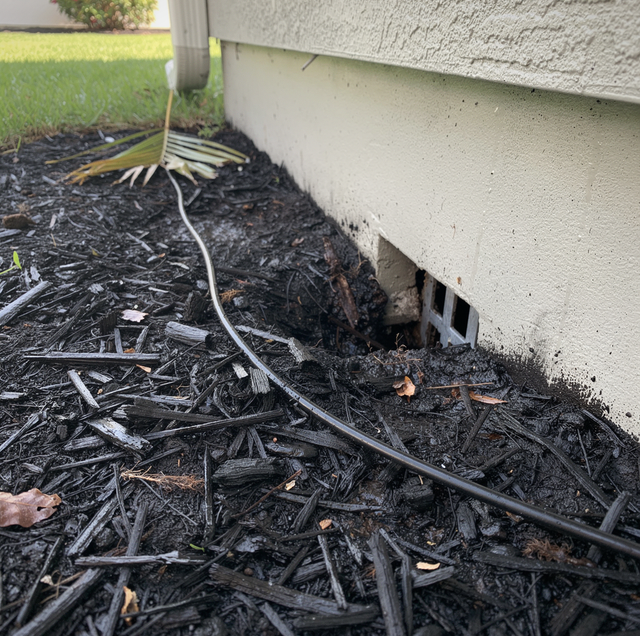
Quick Answer: American cockroaches live outdoors in moist, organic harborage: mulch banked against the foundation, palm frond debris, irrigation valve boxes, and the gap under a lanai's screen channel. Indoor sightings are usually foragers passing through, not a house colony.
For every American cockroach that turns up inside a South Florida home, the population it came from is sitting outdoors, usually within about fifteen feet of your exterior wall, in one of a small number of predictable pockets. That is the whole geometry of this species. It rarely builds a colony indoors at all, so the one you found is far more often a single forager that crossed a threshold gap than evidence of anything breeding in your house. Four outdoor sites account for most of that population, and each one holds it for a slightly different reason.
Why Mulch Against the Foundation Wall Draws Them In
American cockroaches lose water steadily through the cuticle and cannot go long without free water to drink, which is why they are far more tied to damp harborage than a species like the German roach that can subsist on the moisture in food. They settle where wet ground and decaying organic matter sit in the same few square feet, so they never have to travel between the two. A mulch bed banked directly against a stem wall or slab edge checks every box at once: irrigation and rain keep the material wet, the wood or cypress mulch itself is a slow-decaying food source, and the few inches of dead air space between the mulch pile and the wall stay shaded and humid even on a dry afternoon.
That same strip of mulch also happens to sit closest to the weep holes, utility penetrations, and expansion joints where a stem wall meets the slab, which is the entry geometry a forager uses when the outdoor colony gets crowded or a hard rain floods the harborage. The roach doesn't have to travel to find your house; your house is already the wall its habitat is built against.
Mulch pulled back from the foundation: Leaving a 6- to 12-inch gap of bare soil or gravel between the mulch line and the wall removes the wet, shaded microhabitat without touching the landscaping bed itself.
Why Palm Frond Piles Hold a Breeding Population
Palm fronds shed constantly in a South Florida yard, and a pile of them left at the base of a palm, along a fence line, or stacked for pickup does the same thing decomposing mulch does, only at a larger scale. The dense stack of dead fronds traps humidity underneath; the decaying frond tissue and trapped leaf litter give the roaches something to feed on without leaving the pile, and the interior stays dark and undisturbed for weeks at a time, exactly the still, layered harborage an American cockroach nymph needs to develop through its several molts without drying out or being exposed to a predator.
A frond pile also tends to sit closer to a home's perimeter than homeowners expect, especially after storm cleanup gets staged near a fence or side yard before hauling day. An adult female can produce an ootheca, an egg case holding roughly 14 to 16 eggs, and cement it into the base of that pile within a season of the debris accumulating, so a frond pile that sits for more than a couple of weeks isn't just an eyesore. It's a working nursery a short walk from your exterior wall.
Why Irrigation Valve Boxes Function Like a Roach Hotel
An irrigation valve box, the plastic in-ground enclosure covering a zone's solenoid valves, is close to an ideal American cockroach shelter by design rather than by accident. It holds standing moisture from minor valve seepage or runoff after every watering cycle; it's dark and enclosed on all sides, and the lid is rarely lifted more than a few times a year for maintenance, so a colony inside is left completely undisturbed. Add the organic soil and root intrusion that collects inside an older box, and you have food, moisture, and total darkness stacked in one below-grade compartment.
Because most South Florida yards run irrigation zones on an automatic timer, that moisture source refreshes on a schedule independent of rainfall, which is part of why a valve box population can stay active through a dry stretch that would otherwise reduce roach activity elsewhere in the yard. Lift the lid on a valve box that hasn't been opened in a while, and it is common to see roaches scatter along with sowbugs and other moisture-loving invertebrates sharing the same enclosed space.
A valve box or a frond pile that has sat undisturbed is also common harborage for fire ants and ground-nesting yellow jackets. Lift a lid with a tool from the edge rather than reaching in with a bare hand.
Why the Lanai Footer and Screen Channel Matter
A screened lanai's aluminum frame sits on a footer, and the channel where the screen track meets that footer and the adjoining slab collects a specific kind of debris: wind-blown leaf litter, pooled condensate from an outdoor AC unit or pool equipment, and organic buildup that never gets swept because it's tucked behind furniture or planters along the enclosure's edge. That channel runs the entire perimeter of the lanai, so it offers a long, continuous, sheltered strip rather than a single isolated pocket.
A screen channel packed with damp leaf debris: That buildup holds moisture against the footer for days after a rain, creating the same wet, dark, food-adjacent conditions a mulch bed or valve box provides, just running the length of your outdoor living space instead of one bed or box.
Because the lanai footer sits directly against the home's slab, often within a few feet of a sliding door threshold or pool bath, it's one of the shortest indoor routes a forager has. A roach that has built up a stable population in that channel is already at the doorstep, and a worn door sweep or a gap under a threshold is often the only thing separating that outdoor harborage from your living room.
What Actually Changes When You Treat the Outside
Indoor gel baiting and crack-and-crevice work still matter for the occasional forager, but they don't reach a population that's living in a valve box or a frond pile 15 feet from the door. An outdoor-first approach identifies which of these four reservoirs is active on a given property, applies a targeted crack-and-crevice or granular treatment directly to that harborage, and pairs it with an insect growth regulator so the next generation doesn't simply replace the one that gets knocked down. Reducing the moisture and organic buildup at the source, pulling mulch back from the wall, clearing frond debris promptly, and keeping the screen channel free of leaf litter does more to lower activity than any amount of indoor spraying, because it removes the reason the population is there in the first place.
None of these four reservoirs is a homeowner failure. Mulch beds, palm debris, irrigation infrastructure, and screened lanais are standard features of nearly every South Florida property, and the moisture that makes them livable for people is the same moisture that makes them livable for this species. The fix isn't ripping out the landscaping bed or the lanai; it's identifying the specific pocket near the foundation that's currently active and treating it directly.
Frequently Asked Questions
Not necessarily. A single American cockroach indoors, especially near a garage, laundry room, or ground-floor bathroom, is usually one forager that entered through a gap under a door or around a plumbing penetration, not evidence of an indoor colony. Repeated sightings in the same room over several days, or finding a shed nymph skin (the exoskeleton left behind after a molt) indoors, point to a nearby harborage close enough to the structure that individuals move in and out regularly rather than to a single wanderer.
Longer than most people assume, which is why a reservoir that formed months ago is often what produces this week's sighting. An American cockroach ootheca takes roughly 50 to 55 days to hatch, and the nymphs then pass through a series of molts over a period usually measured in months rather than weeks before any of them can reproduce. A frond pile or a valve box that has sat undisturbed since last season is already a mature harborage, while debris that accumulated two weeks ago is not yet producing anything.
A consumer spray applied to the surface of a mulch bed or the inside lip of a valve box typically only reaches the insects present at that moment and breaks down within days under South Florida humidity and irrigation cycling, so activity often rebounds within one to two watering cycles. A professional treatment uses a granular or crack-and-crevice product formulated to persist through irrigation and rainfall, plus an IGR that disrupts the next generation's development, which is the piece a surface spray doesn't address at all.
No, and removing either usually doesn't solve it. The failure point is rarely the feature itself; it's a specific defect that turns a normal one into a reservoir: a valve box lid with a cracked or missing gasket that lets extra rainwater pool inside instead of shedding off, or a gutter downspout that empties directly onto the lanai footer instead of into a splash block routed away from the slab. A technician checking these reservoirs looks for that failure point first, since fixing a misdirected downspout or swapping a cracked valve box lid often does more than any amount of mulch removal.
American cockroaches are strongly nocturnal foragers, ranging farthest from harborage in the hours after dark, when humidity climbs, and surface temperatures fall. A flashlight sweep of the mulch line, valve box lids, and lanai footer an hour or two after dark, rather than during the day, is the most reliable way to actually confirm which reservoir is active on a given property before any treatment is planned.
Yes, and it matters more than a one-time cleanup: a hard rain floods low-lying harborage like valve boxes and frond piles, pushing the population toward higher, drier ground, which is frequently the home's foundation line itself. Clearing loose debris and confirming valve box lids seal properly in the days after a significant rain event reduces that displacement pressure at the exact time indoor sightings tend to spike.
Schedule an outdoor cockroach inspection — Buggify will check your mulch line, irrigation boxes, and lanai footer for active harborage and treat the source directly. Buggify Pest Solutions serves Boca Raton, West Boca, and communities across Palm Beach and northern Broward. Call Tyler: (561) 672-0200.
