

How Often to Treat a House for Pests? Why Quarterly Isn't Always Enough
You spot one roach crossing the kitchen floor after dark, or a thin line of ants working the counter, and the question lands right away: how often does a house actually need to be treated so this stops? One neighbor swears by a monthly visit. Another has a technician out every three months and nothing more. Plenty of people schedule nothing and just reach for a can whenever something shows up. All three habits are common, and they cannot all be right for the same house.
The honest answer is that there is no single number that fits every home. The cadence that fits yours depends on a few things you can actually reason through: how much pressure your area puts on the structure across the whole year, which pests you are dealing with and how fast they reproduce, and how long the products a technician applies stay active on the surfaces where they land. Get those three straight and the right frequency tends to pick itself.
Reactive or Preventive: Two Ways to Think About Timing
The reactive approach: you treat only when you see a pest. A trail appears, you deal with it; a wasp nest goes up, you knock it down. Nothing is scheduled. It works passably for the occasional stray that wanders in and never comes back. Its weakness is that by the time you can see a pest indoors, the population that produced it is usually already established somewhere you cannot see, so you are always fighting the symptom after it has scaled up.
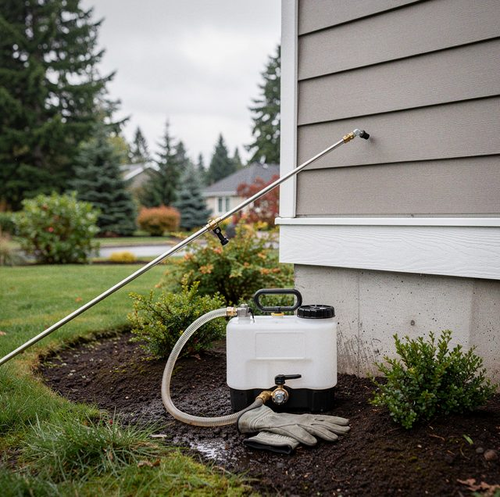
The preventive approach: you keep a barrier in place on a set schedule so populations never build to the point of getting inside. A technician treats the exterior perimeter, the entry points, and the outdoor harborage on a recurring interval, whether or not you have seen anything since the last visit. The point is to keep pressure knocked down continuously rather than chasing it after a breakout.
Neither is automatically correct. A house in a low-pressure setting with a solid envelope may do fine reacting to the rare intruder. A house under steady outdoor pressure loses the reactive game, because something new is always pushing at the structure and an occasional spray never gets ahead of it. That pressure difference is the first thing that sets frequency.
What Climate and Pest Pressure Do to the Schedule
In a place with a true cold winter, a hard freeze does real work for you. It knocks insect populations back, drives breeding to a near halt for months, and gives the house a real off-season when very little is active outside. In those regions, a lighter schedule can be enough, because nature handles part of the job for a quarter of the year.
Warm, humid regions get no such break. Where temperatures stay mild, and the air holds moisture, insects stay viable outdoors in every month, breeding continues through what would be winter elsewhere, and outdoor harborage keeps generating new foragers on a rolling basis. There is no season when the pressure drops to zero, which means there is no stretch of the year when the barrier can safely lapse. A schedule built around four seasons and a dormant winter does not match a place that never has one. This is the core reason a cadence that is plenty in a cold climate can leave gaps in a warm one, and why the same "quarterly" label means two very different things depending on where the house sits.
Local geography stacks onto climate. Standing water keeps mosquito production running; dense mulch beds and irrigation moisture against the foundation feed ants, roaches, and the insects that spiders eat; shared walls and landscaping spread pressure from one unit to the next. The more of these a property has, the harder the schedule works to stay ahead.
Why the Products Don't Last as Long as You'd Hope
People often assume a professional treatment coats the house for months. It does not, and the reason is chemistry. The residual products a technician sprays around a foundation and along entry points keep killing for a window after they dry, not indefinitely. On a typical exterior surface, that active window runs about 21 to 30 days under favorable conditions. After that, the product breaks down, and its knockdown fades, even though nothing looks different to the eye.
Several ordinary things speed that breakdown up. Direct sun and heat degrade many active ingredients faster, rain and irrigation wash product off hard surfaces and dilute it in soil, and the constant wet-dry cycling of a muggy climate wears it down quicker than a dry one would. So in the exact regions where pest pressure never lets up, the residual also burns off toward the short end of its range: a shorter protective window in the places that need the longest one.
Now put that next to a calendar. If a residual holds for roughly three to four weeks and a quarterly visit leaves about 90 days between treatments, the math leaves a 50-to-60-day stretch near the end of each cycle when the product is spent, and the barrier is down. In a cold-winter off-season, that gap may not matter. In a year-round-pressure climate, it is an open door for two months out of every three.
Pest Life Cycles Set Their Own Clock
Frequency is not only about the product; it is about what the pest is doing on the other side of the wall. Different pests reproduce on very different timelines, and a schedule that ignores the breeding cycle keeps missing the next generation.
Cockroaches: a German cockroach egg case, called an ootheca, carries dozens of eggs and hatches roughly a month after it is produced. Miss a hatch by treating too infrequently, and the population is climbing again, which is why heavy roach situations often start with tighter visits before easing to maintenance.
Mosquitoes: in warm weather, the egg-to-adult cycle compresses to about 7 to 10 days. Populations rebuild fast, so mosquito-specific service during the active stretch is usually done monthly, a much shorter interval than general pest work.
Ants: many colonies produce brood continuously, and the ones that nest outdoors send fresh foragers toward the house on a rolling basis. There is no single hatch to catch, just steady output a barrier has to keep meeting.
The pattern is the same across all of them. Insects reproduce on cycles measured in weeks, not quarters, and a new generation can mature inside the gap a long treatment interval leaves open. Visit spacing has to be tight enough that fresh product meets each new wave, not shows up two generations too late.
Why Every 8 Weeks Beats Quarterly in a High-Pressure Climate
Put the three factors together, and the picture is clear. In a warm, humid region, there is no off-season; residuals fade in about three to four weeks and often faster in heat and moisture, and pests breed on cycles of one to a few weeks. Against all of that, a 90-day quarterly interval leaves a long stretch of every cycle unprotected.
A bi-monthly cadence, every 8 weeks, closes most of that gap. At 56 days between visits instead of about 90, fresh product goes down before the barrier has been down for long, and the interval lines up far better with the breeding cycles pushing new pests at the house. It is not about spraying more for its own sake; it is about matching the schedule to the pressure and the chemistry so no long window opens where nothing is working. In a cold climate, those extra visits would be wasted on a dormant season. In a no-off-season one, they are the difference between staying ahead and always catching up.
The best schedules do not just repeat the same spray. A source-first technician spends the visit finding what is feeding the pressure, a moisture problem, an open entry point, an outdoor harborage, and corrects it, so each visit does more than reset a chemical timer.
Matching the Approach to the House
Here is how the common options line up against the home each one fits.
| Approach | Best for |
|---|---|
| Reactive (only when you see pests) | Low-pressure homes with a tight envelope and rare, one-off intruders |
| Monthly | Active infestations being brought under control, and mosquito service during the breeding season |
| Bi-monthly (every 8 weeks) | Homes in warm, humid, no-off-season climates and any property under steady year-round pressure |
| Quarterly | Homes in cold-winter regions with a real dormant season and moderate pressure |
| Annual or one-time | Rarely a standalone plan; useful only for a single targeted issue, not ongoing prevention |
The table is a starting point, not a verdict. A specific house can pull the answer either way: heavy shade and constant irrigation argue for tighter spacing, while a newer home with sealed entry points and dry beds might hold a barrier longer. The property, not the label, decides.
When a Lighter Schedule Actually Makes Sense
None of this means more is always better. There are real cases where stepping down the frequency is the right call, and a good technician will tell you so rather than sell you visits you do not need.
If a house has been on a preventive plan for a while, the outdoor sources are corrected, and activity has stayed near zero across several visits, the interval can often be stretched or the plan trimmed to exterior-only. A property with very low pressure, no standing water, a dry perimeter, and well-sealed entry points may never need more than occasional attention. And a home in a climate with a hard winter can reasonably ease off during the months when little is breeding, then tighten back up as the weather warms.
What rarely works is the middle-of-the-road guess: a single annual spray in a high-pressure climate, or a reactive-only habit in a house under steady outdoor pressure. Those are the setups where people spend the year feeling like they never get clear of the same pest.
Frequently Asked Questions
It depends entirely on your climate. In a region with a hard freeze, easing off during the dormant months is reasonable because little is breeding. In a warm, humid one, there is no true dormant season, so a winter pause hands the outdoor population a head start on spring. There is also a rodent angle people miss: As outdoor temperatures dip even slightly, rats and mice look harder for warm indoor harborage, so the cooler stretch can actually raise indoor rodent pressure rather than lower it. Pausing entirely tends to open a gap right when one door is closing, and another is opening.
Usually not, and that surprises people. On a well-run preventive plan, the recurring work is mostly on the exterior: the foundation perimeter, entry points, eaves, and the outdoor harborage where pests actually originate. Interior treatment is done when there is a specific active problem inside, not as a routine every-visit spray. The barrier that matters is the one outside, where the pressure starts.
You can step down before you stop. A long quiet stretch is a sign the plan is working, not that the pressure has vanished, and in a high-pressure climate the outdoor sources are still there. Stretching the interval or trimming to exterior-only is the low-risk move. Stopping outright removes the barrier, and re-establishing it after a lapse usually takes a couple of visits to knock the rebuilt population back down, so you often trade a small ongoing effort for a larger catch-up one later.
Resistance is a real phenomenon, but it comes from repeatedly using the same class of active ingredient, not from the visit frequency itself. Technicians manage it by rotating between chemistry classes and by using growth regulators, or IGRs, that disrupt an insect's development instead of poisoning it outright, which pests do not build resistance to the same way. Monthly or tighter spacing is warranted for an active infestation or for mosquitoes during breeding season; once a population is controlled, easing to a maintenance interval is both lighter-touch and sound practice, so more-frequent-forever is not the goal.
Give a residual a few days to settle in, and do not be alarmed by a short flush of activity right after a visit, since some products drive pests out of harborage before knocking them down. The signal that your interval is too long is a pattern: if visible activity reliably returns well before the next visit, cycle after cycle, the gap is outrunning the product and the breeding cycle, and the spacing needs to tighten. One-off activity between visits is normal; a predictable rebound every cycle is the tell.
Sanitation helps and is worth doing, but it addresses only the indoor half of the equation. Most pressure originates outdoors in mulch, irrigation moisture, and harborage against the foundation, none of which a clean kitchen touches. And some pests live on almost nothing: German cockroaches can sustain a population on the grease film behind an oven or the starch in cardboard. Cleaning makes any treatment work better, but it does not replace the outdoor barrier that keeps populations from reaching the house.
Landing on the Right Cadence
The same question gets three different answers because people are picturing three different houses. Frequency is not a preference; it is a fit between how much pressure your area applies year-round, how fast the pests reproduce, and how long the product stays active. In a cold climate with a real winter, quarterly can be plenty. In a warm, humid one with no off-season, where residuals fade in three to four weeks, and pests breed in one, a 90-day interval leaves two months of every cycle unprotected, and a bi-monthly, every-8-weeks rhythm keeps a barrier standing. Be honest about which house you have, and the right number stops being a guess.
Not sure whether your home needs every-8-weeks coverage or something lighter? Get the outdoor pressure assessed and a cadence matched to it. Buggify Pest Solutions serves Boca Raton, West Boca, and communities across Palm Beach and northern Broward. Call Tyler: (561) 672-0200.
