

Irrigation Mosquitoes: Which Water Your Sprinklers Actually Leave
A lawn that never browns, beds that look freshly mulched every week, hedges trimmed on a set rotation: that is the yard most homeowners work hardest to maintain, and it can still be the yard holding the steadiest mosquito population on the block. Your irrigation system is part of the reason, though probably not for the reason you would guess.
Damp ground does not breed mosquitoes. A female needs free standing water to lay in, roughly half an inch of it, sitting still long enough for eggs to hatch and larvae to finish developing. Damp mulch, damp thatch, and a damp top inch of soil produce nothing at all. What your irrigation system does is two separate things, and only one of them puts water on the ground in a form a mosquito can use.
The first is that it creates genuine standing water in a handful of specific places, and it creates it on a timer that pays no attention to the weather. The second is that it keeps your beds shaded, humid, and lush, which has nothing to do with breeding and everything to do with where the adults spend their days. Both matter. They matter in different ways, and they get handled differently.
The System Creates Two Separate Problems, and Only One of Them Breeds
Container breeding follows the weather. Rain fills a bucket or a clogged drain, and given enough dry days, the water disappears, and the cycle breaks before anything emerges. Your sprinkler system does not wait on the weather. It runs on a timer, recharging the same few catchment points on the same interval whether the ground needs it or not, so the gap that would normally interrupt a breeding cycle never opens. In summer heat, an Aedes egg reaches biting adult in seven to ten days, and Culex in ten to fourteen; a schedule that tops the same low point up twice a week covers either one comfortably.
The second problem is a resting problem. Adults spend roughly 23 of every 24 hours perched on foliage, and the resting population on a property typically runs ten to a hundred times the number actually biting anyone. Shaded, damp, wind-sheltered planting is what they select for, and a well-irrigated bed under mature canopy is close to ideal for it. No larvae ever develop there. The adults, produced elsewhere, sit in it all day and come out at dusk, which is why your bites can be concentrated around beds that hold no water whatsoever.
Overspray Onto Hardscape Collects at the Lowest Point
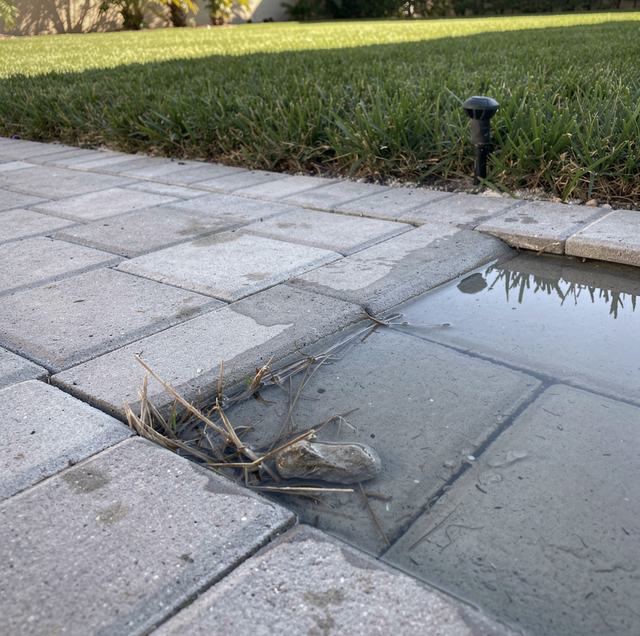
Spray heads aimed across a lawn edge do not always stop at the grass line. Water that lands on your driveway, a walkway, or a pool deck has nowhere to soak in, so it runs across the surface until the grade carries it somewhere lower: a drain grate, a low corner of a patio, the dished spot where two paver sections have settled against each other. If that low point holds enough depth for the water to stand, it is a breeding site, and it gets recharged every time the zone runs regardless of how dry the surrounding lawn already is.
The schedule is what makes the spot worth finding. A puddle left by a storm is a one-off, and in a dry week it disappears before anything in it can finish developing. A puddle refilled by zone three every Tuesday and Friday morning never gets that interruption. If you scan your yard for standing water only after rain, you will walk straight past it because, on a dry week, there was never a storm to blame it on.
A Weeping Valve Box Holds Real Standing Water Below Grade
A valve box on your property is not supposed to hold water between cycles, but a worn seal, a cracked fitting, or a valve that does not close fully can leave one sitting in a few inches of standing water long after the zone has shut off. That is exactly the depth and the stillness a mosquito needs. Because the box sits below grade and largely out of direct sun, the water inside is shielded from the evaporation that would otherwise clear it, so a single box can run as a small, permanent nursery a few inches under a lid you have never lifted.
A head that drips instead of shutting off cleanly does something similar above ground, saturating the soil at the base of the riser until a shallow pool stands in the depression around it in your turf. Both are the kind of source that looks like nothing from a distance, a patch of darker soil or a faint gleam near a fitting, and turns out to be a steady one on a closer look.
A Saucer or Low Spot Kept Topped Up Never Gets to Dry
Your yard almost certainly holds five to ten micro-breeding sites at any given moment, and the ones fed by irrigation are the ones that never draw down. A saucer under a potted plant at your patio edge catches the outer band of a spray pattern twice a week. A low patch of turf near a downspout stays at depth because it is being recharged before it can drain. A tarp, a wheelbarrow, or an upturned lid stored at the edge of one of your beds does the same thing on the same schedule.
Bromeliads deserve their own mention here. Each plant holds water in the cup where its leaves meet, and a bed of ten or more mature plants can produce well over a thousand adults in a month once those cups are being kept full. Rainfall alone will do that through the wet season. An irrigation zone crossing that bed does it year-round.
Damp Shaded Beds Are Resting Habitat, Not Breeding Habitat
Beds along your fence line or under a canopy of shrubs often sit at the outer edge of a spray pattern, catching water meant for the lawn beside them. Mulch holds moisture far longer than open turf, and a bed shaded by mature planting loses even less of it to sun and air movement. Rewet on the same cycle as the lawn next to it, that mulch surface stays damp straight through to the following cycle. An unirrigated bed would have dried well before then.
Nothing hatches in it. What it offers is the thing adult mosquitoes need for 23 hours out of every 24: shade, still air, and humidity high enough that they do not dry out. In a coastal climate where relative humidity already runs 70 to 85 percent, an irrigated bed under canopy holds resting adults continuously. An exposed yard empties out during a dry stretch; this one is never given the chance to. That is why a residual applied to the underside of that foliage does more for your evening on the patio than anything aimed at the water would.
If a bed near a sprinkler zone stays visibly damp days after the last cycle, that pattern is worth pointing out to whoever manages the irrigation system, since head placement and reach are theirs to adjust.
What a Breeding-Source Audit Finds That a Casual Walk-Through Misses
An audit is timed against your controller. A property watered in short daily cycles reads differently on an inspection than one watered deeply and less often: the short-cycle yard shows more surfaces wet at the moment of the visit and more small catchments sitting at depth, while the deep-watered yard shows fewer and drier ones. That is an observation about where to look on the day, and any change to the program itself belongs to whoever manages the system.
The walk separates the two mechanisms. Every place your irrigation leaves standing water is checked for depth and how long it has been sitting: the low corner of the hardscape, the valve boxes, the saucers and bromeliad cups on a zone, the settled patch of turf that never drains between runs. Then the shaded, damp planting gets assessed as resting habitat, which is a different question with a different answer. Sorting a yard that way turns a vague complaint about mosquitoes into a list of specific places, some of which need the water gone and some of which need the foliage treated.
Frequently Asked Questions
Not usually. A rotor head rotates across a wide arc and applies water in a thin stream, so it spreads the volume fairly evenly across your turf. A fixed spray head releases a fuller pattern in one pass over a shorter reach, which makes it far easier for one mistimed or misaligned head to soak a single narrow band of your property on every cycle: a bed edge, or the first foot of your walkway.
Yes. Your rain sensor is designed to skip a scheduled cycle if natural rainfall has already saturated the ground. If yours is missing, disconnected, or reading incorrectly, your controller runs its normal timer regardless of what fell overnight, so the low spots and catchments already full from the storm get topped back up before they ever have a chance to draw down.
After one of your zones shuts off, the water still sitting in the pipe keeps draining out through the lowest head on that line, releasing into the ground around that one riser well after your cycle technically ended. It is a plumbing effect tied to pipe height and gravity. Your zone is not still running. Where that lowest head happens to sit in a depression, the extra volume is enough to leave a small standing pool that outlasts everything else on your schedule.
Yes. A lid that does not seal flush with its box lets rainwater and your own overspray seep in from above, collecting inside the box regardless of what the valve mechanism underneath is doing. From where you are standing, the box looks intact, and it can be holding a pocket of water an inch below the lid the whole time.
Generally yes, on both counts. A drip emitter releases water at the soil surface directly around a plant's root zone. It never broadcasts across the mulch and canopy above, so less of the volume lands where it can run off toward a catchment, and your bed carries less of the surface humidity that makes good resting cover. A drip line that clogs or splits still delivers water to one spot, which is where to look if a single patch of one of your beds is wet.
It is possible. A cracked swing joint, the flexible fitting connecting a sprinkler head to its supply line, can leak below grade with no change in your spray pattern and no obvious wet spot at the surface for weeks. What eventually shows is a patch of your ground that stays saturated between cycles and, where the grade dips, holds visible water with no scheduled reason to be there.
Have your yard walked while the zones are actually running — the pooling at a low point and the water standing in a valve box only show themselves mid-cycle. Buggify Pest Solutions serves Boca Raton, West Boca, and communities across Palm Beach and northern Broward. Call Tyler: (561) 672-0200.
