

Your Yard vs. the Neighbor's: What Mosquito Barrier Spray Targets
Quick Answer: Your yard and the one next door can differ sharply in mosquito pressure because of shade, airflow, drainage, vegetation density, and containers. Those five variables determine how much resting habitat each lot offers, and they operate at the scale of a single property.
Stand at the property line between your yard and the one next door, and the difference can be hard to reconcile. Both lots caught the same storm last week, the same humidity, the same rainfall, the same seasonal pattern every yard within a mile shares. Yours is unusable by early evening, and a few minutes outside turns into a losing battle. Theirs stays quiet enough to eat dinner in. What separates them isn't luck or a stray puddle. It's a set of small, physical differences in how each lot holds shade, still air, and dense, low-growing vegetation, which are the exact conditions a mosquito needs to rest. Both properties sit well inside the flight range of whatever is biting you, so you are not looking at two separate populations that happened to settle on opposite sides of a fence. You are looking at a population that has far more usable resting habitat on your side. Mosquito pressure is determined at a scale much smaller than a neighborhood, and knowing which variables drive it also explains what a barrier treatment is aimed at.
Shade and Canopy Density Set the Baseline for Resting Habitat
Shade is the single biggest variable separating two lots that get identical weather. If your yard carries mature tree cover, especially canopy that holds shade through mid-morning and again in late afternoon, the air beneath it stays cooler and more humid than the open lawn a few doors down. Mosquitoes settle where three conditions overlap: shade, still air, and humidity high enough that they will not dry out. A heavy canopy hands them all three at once.
A lot with a dense tree line along one side, or ornamental plantings holding shade over a patio and side yard, offers far more of that resting real estate than a lot with a wide-open, sun-exposed lawn and a few isolated trees. You can watch the effect inside your own property line: the shaded, low-canopy zones carry noticeably more activity than the open turf a few steps away. Two neighboring lots with different tree cover aren't experiencing the same conditions just because they share a fence and a zip code, and the canopy on your lot does a large share of the work in determining whether you can sit outside at seven in the evening.
Fence and Hedge Structure Traps the Still Air Mosquitoes Prefer
Airflow matters almost as much as shade. Mosquitoes struggle to stay airborne in anything more than a light breeze, so any structure that slows air across your yard extends the hours in which they can stay active and rest comfortably near ground level. A privacy fence, a tall run of hedges, or dense foundation planting all reduce how freely air moves through the space compared with a more open perimeter.
Your lot and the one next door can have almost identical square footage and still have very different airflow if one is more enclosed. The enclosed yard holds onto humidity and still air longer after a storm passes, which stretches the window mosquitoes have to rest in the vegetation along that boundary.
This is one of the harder differences to see from the street. A sheltered back-corner pocket rarely shows up in a curb-level comparison, which is one reason you can look at both front yards, decide the two properties are identical, and be completely wrong about it. Walk to the back corner where a fence meets a hedge, and the difference is obvious at ground level.
Drainage and Low Points Decide Which Lot Stays Damp Longer
Every lot has a low point, where water collects last after rain and dries out slowest. Where your low point sits relative to shaded, vegetated areas decides how long moisture lingers in the habitat mosquitoes rest in. A lot graded so its low point falls under a hedge row or a shaded bed holds humidity in that zone far longer than a lot whose low point sits in open sun and gives it back within a day.
Grading also runs straight across the property line, which is where this comparison gets interesting. If your lot's low point sits against the fence and drains onto your neighbor's side, they inherit the standing water while you keep the shade. If it runs the other way, you are holding both at once. Two properties catching the same storm can finish it in completely different conditions for that reason alone, and neither of you had any say in how the ground was graded. What decides it is where the water ends up sitting once it is down, and how much shade covers it while it sits there.
Vegetation Type Determines How Much Resting Surface Is Available
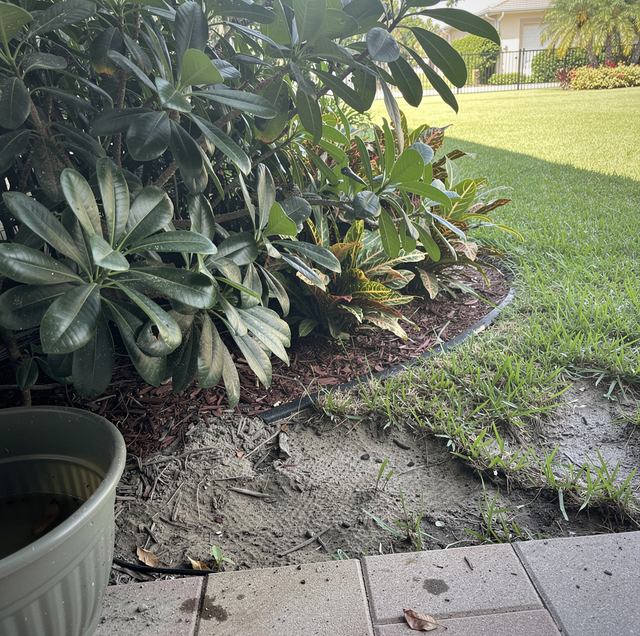
Not all greenery offers mosquitoes the same amount of usable resting surface. Broad-leafed shrubs, dense groundcover, and layered plantings with several levels of foliage close to the ground provide far more shaded leaf underside than a lawn, a bed of mulch with sparse plantings, or ornamental grasses with thin blades. If your yard is heavy with philodendron, ferns, or layered hedges, you are carrying several times the resting surface of a similar-size yard planted mostly in turf and a few widely spaced shrubs.
This is also where two lots with comparable planting-bed footage can carry very different pressure, because density and layering matter more than raw acreage of green space. An inspection of a heavily planted yard typically finds activity concentrated in the lowest, densest layer of foliage, close to the ground and out of direct sun. It is rarely spread evenly across every plant on the property. If the yard next door has open canopy and thin ground-level plantings, it simply has less of that low, dense layer, however many trees it counts overall.
Layered, ground-level foliage holds far more resting mosquitoes than tall canopy alone. An inspection typically checks the shaded understory first, since that dense, low layer usually shows more activity than the open lawn or the high tree canopy on the same lot.
Water Features and Containers Add a Layer Neither Lot Shares Equally
A birdbath, a rain barrel, a seasonal fountain, or a scatter of plant saucers and drainage trays changes your yard's mosquito pressure independently of everything else on this list. These features drop small pockets of standing water into a lot that might otherwise be well shaded and well drained, and they usually end up inside the same shaded, humid zones your vegetation already creates, where they evaporate slowly and stay usable to a mosquito far longer than they would sitting in open sun. If your yard carries an active water feature or a handful of containers that hold water after rain, you have an extra layer the lot next door does not, even where the two of you match on shade and drainage. Same canopy, same grading, and the two properties can still come apart sharply once one of them adds this layer.
| Variable | Yard That Stays Usable | Yard That Struggles |
|---|---|---|
| Shade and canopy | Broken shade, sun reaches the ground most of the day | Continuous canopy holding shade through the day |
| Fencing and hedge style | More open, gapped, or lower plantings | More enclosed, continuous fence and hedge line |
| Drainage and low point | Low point sits in open, sun-exposed ground | Low point sits under shaded planting beds |
| Vegetation density | Turf and scattered shrubs | Layered, dense foliage close to the ground |
| Water features and containers | None holding water after rain | A birdbath, fountain, or containers in shaded beds |
What a Barrier Treatment Targets and Where Its Edge Actually Sits
Every variable above points at the same target: the resting population, not the flying population. Mosquitoes spend roughly 23 of every 24 hours sitting quietly in shaded, humid foliage, and that resting group can run 10 to 100 times larger than the number actually flying and biting at any given moment. The reasons your lot and the one next door differ in shade, fencing, drainage, plant density, and water features are the reasons one of them holds more of that resting population.
That is the level a barrier treatment is built to work at. A yard with heavier canopy, more enclosed fencing, a shaded low point, dense layered plantings, and a water feature or two is offering more of the exact conditions that resting population depends on than a comparatively open, sun-exposed lot next door, before either one is treated. Walking your property with these variables in mind means finding where the resting population is actually concentrated and putting the treatment there. Running it evenly across the whole lot treats every square foot as though it were the same, and yours is not. Your mosquito pressure is a property-specific outcome, built out of your own shade, structure, drainage, and plant layers, and a neighborhood average tells you almost nothing about it.
Frequently Asked Questions
A barrier application is limited to vegetation with enough leaf surface to hold a fine residual: hedges, shrubs, understory plants, and the underside of broad leaves where mosquitoes rest. It does not coat open lawn, bare mulch, hardscape, or the air itself, because those surfaces don't hold residue the way leaf tissue does. So your yard and the one next door end up with quite different coverage, even though from the curb they look like the same visit.
It doesn't stop cleanly the way a property boundary does on a survey. What actually happens is a gradient: resting mosquito numbers fall away across the last several feet of a treated yard instead of stopping at a fixed line, because what changes at that edge is the vegetation, and vegetation pays no attention to a survey pin. A fence or dense hedge along that line can make the transition look sharper than it is, by hiding the last stretch of shaded foliage from view.
It does, and on those two exposed sides it usually works in your favor. A corner lot presents more of its perimeter to open street, which means more air moving across those edges and less of the continuous, enclosed hedge line an interior lot can build along two neighbors at once. What that tends to produce is a lopsided property: the street-facing sides run breezier and drier, and the single interior corner where your two neighbors' fences and plantings meet yours becomes the one truly sheltered pocket you have. If you are getting bitten on a corner lot, that back interior corner is almost always where the resting population is sitting, and it is a much smaller area to work on than a mid-block lot's entire rear boundary.
Losing a mature tree changes more than the view, and the change usually runs opposite to what you would expect. The sun now reaches ground that has spent years in the shade, and the plantings under it respond with faster, denser low growth, which is exactly the layer that holds resting mosquitoes. Stump grinding and the crew's traffic tend to leave a depression where the root plate was, and a depression collects water and keeps it. Then the replacement plantings go in around the same time. What you have done, without intending any of it, is trade high canopy that held relatively few mosquitoes for a thicker ground layer and a fresh low point that holds a great many.
It can, and the useful part is that it does not hold still. The prevailing direction here swings across the year, so the corner of your yard that sat sheltered through one season can be the breezy one a few months later, and the pocket you never gave a thought to becomes the one you get driven out of. That is why one evening's observation is a weak guide to where your resting population is sitting, and why noting the same corner across several weeks is worth a great deal more. Windward and leeward are labels that move around your lot. The shade and the planting density underneath them stay exactly where they are.
How much air a fence lets through decides this, and its height has surprisingly little to do with it. A slatted or picket fence leaks a fraction of the wind through its gaps, and that leakage is enough to keep air moving along the base and stop humidity from pooling there. A solid panel stops the wind outright, and outright is the problem: air hitting a solid barrier lifts over the top and comes back down some distance beyond it, leaving a pocket of nearly still air hugging the base on the sheltered side. That pocket typically reaches farther into the yard than the fence is tall. So the useful question about your own fence is not how high it stands but how much air passes through it, and a six-foot fence with visible gaps behaves very differently from a six-foot fence with none.
Have your lot walked and read against the one next door — Tyler can point to the specific shade, airflow, drainage, and planting differences behind the pressure you are living with. Buggify Pest Solutions serves Boca Raton, West Boca, and communities across Palm Beach and northern Broward. Call Tyler: (561) 672-0200.
