
Lawn Spray vs Mosquito Control: Why Your Yard Still Bites
If a lawn service already treats your yard on a regular schedule, it's reasonable to assume the same pass covers mosquitoes. The truck shows up, your turf gets sprayed, and the logic follows naturally: whatever kills what lives in the grass must also handle what's biting you at dusk. That assumption doesn't hold up, and the reason has nothing to do with how strong either product is. It comes down to where each treatment is actually aimed.
The confusion is understandable. One lawn service already touches every part of your yard you can see: grass, borders, sometimes a hedge line trimmed on the same visit. From the driveway it looks thorough. What that visit is formulated to do, though, is narrower than it looks, and understanding that narrower scope is the first step toward working out what your property still needs.
Where Mosquitoes Actually Spend Most of Their Day
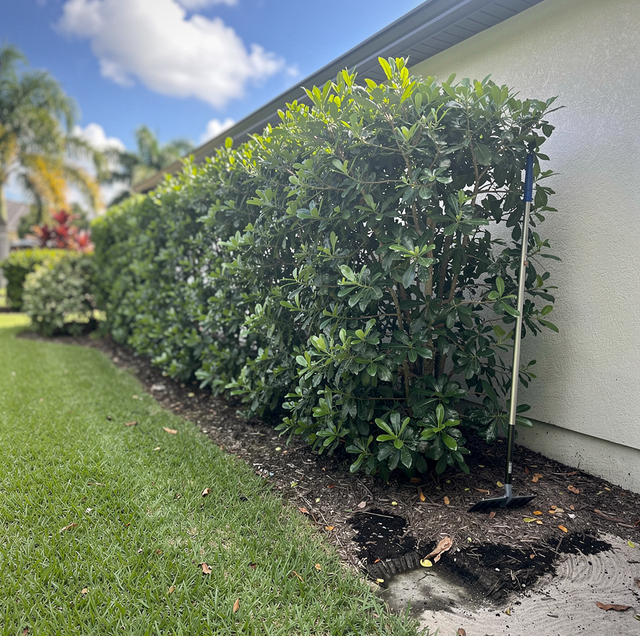
Start with the insect itself. An adult mosquito isn't out flying and biting most of the time — it spends roughly 23 of every 24 hours resting, tucked into the shaded foliage in your yard: the underside of a leaf, the interior of a hedge, a fern bed, a mulched border. That resting population runs 10 to 100 times larger than the number of mosquitoes actually active and biting you at any given moment.
A lawn spray is aimed at your turf: grass blades, thatch, the soil surface underneath. Foliage sitting a few feet away, at hedge height, is a different physical target that a turf-focused application was never formulated or aimed to reach. The insects doing the resting, which make up the bulk of the population on your property, are sitting exactly where a lawn pass doesn't go.
That resting behavior isn't incidental. Foliage gives a mosquito moisture, shade, and shelter from direct sun and wind that open turf can't, so its daily routine gravitates toward exactly the surfaces your lawn pass has no reason to touch. In a yard with deep beds and mature hedges, that routine means most of the population biting you never sets down on grass at all.
Turf Products Are Built for Turf Pests, Not Resting Adults
Products labeled and formulated for lawn care are designed to control insects that live in or feed on grass: chinch bugs, sod webworms, mole crickets, and grubs. Those pests spend their life cycle at or below the blade level, so the application is worked into your turf canopy at ground level, whether broadcast across the lawn or applied as a granular treatment.
Foliage-targeted mosquito treatment works differently. It's applied as a fine mist designed to settle on the underside of leaves, where resting adults land and where a residual layer must remain for an insect to make contact with it at all. That's a different surface in your yard, a different application method, and a different pest category than anything a turf product is built to address. The residuals used on the mosquito side, bifenthrin and lambda-cyhalothrin, are chosen for how long they stay put on a shaded leaf underside in high humidity, which is a question a turf label never has to answer.
A Broadcast Pass Structurally Misses the Vertical Surfaces
Turf equipment is calibrated to move across open ground, whether that's a walking pattern with a handheld sprayer or a wider broadcast head aimed down at your lawn. There's no reason for that equipment to angle up into a hedge canopy or reach the shaded underside of a leaf sitting at hedge height above the soil line, because that space was never part of what it's treating.
Mosquito application moves in the opposite direction. A technician directs the nozzle up into the plant canopy, so droplets settle on the undersides of leaves. The top surface takes direct sun and rain, which strip away a residual layer much faster. Down into your soil versus up into your foliage is the actual structural gap between the two services, and no amount of care on the turf pass closes it.
A turf product aimed up into a hedge canopy is being used outside the surfaces it was formulated and tested against, which puts droplets where drift, skin contact, and overspray were never anticipated. Leave canopy work to the applicator.
Standing Water Needs Elimination, Not a Spray Pass
Even a well-placed foliage application only addresses resting adults. Immature mosquitoes develop somewhere else entirely: standing water, and not much of it. Aedes needs roughly half an inch to complete its life cycle from egg to adult. Bromeliads, clogged gutter sections, plant saucers, folds in a tarp, and low spots in your beds that hold water after an afternoon storm all clear that bar.
A foliage or turf spray doesn't reach larvae developing inside those pockets, because the application is a surface-contact treatment aimed at resting adults. Nothing about it was designed to break a water source's ability to support development. Water sources on your property must be identified and addressed as a separate category, distinct from whatever is applied to your grass or shrub line.
What a Treated Lawn Still Leaves Uncovered
It helps to see the difference laid out plainly, since from your driveway the two services can sound similar even though the target, the method, and the pest category are all different.
| Turf (Lawn) Treatment | Foliage Mosquito Treatment | |
|---|---|---|
| What it targets | Grass blades, thatch, soil surface | Underside of leaves, shaded canopy interior |
| Application method | Broadcast or granular across the lawn | Fine mist directed up into shrub and hedge canopy |
| Pest category addressed | Chinch bugs, sod webworms, grubs, mole crickets | Resting adult mosquitoes |
| What it does not reach | Foliage and shrub interiors | Turf-dwelling insects |
| Water sources | Not addressed | Not addressed by the spray itself; treated as a separate step |
Your yard can be fully covered on the turf side and still be untouched on the side where the biting population actually rests.
One Season Doesn't Answer the Question
In a humid coastal climate, shaded foliage remains a viable resting surface well outside the peak summer months. Even in cooler, drier stretches, your established shrub lines and shaded beds hold enough moisture to continue supporting a resting population long after turf-grass growth and turf treatment schedules slow for the season.
The gap between what your lawn pass covers and what a mosquito population needs doesn't close because the calendar changes. It stays open until something is actually aimed at your foliage, independent of what the lawn service is doing. In practice, that means a yard which looks dormant from the street in February can still be holding a resting population under the hedge line, on a timetable that has nothing to do with when your grass starts growing again.
Frequently Asked Questions
Products used for foliage-targeted mosquito treatment, such as bifenthrin and lambda-cyhalothrin, are residual formulations designed to persist on plant surfaces for 21 to 30 days in high humidity. Rain and new leaf growth can shorten that window in your yard, so the interval between visits matters as much as the application itself.
They can, and on properties carrying both they often do, but they remain two separate passes with two separate targets. The turf application goes down at ground level, and the foliage application goes up into the canopy, so neither one substitutes for the other, no matter how close together they land on your calendar. What matters more for you is the water in between them. A foliage residual needs roughly 30 to 60 minutes of dry time before anything wets the leaves it was applied to. Irrigation or a turf watering that runs too soon after the mosquito pass can strip coverage off the leaves the same afternoon it went on.
No, and the reason is physical before it is anything else. A granular product is built to fall through grass and settle at the thatch and soil line, which is where turf pests live. Dropped into a hedge bed, it behaves the same way: it lands on the mulch under the shrubs, nowhere near the underside of the leaves where adult mosquitoes actually spend the day. Getting a residual onto a shaded leaf underside takes a fine mist and an upward-directed nozzle. A granule has no route to that surface, whatever it gets spread on.
Not necessarily. Most yards carry 5 to 10 active micro-breeding sites at any given time, and the majority are small enough to walk straight past: a clogged gutter section, a plant saucer, a fold in a tarp. Few of them look like standing water from where you would normally be standing, which is exactly why they go unnoticed.
Two things are worth separating here. Lawn care runs only as an add-on for HOA and luxury-estate properties, never as a standalone residential service, so most homeowners reading this have no turf line item to fold anything into in the first place. Where it does run, that add-on is scoped to the turf: grass health and turf-feeding insects. The shaded foliage and shrub lines where mosquitoes rest lie entirely outside it. Mosquito coverage is its own service aimed at the plant canopy, and it is scheduled that way whether or not a turf line exists on the same property.
More than it would on a grass-heavy property, if anything. Taking out turf removes the turf pests and the reason for a lawn pass, but it does nothing to the resting habitat, and beds, hedges, and container plantings are exactly where the resting population sits. A paver courtyard ringed by dense shrubs can hold a heavier resting reserve than an open lawn with a thin border, simply because there is more shaded leaf surface per square foot. With no turf service on your property, foliage treatment isn't competing with anything for credit; it is the only thing aimed at where your mosquitoes actually are.
Point a technician at the foliage line — the resting population finally gets an application aimed at where it spends the day. Buggify Pest Solutions serves Boca Raton, West Boca, and communities across Palm Beach and northern Broward. Call Tyler: (561) 672-0200.
