

Roofer Found Rat Droppings? What Happens to the Job Next
Quick Answer: A roofer who finds droppings or nesting material mid-job is reporting evidence, not diagnosing a rodent problem. A separate pest inspection covers the roofline and interior, and scheduling it while the roof is still open keeps the findings useful.
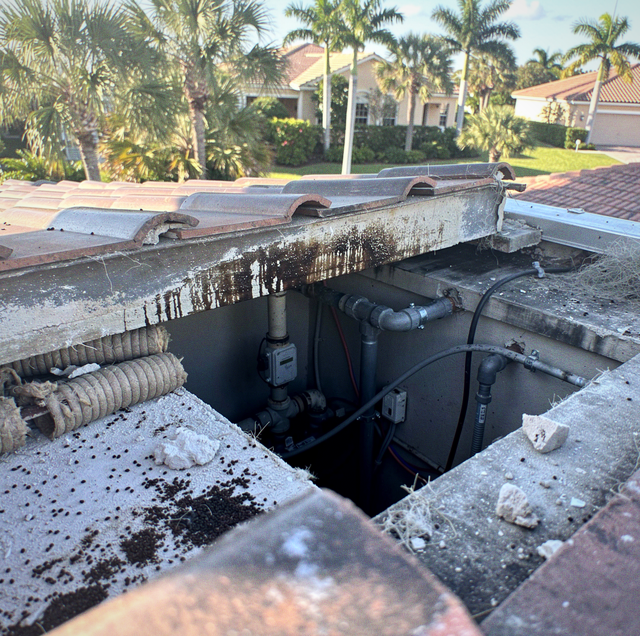
The call comes in around midmorning, while the crew is still up there. It is the roofing contractor, not calling about a problem with the job itself, but to say that when they pulled back a section of tile, they found a scatter of dark droppings pressed into old insulation, and a run of grease-dark staining along the batten line next to it. The tile is off, the deck is exposed, and the crew is still on site, which is the easiest moment there will be to do something with what they found.
Why a Roofer Sees It Before Anyone Else
A roofing job routinely opens sections of a house that almost nobody else ever sees uncovered. Tile gets lifted, old underlayment gets cut away, and while the work is underway, the deck is exposed to daylight in a way it is not the rest of the year. Droppings on old underlayment, nesting material tucked next to a penetration, or a dark rub mark on bare decking becomes visible because the material covering it came off during the roofing work, not because anyone went looking for rodent sign.
That is why the discovery so often belongs to the roofing crew rather than to the homeowner or a pest technician on a routine visit. The crew is handling the one layer of the house that is normally sealed shut. None of that makes a roofer a rodent specialist. It makes roofing the trade most likely to be in the right spot, mid-job, when evidence is lying in the open.
If droppings or nesting material get disturbed while a section of roof is open, that material is a gloves-and-bag matter, and any actual cleanup or insulation removal is separate trade work that a pest control scope does not include.
What Roof Work Actually Closes
Roof repair and replacement legitimately closes some of what it exposes along the way. New decking replaces sections that were compromised. New underlayment goes down as a continuous layer rather than a patch. Boots and flashing around penetrations get replaced outright instead of recaulked. Where an old gap sat under a cracked or shifted piece the crew was already replacing, the new material closes it as a normal part of doing the roofing work correctly.
The same work runs the other direction at the same time, which is the part that gets missed. A tear-off also strips off whatever rodent-rated closure was already in place. The birdstop line where the first tile course meets the eave, the screening on vents, and the counterflashing at a chimney chase all come away with the old tile, and what goes back on is whatever the roofing crew installs as its standard detail. So the net effect of a re-roof on a house's rodent exposure is not known until the finished roof gets checked against a rodent standard rather than a roofing one. A single job can close old gaps and take out old closures on the same house.
Either way, closure here is a byproduct of good roofing craftsmanship rather than a rodent-specific service. A roofer is building to roofing tolerances, checking that a deck is sound and a penetration is properly flashed, not checking a seam against what a rodent can or cannot get through.
What Roofing Does Not Cover
The reverse holds just as firmly, because a roofing scope stops at the roof assembly. Droppings inside the attic away from the deck, nesting material tucked into insulation, a rub mark lower down on framing, or an opening elsewhere on the building envelope that has nothing to do with the tile being replaced: none of that normally sits inside a roofing scope. Whether a given re-roof includes soffit and fascia work varies from project to project, and that boundary is set long before anyone finds anything unusual. The attic interior, wall voids, and ground-level openings around the foundation stay outside the roofing work either way.
That boundary is not a gap in the roofer's work but the edge of it. A roofing crew doing a careful, complete job can still hand back a house with an active rodent route sitting somewhere the roof job was never asked to reach. That is not a contradiction, just two trades working to two different boundaries.
Why the Order Between the Two Jobs Matters
Once tile goes back down and new underlayment is fastened, that section looks the same from above as any other run on the house, and nothing about the finished surface says which one had droppings under it. That is why sequencing matters. While the deck is still open, the specific spot the roofer saw can be looked at directly.
Waiting until the crew is gone does not stop anyone from inspecting the house afterward; the building is still there. What it costs is the one look at the exact spot while it was open. In practice, that argues for getting the pest side scheduled while the roofer's job is still moving, or at least before that specific section closes back up.
What Gets Lost Once the Deck Closes Back Up
None of this makes a completed roof a dead end, and the physical closure work is normally sequenced after the roofing crew finishes anyway, since a re-roof reopens the same eave, vent, and chase lines any closure would sit on. What waiting costs is narrower than it sounds: not the ability to inspect the house, but the ability to point at the exact thing the roofer saw while it is still there to point at.
A description relayed secondhand, after the fact, is not the same as that mark being read directly while the material was still exposed. The section that was briefly open is now identical, from the outside, to every other run on the house. The sighting is still worth having, since it points to a later inspection of the right stretch of roof rather than the whole building, but a lead is a weaker starting point than the same finding read while the deck was open.
What to Ask Each Trade so Nothing Falls Between Them
Before the crew moves past that section of roof, it is worth asking the roofer exactly where the material was relative to a fixed roof feature, what it looked like (droppings, nesting material, staining, gnaw marks, or a live animal), and whether anything was photographed before it got covered back up. None of that asks a roofing crew to step outside its own job. It just keeps a record of what was seen and where, for whoever picks up the pest side of it.
On the pest side, the questions are whether someone can come look while the roofing job is still active, and what that visit will and will not cover, so nobody expects a diagnosis or a trap line out of a call that was really about an exposed section of deck.
Neither trade is positioned to do the other's job. A roofing crew is not going to identify what left the droppings or say whether the attic currently has activity, and a pest technician is not going to touch tile, underlayment, or flashing. Asking each side what it saw and what happens next is what keeps two separate jobs from passing each other.
Frequently Asked Questions
A record that still works after the roof closes shows where the material sat relative to a fixed roof feature, such as a vent stack or the ridge line, so the spot can be located again, and shows it closely enough to tell dark and fresh from gray and crumbling. That freshness read is part of what a later inspection wants to know. None of it involves handling what is in the frame, which stays a gloves-and-bag matter for whoever removes it.
The attic underside of the same run. The deck side is out of reach for good once new material is fastened over it, but the stretch directly below stays reachable from inside, and it reads differently: framing, insulation, and the inner face of the deck rather than anything that was lying on top. Staining or droppings under a run the roofer flagged from above is a separate finding about the same stretch of roof.
No. A tear-off removes nesting material sitting on or under the old roof covering, but rats living below the deck line, in the attic or in wall voids, are not reached by that work at all. Any that scatter during the noise of the job tend to return once the site quiets down, because a tear-off is a roofing process, not a pest treatment.
A repair that lifts a few courses opens a narrower window in both senses. The exposed area is a small section rather than the whole slope, so the finding is tightly tied to a single spot. But that section usually closes back up during the same visit rather than staying open over a longer job, so what survives is the account of what was seen, not the opening itself. On a repair, the description and any photos carry more weight than scheduling around an open roof.
Only one section is open at a time, which turns the question from whether the roof is open into which part of it is. A finding on the section currently stripped can still be read while it is exposed, while slopes not yet started remain covered and finished slopes are closed. Phasing also extends the period when some part of the house is open, so a finding early in a staged job leaves more room to act.
Because they sit on opposite faces of the same board and say different things. Material packed on top of the deck, under tile or old underlayment, points to something nesting or traveling inside the roof assembly. Droppings on the attic side of that same deck suggest something is using the attic space below. A roofing crew working from above sees only the first, which leaves the attic side of that run unread.
Call while the roof job is still moving — the open section gets read before it closes back up. Buggify Pest Solutions serves Boca Raton, West Boca, and communities across Palm Beach and northern Broward. Call Tyler: (561) 672-0200.
