

Mosquito Control Service: Monthly or 8 Weeks, and What Decides It
Two mosquito control service cadences show up on almost every proposal you will read for a South Florida yard: a treatment every month, or a treatment every eight weeks. Both draw on the same residual chemistry and the same application methods. What separates them is what happens in your yard between visits and whether your own water and foliage close that window faster than the schedule assumes. Setting the two side by side before you commit to either is how you land on an interval that matches what is actually breeding behind your house. Neither cadence is inherently better. Your property's biology decides which one closes the gap and which one leaves your yard time to finish a generation before the next visit arrives.
What the Residual Barrier Actually Covers
Professional residual products such as bifenthrin and lambda-cyhalothrin settle into the waxy surface of the foliage in your yard and hold an active adulticide barrier for 21 to 30 days in high humidity. South Florida sits in the 70 to 85 percent humidity range for most of the year, which pushes that window toward its shorter end. Once the period passes, the active ingredient has broken down to below effective concentration, and there is no barrier left on your leaves, whether or not another visit is on the calendar.
A 30-day interval sits right at the edge of that 21-to-30-day window, so a fresh application generally lands on your foliage before the previous one is fully spent. A 56-day interval, the span between visits on an eight-week cadence, pushes 26 to 35 days past the point where the residual has already exhausted itself. For that stretch, your yard carries no active barrier at all.
The Breeding Clock Moves Faster Than the Calendar
Aedes mosquitoes complete an egg-to-adult cycle in 7 to 10 days during summer heat; Culex takes 10 to 14 days. Line that up against the uncovered stretch on an eight-week cadence and your yard has room for more than one full breeding cycle to finish before the barrier gets refreshed. On a monthly cadence, the residual is still active for essentially the entire interval. Hence, eggs laid early in the window rarely reach biting adulthood before the next application resets the barrier.
That arithmetic is the whole cadence decision. The question you are answering is whether the gap between your visits runs longer or shorter than the time mosquitoes need to reproduce on your specific property.
Standing Water Multiplies the Math
Your yard almost certainly has 5 to 10 active micro-breeding sites at any given time: plant saucers, gutter sections, tarp folds, and similar pockets that hold water long enough to sustain a breeding cycle. Bromeliads add a distinct source. The central cup at the base of the leaves holds water. Aedes needs only about half an inch of standing water to complete development, and a yard with 10 or more bromeliads can produce over 1,000 adult mosquitoes a month from cup water alone, independent of anything else you have planted.
If your property carries that many active water sources, it regenerates breeding pressure faster than a yard without them, which pushes your cadence decision toward the shorter interval in any season. If you have few or no standing-water features, less pressure rebuilds in the gap, and that is where the eight-week interval has more room to work.
The two cadences, side by side:
| Factor | Monthly | Every 8 Weeks |
|---|---|---|
| Residual coverage across the interval | Continuous — next visit refreshes the barrier before it fully exhausts | 26–35 days uncovered once the 21–30 day residual runs out |
| Breeding cycles possible in the uncovered window | Essentially none; the interval matches the residual's active life | More than one full cycle can finish inside a single gap |
| Your property fit | 5+ active micro-breeding sites, bromeliads, canal or preserve-adjacent water | Minimal standing water, few resting sites, ongoing source removal |
| Seasonal fit | Peak heat and humidity, when both residual life and breeding cycles run short | Cooler, lower-humidity stretches when both stretch longer |
What Opens Up in the Gap Between Visits
The uncovered window is not unique to the eight-week interval; it gets more severe as the interval stretches. At a 12-week interval, more than 60 days go by with no active residual once the barrier has exhausted, and that stretch is long enough for four to six full breeding cycles to complete on a property with any meaningful water source. Measured against that, eight weeks is already an improvement if your yard runs low-pressure, while monthly is what closes your uncovered window down to nearly zero if it does not.
That window is also not a fixed number, because the residual it follows is not. A barrier that holds the full 30 days leaves 26 days of an eight-week interval with nothing on your foliage; one that gives out at 21 leaves 35. Same schedule, same chemistry, and more than a week of difference in how long your yard spends unprotected, decided by humidity, rainfall, and how much leaf surface the application had to cover.
Season sizes that gap as much as the interval does. Warmer, more humid months push every part of the equation toward its faster end: residual life trends toward the shorter side of its 21-to-30-day range, and both Aedes and Culex development run at the quicker end of their cycles. That is the reasoning behind a monthly interval from May through October and a bi-monthly one from November through April. Cooler, drier stretches reverse both directions at once, so your residual holds longer, breeding takes longer, and the uncovered window narrows even at a wider interval. South Florida rarely sees a true cold snap, so nothing here stops outright, and the seasonal question is only how much cushion your equation needs. If you have watched bites return earlier in one season than another on the same schedule, you have already seen the gap change size underneath you.
Foliage Density Changes Where the Barrier Needs to Reach
Adult mosquitoes spend 23 of every 24 hours resting on the underside of foliage, and the resting population in your yard runs 10 to 100 times larger than the number biting you at any given moment. If you have dense shrub lines, heavy understory, or a mature canopy, you are holding a much larger resting reservoir that the barrier must saturate at every visit. Sparse plantings support far fewer resting sites, so the same interval that leaves a heavily planted yard exposed can hold up fine on a lighter one. A missed or delayed visit also sets you back further on a heavily planted property, since there is more of that reservoir for the barrier to reach each time it comes back.
Two yards on the same street, on the same schedule, can produce noticeably different results for that reason alone. Your cadence question is inseparable from how much foliage your barrier has to cover.
Frequently Asked Questions
Often, yes. A pond or fountain installed in June adds a permanent water source your yard did not have on the day your interval was set, and it sits outside the 5 to 10 micro-breeding sites counted on the original walk-through. Adding it mid-season does two things to your schedule at once. It raises the baseline your property regenerates to between visits, so the same gap that held up comfortably in May no longer holds up in July. It also takes away the seasonal reset a rain-fed container hands you, because a feature that holds water year-round never draws down the way a saucer does between storms. Both effects push in the same direction. An interval already sitting at the edge of comfortable usually wants to be tightened once permanent water goes in, and the middle of a warm season is where that shows up fastest.
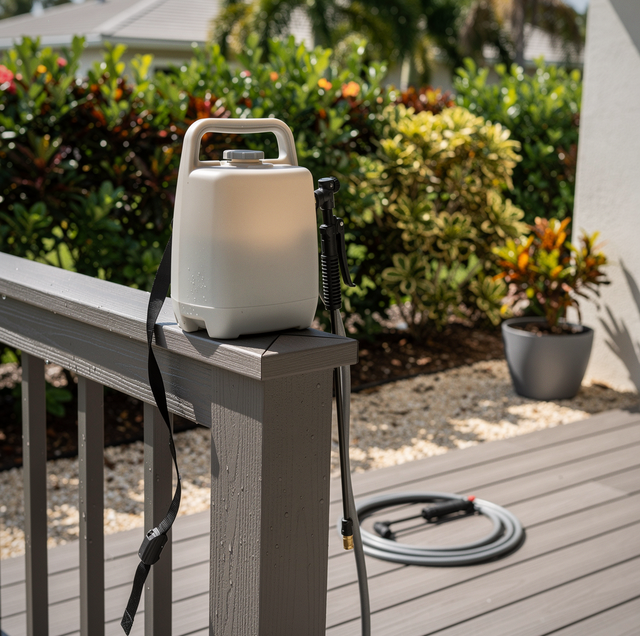
Barrier applications reach your foliage through a VectorFog C100 ULV unit for fine-droplet coverage across broad planted areas, a Cardinal CPS435 for targeted spot treatment, and a Solo 475-BHD backpack sprayer for tighter or hard-to-reach spaces. Which piece comes off the truck on a given visit depends on how your property is laid out. Your schedule does not decide it.
Usually the water side. The first pass drops the adult count and gives a technician a clean baseline to read your yard against; the second visit is where the smaller producers separate, because a property that is no longer throwing off a heavy adult population makes the remaining sources far easier to isolate. Notes from a second visit tend to shift away from where mosquitoes are resting and toward which specific containers, low spots, or plant cups keep refilling between appointments. That shift is often what settles your cadence question for the rest of the season.
A significant storm can leave your property with 50 to 100 new micro-breeding sites overnight: clogged gutters, upturned pots, tarp folds, and pooled debris all count toward that number. If that lands partway through an eight-week gap, flag it. Waiting out the balance of the interval hands those sites the full run they need, and the storm has already reset your breeding math ahead of schedule.
Yes. Canal frontage adds a permanent water edge that sits outside your yard's normal micro-breeding count, and areas like Coral Springs, with its extensive engineered canal network, or canal-built communities like Lighthouse Point, carry more consistent adult pressure from that adjacent water than a property set back from any waterway. That standing pressure is one of the clearer arguments for holding the tighter interval and leaving the eight-week question untested.
Adult numbers typically drop 60 to 80 percent within 48 to 72 hours of a barrier application, so you will notice the change well before the full interval is up. That knockdown speed is roughly the same on a monthly schedule and an eight-week one. What differs is how long your lower numbers hold before the next visit is due.
Talk through the cadence decision for your property — and land on an interval sized to what is actually breeding behind your house. Buggify Pest Solutions serves Boca Raton, West Boca, and communities across Palm Beach and northern Broward. Call Tyler: (561) 672-0200.
