

Mosquito Treatment for Yard: Why Canal-Front Lots Differ
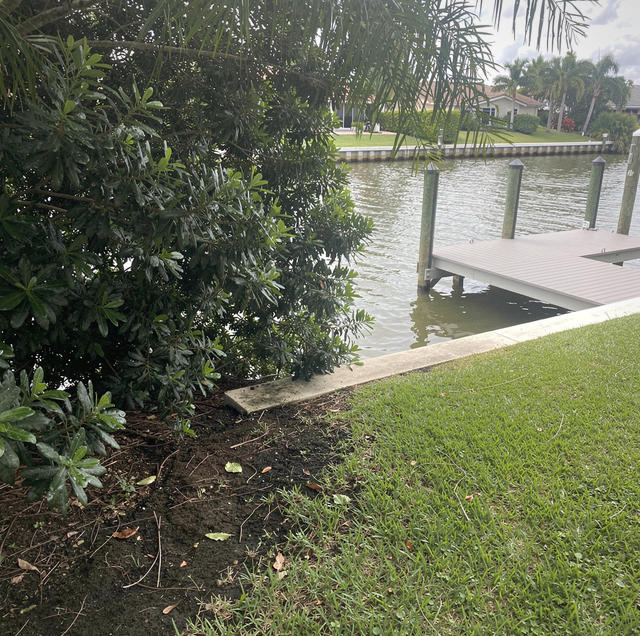
A canal-front yard and an inland yard of the same square footage are not the same job, even when the property lines look identical on a survey. An inland quarter-acre stops at a fence or a hedge, and every part of it either holds water after rain or dries out within a day or two, so a standard perimeter treatment can reasonably cover the whole property because the whole property is lawn, mulch, and a handful of low spots. Your canal-front lot has all of that, plus a second edge that never fully dries out: the bank sloping down to the waterline, the seawall or rock bank holding that slope in place, and often a dock structure sitting over the water itself.
That extra edge is more than a small add-on to your yard. Resting adults outnumber the ones actually biting anyone by something on the order of ten to a hundred times, and the shade, moisture, and shelter they select for are concentrated at exactly that edge, so a disproportionate share of the resting population on a waterfront lot spends its day there. Treating your canal lot like a standard perimeter, stopping where the lawn stops, leaves the busiest part of the property untouched, and it is the part most likely to be missed by anyone who has not walked a waterfront lot before.
The Waterline Edge Is Its Own Habitat, Not a Property Line
On an inland lot, the back property line is usually a fence, a wall, or a hedge, and a technician's perimeter sweep naturally ends there. On your canal lot, the property line runs down a graded bank to the water, and that bank behaves nothing like the flat lawn above it. Moisture wicks upward through the soil at the base of the slope even on days without rain; the grade itself keeps a strip shaded for much of the day, and the grass or ground cover along that strip tends to grow thicker and stay damper than the turf higher up your yard.
How long it stays damp depends partly on which way your bank faces. A north- or east-facing slope loses the afternoon sun entirely and can still be wet at the surface when a west-facing bank forty feet away has dried out. Either way, the transition from dry lawn to damp bank happens within a few feet, which is easy to miss from your patio and obvious once you walk the slope directly. A perimeter treatment aimed at the fence line or the edge of the lawn never reaches this zone at all, because on paper it reads as more lawn. On the ground it is a separate edge running on its own conditions.
Walk your bank on a dry afternoon and note where the ground turns cool and yielding underfoot. That line marks the top of the damp margin, and it usually sits several feet higher up the slope than the waterline itself suggests.
Dock Lines and Pilings Hold Their Own Microhabitat
Your dock adds structure the rest of the yard does not have: pilings, cleats, boat lift hardware, and the joints where decking meets the seawall or the water. Each of those pieces creates a small shaded gap or void that can trap rainwater and stay damp long after the surrounding deck boards have dried, and metal fittings in particular tend to hold a film of moisture that plain wood decking sheds more quickly. Foliage often grows up around pilings and along the dock line too, since the structure blocks foot traffic and mowers alike, leaving a strip of unmanaged growth right where the shade and moisture are already highest. On canal-front properties, this dock line usually gets its own foliage residual application, applied separately from the rest of the yard because it behaves differently from open lawn.
Bank Foliage Carries the Resting Population
Adults spend the overwhelming majority of their lives at rest, roughly 23 of every 24 hours perched on foliage, and the resting population on a property typically runs ten to a hundred times the number actually biting anyone. Dense bank plantings matter more than the water itself for exactly that reason. Mangrove, sea grape, and other shoreline vegetation common along canal banks create the shaded, humid, wind-sheltered cover resting adults prefer over open lawn grass, which gets direct sun and airflow for most of the day.
That preference holds regardless of how manicured the rest of your property is. A well-kept lawn with one dense, untouched planting bed at the water's edge can still carry a sizable resting population in that single strip, and your bites will keep coming from it while the turf twenty feet away stays quiet. A canal-focused treatment applies a targeted residual to this foliage and treats it as a separate surface from the open turf closer to your house, because the two are not doing the same job for the insect population.
The Seawall Face and Its Weep Holes Add Vertical Habitat
A seawall is not simply a wall; it is a vertical strip of habitat that a flat inland yard has no equivalent for. Most seawalls include small weep holes built into the face to relieve water pressure behind the wall, and those holes remain damp or continuously seep, providing mosquitoes with a steady moisture source at wall height and at ground level. The shaded side of your wall, especially where it faces away from direct afternoon sun, often carries a film of algae or moss that traps additional moisture against the concrete, and the cap along the top edge can collect a thin layer of standing water after a heavy rain. A canal-appropriate perimeter treatment along this face is applied with care to avoid water on the other side, using smaller, hand-directed volumes instead of broad equipment near the wall's edge.
Seawall caps, dock edges, and rock revetment banks can be slick with algae or unstable where erosion has undermined their bases. Check your footing before you step onto any of them, and keep children and pets back from the edge.
Open Canal Water Rarely Breeds What the Margin Does
It is tempting to assume the canal itself is your source, but open water with wind moving across it and fish feeding beneath the surface is a poor place for mosquitoes to develop. Wave action from wind and passing boat traffic disturbs the surface enough to disrupt egg-laying and larval development, and predatory fish common in canal systems feed on what larvae do survive, which keeps the center of the channel largely unproductive even on a lot with dozens of feet of water frontage. The habitat that actually supports the population sits at the margin instead: your bank foliage, the seawall face, and the sheltered pockets around dock structure, all of which stay calm, shaded, and damp in a way the open channel does not. Coral Springs, with its extensive canal network winding through nearly every neighborhood, and Lighthouse Point, built almost entirely around canal frontage, both show the same thing at a larger scale: more canal edge means more margin habitat, and the open water in between stays largely unproductive.
The Pressure Doesn't Ease the Way It Does Inland
An inland yard usually gets some relief during a stretch without rain, when puddles and low spots dry out and the yard resets. Your canal-front margin never gets that reset, because it is fed by the water body itself as much as by rainfall, so the bank stays damp even when the rest of your yard has gone dry for a week or two. Around Delray Beach and Boynton Beach, properties along the inland freshwater shorelines see breeding activity at that margin persist year-round, without the seasonal pause an inland lot experiences.
Seasons still count for something. Overall numbers shift with rainfall and temperature, and a service schedule that runs monthly from May through October and every other month from November through April reflects lighter, though not absent, activity in the cooler months. Boynton Beach and Deerfield Beach properties along their own canal systems follow the same pattern, so a canal-aware approach is applied consistently across the thirteen cities in the two counties where waterfront lots appear, in the cool months as well as the warm ones.
Frequently Asked Questions
Yes, and it changes how your edge gets walked. A vertical seawall hands insects one continuous damp face to rest against. A riprap or rock revetment breaks that same edge into dozens of small crevices, each holding its own pocket of shade, trapped debris, and moisture between the stones. Whichever one holds your slope in place gets treated on its own terms, because the insects use the two edge types differently.
It changes which species are most comfortable working the immediate margin, since tolerance for salinity varies between them, but it does not change the basic picture. Whether the water at your bank is fresh, brackish, or somewhere in between, the vegetation, structure, and shaded, damp edge next to it remain the part of the yard that does the work.
Somewhat. A fixed dock sits at a constant height above the water. If yours floats, it rides up and down with the tide or with rainfall, which keeps the underside of its pontoons and the joint where it meets your seawall wet across a much wider band than a stationary structure ever gets. Say which one you have when you book the walk.
Cutting back is not the same as treating, and it is not a pest technician's call to make on your waterway bank. Thinning dense growth does reduce shaded resting surface. Your bank then regrows in the same habitat within a season or two, and the damp margin beneath it never changes at all. Foliage treated where it stands keeps working on the resting adults and leaves your slope as it is.
It does. If your canal is tidal, its waterline rises and falls through the day, exposing and re-wetting a band of your bank twice daily. A landlocked pond or lake's edge leaves one with a fixed, wet line and holds it. That moving band is usually wider than you would guess from watching the water at any single hour.
Anything you leave dockside with a curved surface, a lid, or a recessed handle can hold a small amount of water after rain, exactly the way a forgotten planter elsewhere in your yard does. Your stored gear along the waterline gets checked for the same reason every other object capable of holding water gets checked.
Have your waterline walked by someone who treats the bank, dock line, and seawall on their own terms — a canal-front lot carries habitat that a standard perimeter sweep never reaches. Buggify Pest Solutions serves Boca Raton, West Boca, and communities across Palm Beach and northern Broward. Call Tyler: (561) 672-0200.
