
Bird Feeders, Pet Bowls, and What Attracts Roof Rats
Quick Answer: A bird feeder, a pet bowl, or a fruit tree does not have to go away to stop drawing roof rats. What matters is how much food sits within reach after dark and how long it stays there.
You put that feeder up because you like watching cardinals work the perch in the morning. You feed the dog on the lanai because dragging a bowl in and out twice a day is not how you want to spend your life. Neither is a mistake, and neither has to end for a roofline to stay quiet.
What follows looks at each place food is put out on purpose, what a roof rat actually finds there, and the one adjustment at each spot that changes what the property offers, without asking you to give up any of it.
Seed Feeders and the Spill Zone Beneath Them
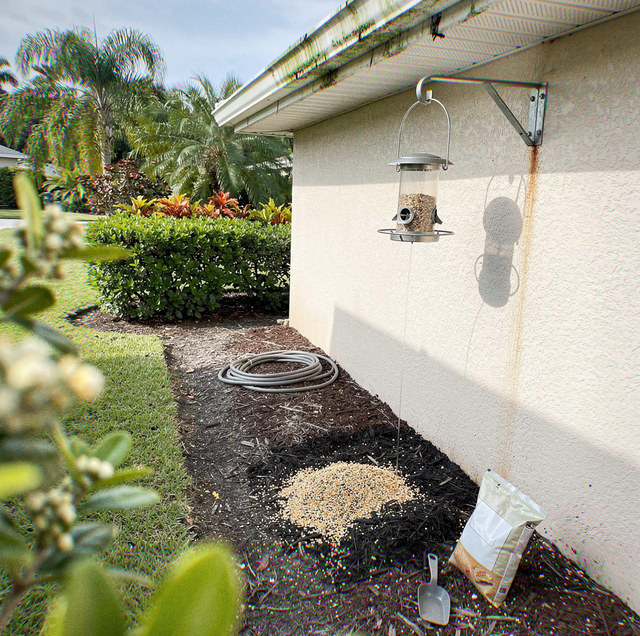
The draw at a seed feeder collects on the ground underneath it. Birds knock hulls and whole seed off the perch, and a mixed blend loaded with milo and cracked corn gets kicked out faster than it gets eaten, because most backyard birds pick through a mix for the parts they want. That discard pile builds night after night, and a rat has no reason to reach the feeder itself when the ground beneath it is already stocked.
What happens to the miss matters more than the feeder style. Seed over bare soil or mulch settles in and keeps its value to something feeding after dark. The same seed over a surface that gets cleared on a regular pass through the yard never builds into a reserve at all. A blend with less filler and more of what local birds actually eat also means less gets kicked out to begin with.
Fallen fruit under a mango, a loquat, or a citrus works the same way once it splits where it lands: feeding by consequence rather than intent.
None of this asks you to take the feeder down. It asks you to treat the ground under it as part of the feeder rather than as something separate.
Outdoor Pet Feeding and the Schedule
A bowl set out once and left is a different situation than a bowl that gets filled, watched, and picked up. The difference is not the food; it is how much of the day it sits available with nobody around.
Feeding at set times and removing what is left once your pet loses interest keeps the bowl empty for most of the night, when roof rats are active and foraging. A bowl topped off before bed and left for a dog or an outdoor cat to graze through the night is available for exactly the stretch a rat is out looking. The pet gets fed the same either way.
Dry kibble in a covered bowl does not spoil quickly, and it sits reachable at ground level, right where a climbing rodent still has to pass on its way up the wall.
Between meals, the bigger reserve is the bag it came out of. What sits in a bowl overnight is one animal's grazing; an opened sack of kibble or seed is a standing supply that outlasts any single spill many times over, which is why the container it lives in carries more weight than the bowl ever will.
Water Beside Food
Water on its own does not decide whether a rat comes around. What it does is hold an animal that is already being fed. A pet's water dish beside its food dish, or a birdbath near a feeder, turns one stop into a complete one, and a spot offering both a meal and a drink gets revisited more reliably than a spot offering only one.
Water that drains, or that gets refreshed on the same routine as everything else rather than standing in a shallow dish at a feeding spot, takes that half of the stop away without touching the feeding routine at all.
Cover Beside the Feeding Spot
Where a bowl or feeder sits affects how usable the food is, separate from how much of it there is. Food set tight against a wall, a dense planting bed, or a stack of pots can be worked from under cover with an exit available the whole time. The same food out on open ground leaves an animal exposed for the length of the meal, and exposure is something a rat weighs.
That is why two identical bowls on the same property get used differently. Nothing here asks for a bed to be thinned or a shrub to come out. It is only about where the food sits in relation to them: a dish set out from the wall, or a feeder hung over open turf rather than over dense ground cover, offers the same meal on worse terms.
Anything on the ground showing gnaw marks, whether chewed fruit, opened seed, or a bag that has been worked, is a gloves-and-bag removal rather than a bare-hand one. Gnaw damage means an animal has already been feeding there.
What Changes and What Stays the Same
Each of these is a place food shows up on purpose, or as a side effect of something put there on purpose. None requires giving up the feeder, the bowl, the pond, or the tree to stop functioning as an open invitation.
| Feeding situation | What draws a rat | The adjustment |
|---|---|---|
| Seed feeder | Spilled seed and hulls on the ground | Keep the ground under it cleared on a routine, and pick a blend with less filler |
| Outdoor pet bowl | Food available around the clock | Feed on a schedule and take the bowl up after the meal |
| Water near food | A complete stop in one spot | Keep water fresh and draining rather than standing |
| Stored feed | An open bag holding far more than any single spill | Keep it in a sealed metal or hard plastic container |
| Fallen fruit | Fruit left to split where it lands | Clear it on the same routine as the rest of the yard |
These adjustments do the same job several ways: they shorten how long food sits reachable after dark. The feeder stays up, the bowl still goes out, the tree keeps its fruit. By the time a rat comes looking, there is less of it still sitting there.
Frequently Asked Questions
A catch tray reduces the amount of seed that reaches bare ground, but it does not eliminate spillage. Hulls and fine seed dust still sift through most tray designs, and the tray itself becomes a reservoir of debris that has to be cleared out on a routine basis, or it ends up working as a shallow feeding dish of its own, just lower to the ground.
Suet is a solid block of rendered fat held inside a wire cage, and birds peck it in place rather than carrying pieces to the ground the way they do loose seed. Because very little falls or gets kicked loose, a suet feeder does not build the same ground-level spill pile a seed feeder does, even hung in the same spot.
It depends which kind. A programmable feeder releases a measured portion at set times, so availability stays tied to a schedule. A gravity or self-dispensing hopper does the opposite: it refills the dish as fast as it empties, so taking up what is left accomplishes nothing, and the bowl is effectively full all night. A hopper is the one setup where the schedule adjustment does not apply.
Removing the bowl removes the food, not the residue. Grease and food particles work into porous concrete, wood decking, or pavers under a bowl kept in the same spot every day, and that residue holds odor long after the dish is back inside. A rat working a route at night can register that spot as worth checking even when nothing is sitting out.
Both add a version of the same problem, differently. Loose layer feed scattered around a coop floor sits at ground level in a structure that also offers cover, a combination a bird feeder rarely creates alone. A koi pond adds floating pellet feed that drifts to the edge uneaten, plus a pump or filter housing along the bank that gives a rodent a dry, hidden spot to feed from.
Less than almost anything else here. Sugar water draws ants and bees far more directly than it draws rodents, and a feeder that is not leaking has nothing solid for a rat to eat. Where it becomes relevant is a feeder that drips or overflows onto the ground below, since dried sugar residue on soil or a sill can still register as a food source even though the feeder itself never holds anything a rat could carry off.
Not sure whether your feeding setup is part of what is drawing roof rats in — get it checked before you change anything. Buggify Pest Solutions serves Boca Raton, West Boca, and communities across Palm Beach and northern Broward. Call Tyler: (561) 672-0200.
