

Palms, Fruit Trees, and Roof Rats: What the Exterior Read Decides
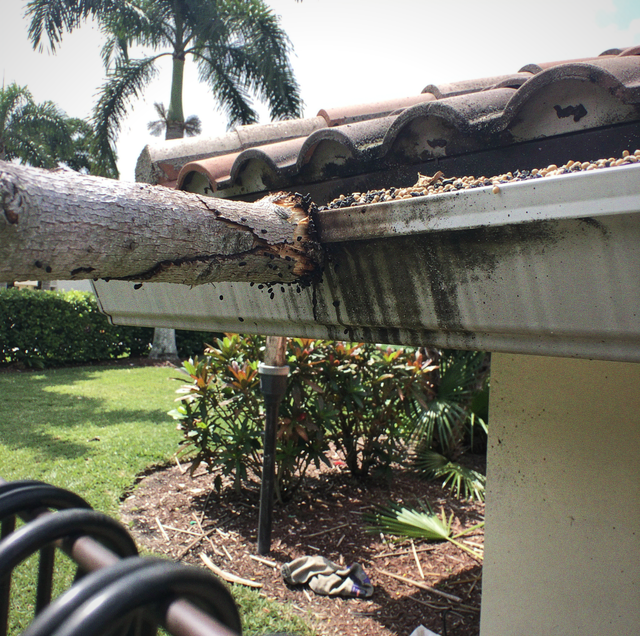
A technician who walks the outside of a house before opening the front door is not counting palms. That walk is a short sequence of questions, each one asked so the answer can eliminate something. By the time it reaches the back gate, several versions of the problem are gone, and one or two are still standing; that is what decides which run of soffit opens first.
Two houses on the same street can carry identical plantings and produce completely different write-ups. The plantings are not the finding. What a rat has done with them is.
Quick Answer: Palms and fruit trees tell a technician nothing on their own. The exterior read produces eliminations: whether vegetation currently touches the structure, and whether the food and cover on the property are being worked or ignored.
What the Exterior Read Is Trying to Settle
Three questions are answered outside, and all three must be answered before interior work is worth scheduling.
The first is height. Roof rats nest above grade and climb by preference, so the evidence that counts sits well off the ground: a fence rail, a limb, a fascia edge, the top of a screen enclosure frame. Evidence found only at ground level points toward a different species and a different job.
The second is direction. A homeowner reports noise over a bedroom or near one corner of the ceiling, and the outside evidence either agrees with that report or contradicts it. Agreement narrows the interior search to a short run of framing. Contradiction means one of the two readings is wrong, and settling that is worth more than any amount of trapping.
The third is source. A property can hold the population, or it can simply be crossed by someone living elsewhere. Those two produce nearly identical complaints indoors and completely different work orders.
Tell the technician which room the noise sits over and what time of night it starts before the outside walk begins. That single detail decides which face of the building gets read first and against what.
Contact Points and What a Live One Rules In
A contact point is anywhere something growing or built physically reaches the structure: a limb resting on a roof edge, a vine on a stucco corner, retained dead fronds leaning against a fascia board, a fence rail that ends at a post set against the wall. Contact fixes a height. An animal using it arrives at a known point on a known face.
Contact by itself is not a finding. A limb can rest on a roof for years without a rat ever using it. What makes a contact point live is what sits on it: bark polished smooth and darkened along the underside where a body has passed repeatedly, droppings on the flat top of a rail below that contact, fresh gnawing at the fascia paint where the limb touches.
Find that and the read closes fast. The route is on that face, the entry attempt is at that joint, and both the sealing work and the first exterior sets belong on that stretch rather than around the full perimeter.
The elimination is worth as much as the confirmation. A dramatic contact point with no polish, no droppings underneath, and no gnawing at the joint is not the route in use. If the interior evidence is real and that contact is clean, there is another way up, and the read continues until it is found.
Cutting back a limb or a frond mass that reaches a roof is tree service work, not homeowner work. It carries fall and blade risk that sits outside a pest inspection entirely, and no inspection finding changes that.
A Heavy Draw with No Contact Point
The most useful reading on a property is often the one that finds plenty and explains nothing.
Fruit left on the ground with fresh gnawing on it. Seed spilled under a feeder. Pet bowls kept outdoors. Dense cover against the foundation with droppings in it. All of that says animals are feeding here and moving at grade. Then the same walk finds nothing touching the structure anywhere.
That combination is the read that sends the job indoors, and it does so by elimination. The draw is confirmed, the activity is confirmed, and vegetation has been removed as the way up. What is left is the building: downspouts, an air conditioner line set chase, a rough stucco corner, a screen enclosure frame, a trellis fastened to a wall. Those are climbable surfaces belonging to the structure rather than the yard, and a technician who has eliminated vegetation goes to them next rather than guessing.
Water usually eliminates nothing here. Across Palm Beach and northern Broward, standing and moving water are nearly constant. A water source on a lot is background rather than a finding, because there is no version of this region where a rat has to approach a house to drink.
Reading Age into What the Grounds Show
Every exterior finding carries a rough date, and the date changes the job more than the finding does.
Gnawed fruit browns at the cut quickly, so pale, wet gnawing is from last night while dark, dried gnawing is from some earlier week. Rub polish on bark, or a rail dulls under pollen and rain, so a bright, greasy sheen reads as current and a flat, dusty version of the same mark reads as historic. A nest mass in retained fronds holds either fresh, flexible material or weathered, collapsed material that has been rained on.
The consequence splits three ways. Current evidence outside with a current complaint inside means an active population and a trapping job. Old evidence outside with a current complaint inside means the animals indoors are being fed somewhere other than this property, and sealing carries more weight than the trap line does. Old evidence outside with nothing reported inside means monitoring rather than treatment.
What the Grounds Cannot Tell You
An exterior read cannot confirm that anything is living inside the building. It cannot count animals, it cannot tell you how long a population has been in an attic, and it cannot see onto adjoining lots.
It also cannot rule the building out, which is the part homeowners are most surprised by. A clean exterior, no contact points, no worked food, no cover against the wall, does not end the visit. Plenty of roofline entry sits at a construction joint that has nothing to do with anything growing on the lot, and an animal that walked a utility line onto the roof leaves no evidence in this yard.
So the walk narrows the interior search when it can and hands over an open one when it cannot. Either way, the inspection continues to droppings, rub marks along a beam or pipe run, and gnawing at framing, because occupancy gets confirmed indoors and nowhere else.
How the Read Moves the Equipment
Equipment goes on confirmed travel, not on attractants. That is the largest practical difference between this read and a yard cleanup list.
A live contact point puts the first exterior sets along the run leading to it and concentrates sealing on the joint it reaches. A worked grade-level draw with no contact puts sets along the wall line and sends the climb search onto the structure. An old-evidence read with a live interior complaint shifts the balance toward sealing and monitoring rather than a heavy trap line outside.
The timeline itself does not move. A confirmed roof rat trap-out generally runs four to six weeks from first placement to clearance, with activity typically dropping off by the second week and most properties quiet by the fourth. What the read changes is how much of that work happens outside versus inside, and how often the first placement is already in the right spot.
Frequently Asked Questions
No. The read stops at the property line. A canopy leaning over a shared fence or material stacked against it gets noted as context, so the findings on your own lot make sense. It stays context rather than a work item, because nothing can be placed, cut, or sealed on a lot the company was not engaged to service.
It removes some and leaves the rest, which is why outdoor reads weight evidence differently than attic reads do. Droppings break down fast outdoors and can be gone after enough rain, so they count as strong evidence when present and weak when absent. Rub marks and gnaw damage survive weather far better, so an exterior read leans on those instead.
The animals, yes. The evidence, no. Roof rats move mostly after dark, so a daytime walk reads leftovers rather than behavior. Where the daytime evidence is ambiguous, a technician can add an after-dark check with a flashlight along a fence top or a limb line, which sometimes settles on the spot a question the daytime read could not close.
They get read harder because they are more consistent than a tree is. A wood or PVC top rail provides a flat, continuous surface at a single fixed height, so marks accumulate into a readable line rather than scattering across a canopy. Droppings also sit and stay on a flat cap, while anything landing on a rounded limb rolls off, which is why a fence line often reads more clearly than the branches above it.
It adds a surface and a seam. The frame offers a path at height along its entire length, and where it fastens to the house, there is a joint cut into the wall to attach it. A technician reads that attachment line on its own, because access found there does not behave like access at a soffit and is not closed the same way.
Often, yes. Squirrels are active in daylight and build visible nesting balls of leaves and twigs high in a canopy, which rats do not build. They also strip bark in patches and cache nuts in mulch and planter beds. Any of those shifts the read before anyone goes inside, since the ceiling noise that brought the technician out is frequently identical.
Have the outside read done before anyone goes into the attic — you will know which side of the house the work belongs on before the first trap is set. Buggify Pest Solutions serves Boca Raton, West Boca, and communities across Palm Beach and northern Broward. Call Tyler: (561) 672-0200.
