

Spiders Indoors After Heavy Rain? What's Pushing Them In
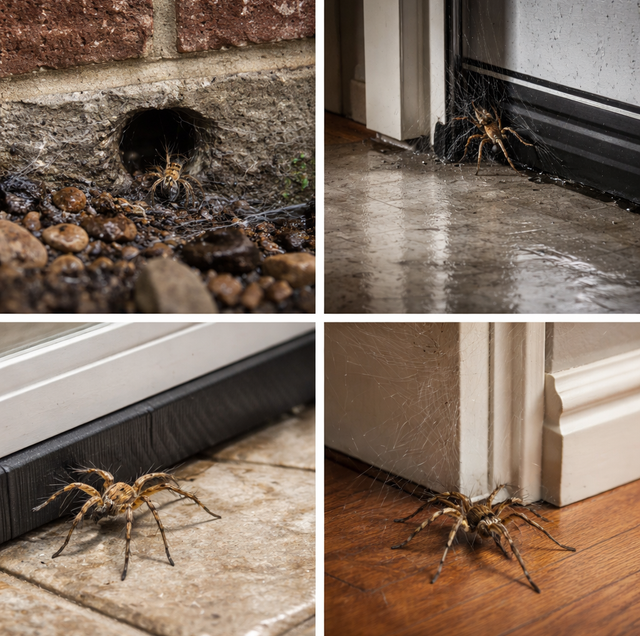
Quick Answer: Heavy rain floods the ground-level gaps spiders already use outdoors, and rising soil moisture pushes them toward the nearest dry opening, usually a door sweep, a garage seam, or a foundation weep hole, not a sign of an indoor infestation.
Two days after the last hard rain moved through, you found a spider tucked into the corner of the garage door track that wasn't there before the storm. By the end of the week, there was a second one working a web across the outer track of the sliding door, and a third turned up behind a stack of towels in a laundry room you hadn't touched in a month. None of this happened during the rain itself. It showed up afterward, once the ground had dried out elsewhere and this particular spider decided that somewhere else wasn't an option anymore.
This pattern isn't tied to one time of year. A cold front pushing through in March, an afternoon thunderstorm in June, or a slow-moving system in September all saturate the ground the same way, and spiders respond to the water, not the calendar. Any month a heavy rain event drops enough water fast enough, the same chain of events plays out.
Heavy Rain Floods the Harborage Spiders Were Already Using
Before a spider ever gets near a door, it's living somewhere outside: under a mulch bed, in the gap beneath a paver edge, inside a stack of loose bark, along the base of a retaining wall, or tucked into leaf litter that never fully dries out. Ground-dwelling and crevice-dwelling species, wolf spiders, ground spiders, and immature house spiders among them, use these low, dark voids as daytime shelter because they hold steady moisture, block light, and stay cooler than open ground.
A hard, sustained rain changes that math fast. The same voids that once made good shelter by holding some moisture now hold standing water or turn into saturated mud. A gap that worked as a hiding spot an hour earlier stops functioning as one at all. Spiders breathe through book lungs, thin, folded membranes that need air moving across them, and a flooded burrow or root gap no longer offers that. What was reliable shelter an hour before the rain started can become unusable by the time it lets up.
Rising Ground Moisture Pushes Them Toward the Driest, Most Sheltered Gap
The saturation problem isn't only coming from above. In much of this region, groundwater already sits close to the surface, and a heavy rain event doesn't need to fall for long before the water table rises to meet it. That means a ground-level void can be squeezed from two directions at once: rain soaking down from the surface, and rising groundwater pushing up from below.
For a spider sheltering in that gap, the result is the same either way: less air, more water, and a shrinking margin of dry space. The response is a straight search for the nearest patch of ground that isn't saturated, and a house interrupts that math in a spider's favor. A structure sits above grade, and the foundation, block cavities, and wall cavities around it form a network of small connected voids that drain faster and stay drier than open soil during the same storm. The shift works something like a game of musical chairs played across a whole yard: every downpour removes another patch of dry ground, and whatever was sheltering there competes for whatever dry gap is left, which is very often the narrow strip running along the base of the house.
The Specific Entry Points Saturation Pushes Them Toward
The gaps a displaced spider actually finds aren't random. They're the specific low, dry openings a house offers at ground level, and most fall into three categories.
- Door sweeps and threshold gaps: A door sweep that's compressed, cracked, or pulled loose over a few years leaves a thin, dry, horizontal opening flush with the slab. Slab edges are among the last surfaces to stay dry once a yard is fully saturated, which makes a worn sweep one of the first paths a wandering spider finds.
- Garage seams and the slab-to-door gap: Garage slabs are frequently poured at or slightly below the surrounding grade, and settling over the years widens the seam where the slab meets the exterior wall. A garage door that's lost its bottom seal adds a second gap right at floor level. Both sit exactly where ground moisture lingers longest after a storm.
- Weep holes in the exterior wall: Concrete block homes finished in stucco or brick veneer rely on small weep holes near the base of the wall to let moisture that builds up behind the finish drain back out. Those holes have to stay open to do that job, which also means they stay open to anything small enough to walk through them, and a wandering spider looking for a dry, sheltered gap during a saturated week fits easily.
What Finding Them Inside Does and Doesn't Mean
A spider or two turning up indoors within a day or two of a storm usually means one thing: a wanderer got displaced and found a way in, not that a breeding population has relocated into the house. South Florida's common web-building species, orb weavers and brown widows among them, build a fixed web and generally hold onto it even when conditions outside turn unpleasant, rather than abandoning the structure for the inside of a house.
What tends to show up indoors after a storm are species that don't build a fixed web at all: wolf spiders, common house spiders, and other ground- or crevice-dwellers that were already moving to hunt and shelter before the rain gave them one more reason to move sooner. A single sighting a day or two after heavy rain fits that pattern far more often than it signals anything established.
Sealing the Gaps Without Addressing the Water Doesn't Hold
Caulking a door sweep or patching a garage seam after a storm buys time, but it only holds until the next saturated week finds a different low point in the same wall. The gap and the moisture that's forcing something toward it are two separate problems, and closing one without touching the other just shifts where the next opening turns up.
Pulling mulch back a few inches from the foundation, redirecting an irrigation head that's spraying the base of the wall instead of the bed, and correcting grading that pools water against the slab all shorten how long the ground right next to the house stays wetter than the house itself. Combined with sealing the specific gaps a saturated yard actually exposes, that's what keeps one heavy rain from turning into a repeat problem every time the next one rolls through.
Frequently Asked Questions
Most spiders stay put while it's actively raining. Heavy rainfall and wind disrupt the vibration cues they rely on to sense prey and threats, so moving during the storm itself is a poor bet. Relocation tends to occur once the rain stops and the ground starts to drain, which is also the point at which a flooded gap has clearly stopped serving as shelter. That lag is why a sighting usually lines up with the two or three days after a storm rather than the storm itself.
Exterior treatment reduces the prey-insect population spiders are following and knocks down wanderers already active near the foundation, but South Florida humidity breaks residual products down in roughly three to four weeks, well inside the gap between one heavy rain event and the next. That's part of why an every-eight-week service cycle holds up here where a single one-time visit or a quarterly schedule doesn't; the barrier gets refreshed before it fully wears off.
The species most likely to end up inside this way, wolf spiders and common house spiders, rarely bite unless physically trapped against skin, inside a shoe or bedding, for instance, and a bite from either is typically no worse than a bee sting. The two species in this region actually worth a second look, the brown widow and, less often, the black widow, stay near a permanent web rather than wandering indoors during a storm, so a spider crossing open floor is a different animal than one sitting still in a web tucked into a corner.
Garage slabs and pool equipment pads are frequently poured lower than the surrounding grade or include expansion joints that hold rainwater longest after everything else has drained, so ground moisture lingers there days after the rest of the yard has dried out. Both spots are also dark, rarely disturbed, and close to the drains, filters, and equipment housings that draw the small flying insects spiders feed on, stacking shelter and food in the same place.
Sealing stops new arrivals but doesn't remove ones already past the threshold. A spider that wandered in during a saturated week is usually looking for the next patch of moisture; bathrooms, laundry rooms, and utility closets tend to draw them, or for a light source at night that leads back toward an exit. Without a fresh insect food source indoors, most don't establish there and turn up dead on a windowsill or baseboard within a week or two.
Shredded or dyed hardwood mulch mats down and holds water against the foundation longer than pine bark nuggets or rock mulch, which drain and dry faster. A mulch bed that stays saturated for days after a storm extends the window during which the ground right next to the house is wetter than the house itself, which is exactly the condition that pushes activity toward the wall. Pulling mulch back two to three inches from the foundation and swapping to a faster-draining material shortens that window.
Schedule a spider inspection — Tyler checks door sweeps, garage seams, and weep holes for the gaps saturation opens up, plus the outdoor harborage feeding it, before recommending a plan. Buggify Pest Solutions serves Boca Raton, West Boca, and communities across Palm Beach and northern Broward. Call Tyler: (561) 672-0200.
