

Roaches in the AC Closet: What's Actually Drawing Them
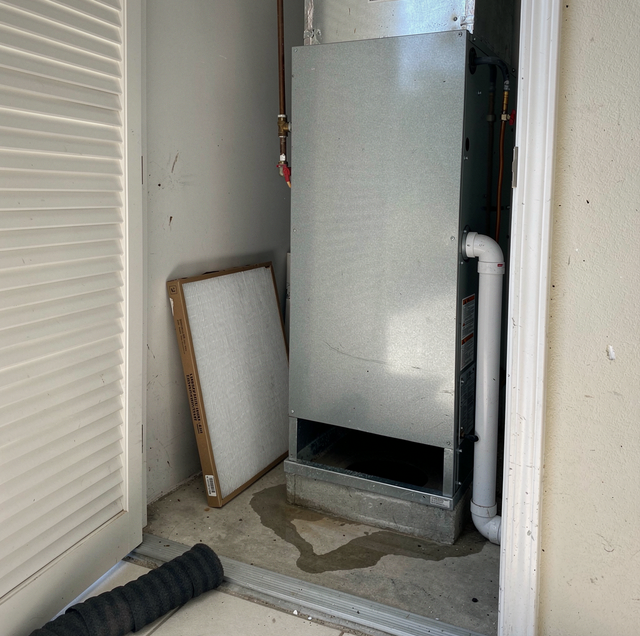
You open the louvered door to the AC closet to change a filter or check the breaker, and roaches scatter across the floor, up the side of the air handler, or behind the water heater. It feels random until you notice the floor is damp, or the wall behind the unit has a faint musty smell. It is not random. That closet is one of the few spaces in the house that stay warm, dark, and humid at the same time every day of the year, and the air handler is usually the reason why.
Why This Closet Behaves Like Nowhere Else in the House
Most rooms in a house dry out between uses. The AC closet does not, because the equipment inside it is actively producing moisture on a schedule. As the air handler pulls warm, humid air across the evaporator coil, water condenses from that air and collects in a drain pan beneath the coil. A PVC condensate line carries that water out of the closet, usually to an exterior termination point or a laundry sink. When that system is working exactly as designed, the pan stays wet on a normal cycle, and the line carries the water away before it accumulates.
The trouble starts at the points where that system leaks, sweats, or backs up. A cracked or disconnected trap fitting on the condensate line can drip steadily onto the closet floor instead of routing water outside. Foam pipe insulation wrapped around the refrigerant lines will sweat and shed water onto the floor below if the vapor barrier on that insulation has a gap or has come loose with age. The drain pan, primary or secondary, holds standing water whenever the primary line is even partially restricted. None of that requires a leak anyone would call an emergency. A slow drip, a damp inch of subfloor, or a pan that never fully dries between cycles is enough to keep a dark, enclosed space humid around the clock, which is exactly the microclimate a roach looks for over an open, dry room.
The Walkthrough: Check the Closet in This Order
A flashlight and a few minutes with the unit running is all this takes. Work through it in this order so you catch the moisture source before you get distracted by the roaches themselves.
Floor first, before you touch anything: Look at the floor around the base of the air handler before you move a single box or filter. Note any damp spot, water stain, warped baseboard, or standing puddle, and where it sits relative to the unit.
The drain pan: Most air handlers have a shallow pan directly under the unit, and many in an enclosed closet also have a secondary pan mounted underneath that as a backup. Check both for standing water rather than just a damp residue. Standing water in the secondary pan, in particular, indicates the primary line is not draining properly.
The condensate line itself: Follow the PVC line from the unit to wherever it exits the closet. Look at every joint and the fitting where it passes through the wall for a wet ring, a cracked seal, or gapped caulk around the penetration. A line that is bone dry at the unit but wet at the wall penetration usually means the leak is at that exit point, not inside.
The insulation: Feel the foam wrap on the refrigerant lines with the back of your hand, not your fingertips, since a slow leak often feels cool and damp rather than obviously wet. Spongy, sagging, or visibly split foam is a sign the vapor barrier has failed, and the insulation is sweating instead of protecting against it.
Wall and floor penetrations: Check where the refrigerant lines, drain line, and any low-voltage wiring pass through the closet wall to the outside. Gaps around these penetrations are common, since they are rarely sealed as tightly as the rest of the exterior wall, and they double as an entry route from outside as well as a place for moisture to sit.
Signs of activity, not just the roaches you already saw: Look for droppings that resemble coffee grounds or black pepper along the baseboard and behind the unit, shed skins caught in spider webs or dust, and a musty, oily odor that lingers even with the door open. These tell you how long the activity has been established, not just that it exists.
An air handler closet carries line voltage at the disconnect, the contactor, and any electric heat strips. Do not reach into standing water around the equipment. Note where the water is sitting and have it looked at.
What Each Sign Actually Means
A damp floor with no visible line leak usually points to sweating insulation rather than a plumbing failure, since a failed vapor barrier drips steadily without ever showing a cracked joint. A wet spot concentrated right at the wall penetration, on the other hand, more often traces back to a gap in the exterior seal that lets both water and pests enter through the same opening. Standing water in a secondary pan is the strongest single signal, because that pan only fills when the primary line is not doing its job, and it is also the detail most homeowners miss since it sits underneath the unit rather than beside it.
None of this tells you how to fix the HVAC side of it, and that is not the goal here. A restricted line, a failed vapor barrier, or a cracked fitting is HVAC work. What the walkthrough gives you is a clear account of where the moisture is coming from, which matters because treating the roaches without addressing that source only resets the clock. Bait and residual treatments knock down the population that is already established; they do nothing to stop a new one from moving in behind the same damp insulation two months later.
When the Closet Isn't the Only Source
The AC closet is rarely the sole point of entry, even when it is the most obvious one. In South Florida, the outdoor conditions that make this closet attractive year-round- warm temperatures and high ambient humidity that never really lets up- are the same conditions driving activity in mulch beds, under lanai screens, and along irrigation lines outside the house. A closet that stays dry inside can still experience steady roach pressure if exterior harborage near the foundation is heavy. Treating the closet in isolation, without considering what is happening along the exterior wall it backs onto, tends to produce a population that keeps coming back from outside, even after the indoor moisture is corrected.
Putting It Together
The roaches in that closet are not there because the space is dirty. They are there because it is the one enclosed spot in the house that reliably stays warm, dark, and wet at the same time, and a leaking or sweating HVAC system is very good at keeping it that way for months without anyone noticing. Fixing the moisture source and addressing the harborage, both indoors and along the exterior wall it shares, is what actually breaks the cycle rather than just thinning it out for a few weeks.
Frequently Asked Questions
Yes. The dark, insulated cavity around the coil box and the underside of a secondary drain pan are common harborage spots because they stay warmer and more humid than the open closet floor, and they are largely undisturbed. A technician inspecting for this checks both areas, not just the visible floor space.
Not on its own. Most louvered closet doors are designed to allow airflow to the equipment, so gaps around the door are usually intentional, not a defect to caulk shut. The more relevant gaps are the wall penetrations behind the unit and the exterior condensate line termination, since those connect directly to the outside.
The moisture mechanism is identical, but it plays out differently. An attic unit's pans sit above a ceiling, so a drainage failure shows up as a stain on the drywall rather than a puddle anyone can see, which means it usually runs for much longer before it gets noticed. An attic also swings hot and dry between cycles, so it tends to see American cockroaches passing through more than a settled indoor colony. A closet on the conditioned side of the house holds a steadier temperature, and that steadiness is what lets a population stay put.
Usually, the fiberglass duct board or the flex-duct connections are at the plenum rather than on the floor itself. Once a closet has run humid for a stretch, the porous liner on the duct board holds moisture and keeps a musty odor lingering long after the floor has dried, and it will still read as a damp space to a roach, even with the leak corrected. A roach harborage produces its own separate smell, oilier and more sour than musty, and both can sit in the same closet at once.
It removes the draw, not the population. There is also a lag to expect: closet framing, drywall bottom plate, and any particle-board shelving that has been wicking moisture for months keep releasing it for weeks after the leak stops, so the space stays humid enough to sustain activity well past the repair date. A moisture meter reading on the bottom plate tells you when the closet has dried out rather than merely stopped dripping, and that is the point at which treatment stops fighting the building.
Clear it, but expect a short spike first. Stored boxes, paint cans, and a stack of spare filters are harborage in their own right, and pulling them out pushes whatever was living in them into the open for a few days before things settle. The useful part is doing it before a treatment rather than after, so that bait and residual go into a closet stripped down to bare walls, the equipment, and the penetrations, instead of into a room where half the harborage is cardboard someone is going to remove next week.
The closet is worth putting on the same schedule as the filter. A two-minute look at the pan and the floor every time a filter comes out catches a slow drip in the weeks it is still a drip, rather than the month it has turned into harborage.
Schedule a cockroach inspection — Tyler will trace the harborage, indoors and out, before any treatment goes down. Buggify Pest Solutions serves Boca Raton, West Boca, and communities across Palm Beach and northern Broward. Call Tyler: (561) 672-0200.
