

Norway Rats at the Water's Edge: Canal Banks to Seawalls
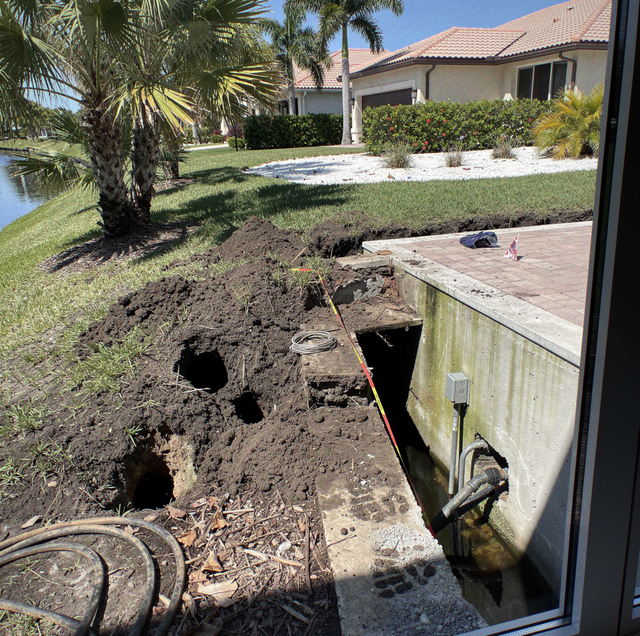
Quick Answer: On a canal or seawall property, the bank, the hardscape, and buried utility lines function as one connected route from open water to the slab edge. The openings that route ends at sit low: expansion joints, weep gaps, and slab-level utility penetrations.
A canal bank holds water at one edge and packed earth at the other, and that boundary is where a Norway rat's day starts, well before any nearby house comes into the picture. The slope holds moisture at the root line, stays shaded most of the afternoon, and puts a steady drink within a short trip of a burrow entrance. None of that requires a structure nearby. A canal bank, a seawall base, or a drainage swale can support a colony on its own, and the house at the top of the yard is often just the next stop, not the reason the rats showed up.
Where the Bank Becomes a Burrow Site
A canal bank, a drainage easement edge, a retention pond berm, or a seawall base all present the same thing to a burrowing rodent. The construction differs, and so does the look from the street, but the draw is cover close to reliable water rather than a particular kind of wall.
A bank holds a burrow site when the plantings shade the soil and hold moisture at the root line, the slope is stable enough that a tunnel does not collapse under its own dig, and the water sits close enough that a short trip covers the distance. Mulched beds, dense groundcover, and shrub lines meet that description. A burrow opening in that kind of ground often shows a worn, smooth rim where traffic has passed the same way repeatedly; fresh soil pushed out to the side points to recent digging instead. Either reading can belong to a system that is still in use.
The Seawall and Rip-Rap as a Travel Surface
A seawall does more than hold the property line in place. Its cap sits above the waterline as a continuous dry surface, and the joint where the cap meets the wall panel, along with the small gap that can form around a tie-back anchor, gives a rat a route to travel end to end without touching open soil or exposed water. Rip-rap, the loose stone sometimes used to armor a bank instead of a poured wall, works the same way: the voids between the stones link into a connected space a rat can move through, out of sight and mostly out of reach. Either surface treats the wall as an extension of the yard rather than a barrier.
A seawall cap or an eroding bank edge can give way underfoot without warning. Observe burrow openings and worn ground from a stable point on the lawn rather than stepping onto the cap or the slope itself.
Utility Trenches and Buried Lines as Inland Routes
Once a burrow system has a foothold at the bank, the yard between the water and the house rarely stays uniform ground. Irrigation lines, conduit runs, and drainage trenches are backfilled after installation, and that fill never compacts back to the density of the undisturbed soil around it. A tunnel following a trench line is working soil already loosened once, making it easier than digging fresh ground, and it runs in the direction most utility lines run: from the water source or the street toward the house. That is why a burrow system at a canal bank does not necessarily stay there; a buried line installed earlier can give a colony a path most of the way to the foundation before a second entrance opens closer to the house than the first.
Where the Yard Meets the Slab
South Florida's slab-on-grade construction, with no basement between the yard and living space, means the ground against the foundation does much of the work that other regions leave to a below-grade wall. A planting bed pushed against the stucco, mulch piled at the base of the wall, or a sprinkler head or utility pad set close by all narrow that strip, giving a rat a place to sit and work an opening unseen from the house or the street. This is also the zone where a burrow that started at the bank tends to show its last outdoor sign before activity moves indoors: another opening, worn the same way as the original, sitting right where the soil line meets the slab.
Turf near a slab edge that has sunk slightly below the surrounding grade, or a bed where the mulch has dropped away from the wall, can mean the soil underneath has been worked. Note the spot and leave it alone.
The Grade-Level Openings That Get Used
At ground level, the openings a Norway rat actually uses sit close to the soil: a gap along a slab edge where settling has opened a seam, an expansion joint that has lost its sealant, a weep hole meant to drain a block wall, or the sleeve around a pipe or conduit passing through the foundation at grade. A garage threshold is another opening in that same low category, worth noting alongside the others, even though the door sweep and jamb conditions that make it work are their own subject. None of these look dramatic, which is why they hold up as an entry route long after they open. A gap closed with material that resists gnawing tends to stay closed: copper mesh packed into a confirmed opening and sealed over holds up where plain caulk, which breaks down in this level of humidity, generally does not.
What Changes Once They Are Inside
A Norway rat working a burrow system outdoors does not switch behavior once it gets past the slab edge. It stays low. Without a crawl space or basement to spread into, a ground-level entry here usually lands the animal in a wall void at the base of a block wall, behind a cabinet toe-kick, under an appliance, or inside a laundry closet against an exterior wall. That indoor pattern is what a trap-out is built around: mechanical trapping for Norway rats typically runs three to four weeks, checked roughly every seven to ten days, with activity dropping sharply by the second week and most jobs quiet by the fourth.
Reading the Yard Without Getting Close
None of this requires stepping onto a seawall cap or down a bank slope. From a stable spot on the lawn, the same outside-in sequence an inspection works through is visible from a distance: a change in soil color or texture at the water's edge, a fence line where the ground looks disturbed, a sprinkler head that has tilted or sunk, or a bed against the house where the mulch looks packed down in one spot more than the rest. A property bordering a canal or a seawall carries this whole sequence built into its layout already, bank to hardscape to yard to slab, in a way a landlocked lot simply does not. Reading it in that order, from the water in toward the house, turns a vague sense that something is out there into an actual starting point for where to look first.
Frequently Asked Questions
A few other animals dig at the same water's edge. Land crab burrows common in South Florida are narrow, mostly vertical, and often ringed with small pellets of excavated dirt, while an iguana burrow angles into a slope and follows root systems into the bank, neither of which is a rodent job, and neither is handled here. A Norway rat's opening is oval rather than round and angled slightly downward, and its rim can read either way: smooth and worn where the opening has seen repeated traffic, or carrying fresh spoil where it has been dug lately.
It usually means the seawall itself functions as a travel route rather than an entry point: dry, shaded, and above the tide line, so nothing ever had to be dug on the property. That changes where an inspection starts. Rather than working the beds and the lawn for openings first, the read begins along the wall line and the property corners, then moves straight to the low openings at the structure, because the animal arrived on a surface rather than through the soil.
A tunnel dug at grade floods when the water table rises, and a Norway rat will not stay in a flooded burrow. It surfaces and either re-digs close by on higher ground within the same bank or bed, or moves toward the nearest dry structure, which is why activity around a house often spikes after a heavy rain rather than during the storm itself. A burrow that looked settled before can show fresh openings once the ground has dried enough to dig again.
A fence line does two things at once: where a post footing has disturbed the soil, it gives continuous cover between two points without crossing open lawn, and where the line runs from the water's edge toward the house, it functions as a direct bridge between the two zones. Closing an opening at the structure without accounting for the fence line as a route usually just moves activity to a different point along the foundation.
Pavers set on a sand or crushed-stone base create a shallow, connected void underneath the whole field, and a rat can travel that space, and sometimes den in it, without ever breaking the surface. A deck that looks undisturbed from above can still have activity running beneath it end to end. The common surface sign is not a hole at all; it is a single paver sitting slightly below the line of its neighbors.
A single tunnel system can have more than one entrance feeding it, so closing the easiest-to-find entrance often just pushes activity to a second opening already in use nearby. That is why entrance work at the bank or the yard is paired with confirming the active route at the structure before anything is sealed, rather than being treated as a fix on its own.
Schedule a water's-edge inspection — have burrow activity along the canal bank or seawall traced to its actual opening before it reaches the slab. Buggify Pest Solutions serves Boca Raton, West Boca, and communities across Palm Beach and northern Broward. Call Tyler: (561) 672-0200.
