

Roaches Under the Kitchen Sink? Three Places to Check
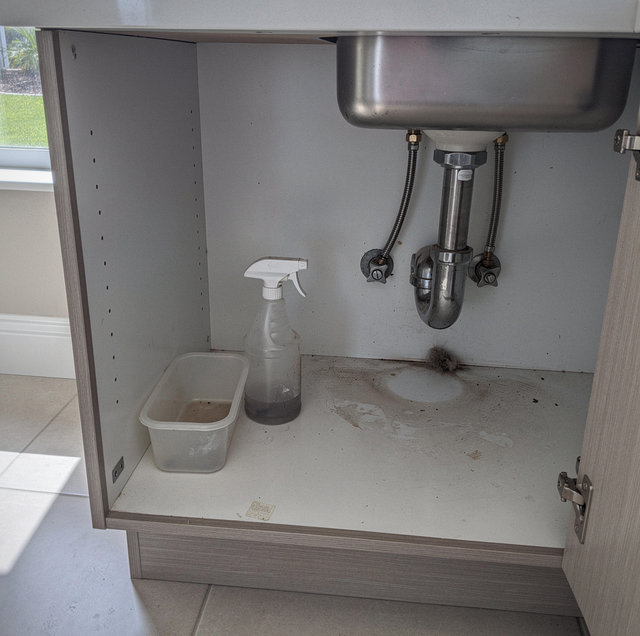
Quick Answer: Check in order: an active leak at the supply lines or disposal, then condensation on the drain trap, then the cabinet itself. Roaches follow water, so which source you find determines the fix.
Open the cabinet under your kitchen sink, and the first instinct is to blame the plumbing. Sometimes that is correct. Sometimes the pipes are bone dry, and the actual source is a wet sponge left in a caddy, or a sheet of particle board that has been slowly absorbing ambient humidity for months. Under-sink roach activity has three distinct possible drivers, and they call for different responses, so guessing which one you have and treating for it is how a problem that looked solved comes back in three weeks. Work through the cabinet in a fixed order, checking the most active source first, and you'll usually know which of the three you're dealing with before you finish.
Step One: Rule Out an Active Leak at the Supply Lines or Disposal
Start here because an active leak is the most urgent of the three and the easiest to miss if you only glance at the cabinet floor. Clear everything out from under the sink so you can see every surface, then work top to bottom.
Check the supply line connections first: Most homes run braided stainless lines from the shutoff valves to the faucet, and the compression fittings at each end are the most common failure point. Run a dry finger around each connection and along the underside of the valve body; even a slow weep leaves a slightly tacky or gritty mineral residue before it ever drips far enough to reach the floor.
Feel around the garbage disposal mounting flange: The rubber gasket that seals the disposal to the sink flange degrades over time, and when it starts to fail, water can seep into the mounting ring and travel along the disposal body before it drips anywhere visible. Run your hand around the underside of the unit where it meets the sink, not just underneath it.
Kill power to the disposal at the breaker or unplug it under the cabinet before you feel around the mounting flange. Never put a hand inside the grinding chamber, powered or not.
Check the dishwasher drain hose and air gap fitting, if your kitchen has one: These connections only carry water during a wash cycle, so a cabinet checked between loads can look completely dry even with a failed hose clamp. If you have a dishwasher tied into this cabinet, run it once and check the connection again partway through.
Look for mineral staining, not just wetness: A leak that has been slow for a long time often dries between drips, leaving a white or rust-colored ring on the cabinet floor or the underside of a shelf even when nothing is actively dripping the moment you check.
If you find any of these, you have your answer. An active leak means the roaches are drawn to running water, not just dampness, and that the water source will only get worse until it's repaired, so it's worth having a plumber confirm the fix before anything else in the cabinet is addressed.
Step Two: Check the Drain Trap for Condensation, Not a Leak
If the supply lines and disposal are dry, look next at the drain trap itself, the curved section of pipe just below the sink strainer. This is a different mechanism from a dry trap losing its water seal upstairs in the house: here, the trap has plenty of water in it, and the problem is what forms on the outside of the pipe, not inside it.
Run cold water for a minute, then feel the trap's exterior: A chrome-plated brass trap conducts cold quickly, so once cold water has been running through it, the metal surface can drop below the surrounding air's dew point and condensation beads on the outside, exactly like a cold glass of water on a humid day. A PVC trap does the same thing to a lesser degree, since plastic conducts heat more slowly than metal.
Look for a puddle that forms without a corresponding drip mark on the shutoff valves or supply lines above it: Condensation collects directly below the pipe it forms on, without the staining trail a slow drip usually leaves along whatever it ran down first.
South Florida's ambient humidity makes this more common here than in a drier climate, since the air inside an unvented cabinet often sits close to its dew point even without any plumbing problems at all. A cabinet that traps that humid air against a cold pipe surface is doing exactly what a cold drink glass does on a humid afternoon, just out of sight.
If the trap is only sweating, the water is still real, and roaches will use it exactly like a leak, but there is nothing to repair in the plumbing itself. The fix is managing condensation, commonly with a foam pipe insulation sleeve sold for exactly this purpose, not a plumbing repair.
Step Three: Look at the Cabinet Material and What Is Stored in It
If both the supply side and the trap check out dry, the source is usually the cabinet itself rather than anything connected to the plumbing.
Check the cabinet floor for swelling or delamination, especially at the corners: Most kitchen cabinets are built from particle board with a thin laminate or veneer skin, and the edges and cut corners are the least sealed part of that skin. Repeated exposure to humid air, even without any standing water, allows moisture to migrate into the exposed particle board first, where it swells and softens before the rest of the panel shows any change.
Pull back any shelf liner and check underneath it: Vinyl or adhesive-backed liner traps whatever moisture is already in the cabinet against the surface below it, which can hold a damp microclimate in place even in a cabinet with no leak and a healthy trap.
Take stock of what is actually stored down there: A mop bucket with water still in it, a wet sponge left in a caddy, a spray bottle that weeps around its trigger, or cleaning rags left damp after use are all standing water sources in their own right, independent of the plumbing entirely. It's common for a homeowner to find roach activity here, assume it must be a hidden leak, and call a plumber before ever checking what's sitting on the cabinet floor.
Note whether the cabinet has any ventilation at all: Many under-sink cabinets are sealed boxes with no gap at the toe kick or back panel, which means whatever humidity gets in from a dishwasher cycle, a wet dish rag, or just South Florida's ambient air has nowhere to go and stays trapped against the panel.
To tell condensation from a slow leak, tape a dry paper towel under the trap and against the cabinet floor overnight. A ring only under the pipe indicates condensation; a trail leading toward the supply lines indicates a leak.
When the Signs Don't Point One Way
Most cabinets land clearly in one of the three categories once you've gone through all three steps, but it's worth knowing what mixed signs mean. A dry trap and dry supply lines with real swelling on the cabinet floor is a moisture-management issue, not a plumbing one, and no amount of tightening a fitting will change it. A sweating trap combined with heavy particle-board swelling usually means the condensation has been going on long enough to soak into the wood, which is a stronger case for insulating the pipe soon rather than monitoring it further. An active leak, along with old mineral staining, suggests the drip has been intermittent for a while, which matters to a plumber trying to pin down a fitting that only weeps under certain conditions.
Whichever of the three you land on, roach activity under the sink is a symptom pointing at a specific, physical cause in that cabinet, not a sign that the kitchen as a whole has failed some standard of cleanliness. Treating the visible insects without correcting whichever of the three is actually feeding them just means the same cabinet shows activity again once the residual product wears off.
Frequently Asked Questions
Less than most people picture. Cockroaches continuously lose water through their cuticle and need free water far more urgently than they need food, which is why activity persists in a cabinet holding nothing edible at all. A trap that beads up for twenty minutes after each use, or a liner holding one damp patch, supplies enough for a small harborage on its own. That's also why drying the cabinet out has a greater effect than any product applied inside it.
It usually announces itself outside the cabinet first. A supply line weeping inside the stud bay tends to show at the base of the cabinet's back panel, on the baseboard on the far side of that wall, or as a soft spot in the flooring at the toe kick, while the cabinet interior stays dry. That pattern, dry inside and damp at the edges, is worth a moisture-meter reading rather than more looking, because nothing visible from inside the cabinet will confirm it either way.
Not if the cabinet is the real problem. A foam sleeve prevents condensation on the pipe it covers, but the slip nuts, the tailpiece, and the trap arm where it enters the wall are usually left bare because the sleeve doesn't fit them, and those spots keep beading. In a cabinet with no ventilation at all, the humid air that caused it is still sitting in there, so the more durable fix is often a vented toe kick or a louvered panel alongside the insulation rather than instead of it.
Particle board doesn't recover its structure once the fibers have swelled. The panel can dry, but the thickness change and the softness at the cut edges are permanent. What matters here isn't cosmetic: a delaminated edge or a lifted seam creates exactly the tight, humid void a harborage needs, right at floor level where a roach is already traveling. Sealing or replacing the panel closes that void, while drying it out alone leaves the gap sitting there.
Get everything up off the panel. A shallow boot tray or a low wire rack keeps containers from sitting directly on particle board and lets air move underneath, turning the tray into a telltale: a fresh drip shows as a wet ring on a dry surface instead of soaking in unnoticed. Check it whenever you reach in for something, which will be far more often than anyone inspects a cabinet on purpose.
It changes what the treatment can do. A gel bait placement works by being the most attractive thing within reach, and a cabinet with a live water source and damp, softened board gives a roach reasons to stay put that the bait then has to compete with. Products applied to a swollen or wet panel also bind unevenly and break down faster than they would on a dry surface. Correcting the moisture first isn't a precondition anyone will insist on, but it's often the difference between one visit and several.
Get the actual source under your sink identified—leak, drain, or cabinet moisture —confirmed rather than guessed. Buggify Pest Solutions serves Boca Raton, West Boca, and communities across Palm Beach and northern Broward. Call Tyler: (561) 672-0200.
