

Borescope Rodent Inspection: What a Flashlight Misses
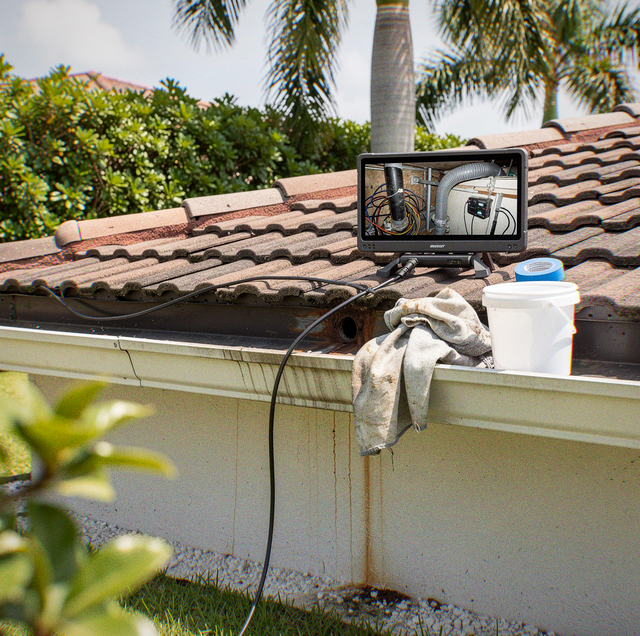
Quick Answer: A borescope is a thin camera on a cable that routes past framing and through an existing opening into closed cavities. It shows what a flashlight beam cannot reach: whether droppings in a sealed cavity are current or long abandoned.
A flashlight only shows what stands between the beam and a flat surface. Point it into an attic, and it lights up whatever framing, insulation, and ductwork happen to sit in the open middle of the space. It does not bend around a rafter, travel past a top plate, or reach into a soffit box at all. A rodent problem rarely announces itself in the open middle of an attic. It sits behind the joist, inside the wall cavity, or past the point where a person can safely stand. A borescope is a thin camera on a flexible or rigid cable that a technician can route around framing and into spaces a beam of light cannot follow, and what it turns up often changes the read on a job that looked routine from the attic hatch.
This is owner-operated work in Boca Raton and the surrounding area, and the same technician runs every inspection start to finish. Below are the specific limitations a flashlight-only walk-through runs into, what routing a camera into those spaces resolves, and where the camera itself can no longer answer the question.
Where a Flashlight's Line of Sight Runs Out
A beam of light travels in a straight line. It illuminates the surface it hits and nothing behind that surface. In an attic full of trusses, ridge boards, and cross-bracing, most of the actual cavity space sits behind something. A rafter bay on the far side of a ceiling joist, the far side of a chimney chase, the underside of a valley where two roof planes meet — a flashlight can point in that general direction, but it cannot see around the framing member in front of it.
A borescope solves this by going where the light beam cannot. The camera head is on a cable, not a fixed mount, so a technician can guide it past a joist, around a brace, and into the section of a rafter bay a flashlight only grazes at an angle. Mice fit through gaps under 1/4 inch, which means the openings and travel routes a scope checks for are often smaller than what a flashlight beam would even register as a gap worth investigating. Once that stretch of cavity is visible on a screen rather than guessed at from a distance, a technician can note exactly what is back there instead of assuming it matches the visible section.
Depth Inside a Closed Cavity
Some spaces are not blocked by framing so much as closed off entirely. A soffit box, a chase built around plumbing, the enclosed space above a dropped ceiling in a garage, or the narrow run between a subfloor and a step-down slab are sealed on most sides. There is no direct sightline into them at all, not even an obstructed one. A flashlight illuminates a surface it can reach. It cannot illuminate the inside of a box it cannot enter.
Because South Florida homes are built slab-on-grade with no basement, several of the closed cavities a rodent problem hides in sit low, near ground level, rather than stacked in multiple floors. A borescope reaches these low, closed spaces through whatever small opening already exists, an access panel, a gap around a fixture, or a service opening left by another trade, without opening up the cavity to get a look inside. The camera goes in through the existing gap, the technician watches the feed, and the space gets checked without cutting into anything to create access that did not already exist.
Leave cavity and attic checks to a technician. Florida attics run dangerously hot; the only footing is the joists themselves, with loose insulation beneath them and no walking surface between them; and rodent-gnawed wiring can still be live where a hand or knee lands.
Active Rodent Activity or an Abandoned Nest?
Droppings, gnaw marks, and nesting material left behind by rodents do not disappear once the animals move on or get trapped out. A flashlight shows the debris. It does not show whether the debris is a week old or two years old, and a homeowner or technician relying on sight alone from a distance has no reliable way to distinguish current activity from a nest that has been empty for a long time.
A borescope lets a technician get close enough to examine the condition of droppings and nesting material directly, rather than assessing it from several feet away through open air. Fresh droppings look and sit differently than old, dried material, and getting the camera within inches of the pile instead of viewing it from across an attic makes it possible to call that distinction with confidence. This matters for scheduling: a roof rat trap-out typically runs four to six weeks, a Norway rat trap-out three to four weeks, and a mouse trap-out two to three weeks. Confirming which stage a problem is at before that clock starts prevents a job from being scoped incorrectly from day one. Once trapping is underway, activity generally drops by the second week, and most jobs go quiet by around week four, with monitoring visits scheduled every seven to ten days to track that progress.
Gnaw Damage or Old Staining?
Wood that has been chewed looks different from wood that has only been stained by grease, urine, or moisture tracking across a surface over time. From a distance, in dim light, both can read as a dark mark or a rough patch on framing. A flashlight held several feet away does not resolve the difference between a surface stain and an actual bite mark or gnawed edge.
Getting the camera lens within a few inches of the mark changes what is visible. Actual gnaw damage has a distinct texture along the edge, and staining does not. A technician can move the camera close enough to make that call directly rather than infer it from the general appearance of the area at a distance. Getting this distinction right matters because it changes what gets flagged as a repair concern versus what gets treated as a rodent activity marker with no structural consequence attached.
The one finding in this category that is not cosmetic is chewed electrical wiring. Rodents gnaw insulation off Romex and low-voltage runs, not just framing, and a scope run along a top plate or through a soffit box is often the first look anyone has had at wiring buried under blown insulation. A stripped conductor reads differently on camera than a stained cable jacket, and correctly identifying that difference determines who gets called next.
Gnawed wiring found during a scope run changes the referral. Exposed conductor inside an attic or wall cavity is an electrical hazard, and that repair belongs to a licensed electrician before trapping or sealing work continues anywhere in that cavity.
The Record the Camera Leaves Behind
A flashlight inspection produces a verbal description after the fact. Whatever the technician saw, the homeowner hears about it secondhand, in words, once the technician is back down from the attic hatch. There is no way to go back and check what was actually there.
A borescope inspection produces still images and video pulled directly from the cavity while the camera is in position. That footage becomes part of the job record, something the technician can review later, point to when explaining a specific finding, or reference if a homeowner has a question about a spot that was checked. How that material is organized into a written report is a separate subject; what matters here is that a finding remains checkable rather than resting on the technician's word for it.
What a Borescope Cannot Resolve
Confirming which opening is active before anything gets sealed is settled ground across this site. The more useful thing to say about the instrument is where it stops.
It cannot see through insulation. A cavity floor under several inches of blown cellulose or fiberglass appears on camera as a flat surface, and droppings, a gnawed hole, or a travel route buried beneath that layer remain hidden. The camera reports the surface it is aimed at and nothing beneath it.
It cannot count. A confirmed travel route, fresh droppings, and a nest in a rafter bay together establish that something is living there now. None of it establishes how many, which is why the trap line and the monitoring visits every seven to ten days, not the camera, are what tell a technician when a population is actually cleared.
A clean read is not an all-clear for the house. The cable goes where it goes: one soffit run, one rafter bay, one chase. A quiet stretch of cavity means that stretch is quiet. Cavities branch and connect, and clearing the section the camera reached says nothing about the section it could not.
Some cavities have to be opened regardless. A fire block, a full-depth top plate, a turn tighter than the cable will take, or a run packed solid with insulation stops a scope at the entrance. When that happens, the choice is either a small access opening cut in the right place, or a monitoring period that answers questions that the camera could not answer in a few minutes over several weeks.
And every read is a snapshot. It describes a cavity on the day the camera went in. Roof rats reproduce roughly every 21 to 25 days, so a scope run left sitting for a month may no longer hold, which is why confirmation checks are scheduled against that clock rather than whenever it is convenient.
Do not seal a suspected entry point before confirming activity first. Sealing an active cavity from the outside can trap rodents inside a wall or attic space, creating odors and secondary pest problems that are harder to resolve.
Frequently Asked Questions
Yes. Cabinetry is a common blind spot. A technician can thread the scope through a kitchen toe-kick gap or a plumbing access cut to check the cavity below cabinets, an area a general walkthrough with a flashlight rarely reaches because it sits under counter height instead of overhead.
Often, yes. A single oversized penetration often carries several items at once: an air-conditioning line set, its condensate drain, and a low-voltage wire through a single hole. From outside, all of that shows as one collar of sealant. The camera goes in alongside the line set and shows which of those runs the void follows and whether it opens into the wall bay or dead-ends at a stud.
Not always. The cable can pass through the gap around the hatch trim itself, allowing a technician to get a partial read on activity near the opening, even on a visit when pulling the full hatch cover isn't scheduled.
Exclusion work typically carries a 30- to 90-day warranty, and a borescope recheck scheduled near the end of that window is how a technician confirms that a sealed opening is still holding before the coverage period closes.
No. A snap trap traps and holds rather than releasing, so whatever it catches stays on the trap where it fired until it is removed in person at a service visit. A camera can confirm that a trap placed in a tight bay is still sitting where it was set and whether it has fired, but confirming it has fired does not deal with what is on it.
The camera's job changes from avoiding the cut to placing it. If a fire block or packed insulation stops the cable, and drywall or a soffit panel is coming off regardless, the partial read still tells a technician which bay to open, so one access opening lands on the activity instead of three exploratory ones landing near it.
Request a borescope rodent inspection — see what's confirmed active inside the cavity before any work is scheduled. Buggify Pest Solutions serves Boca Raton, West Boca, and communities across Palm Beach and northern Broward. Call Tyler: (561) 672-0200.
