

The 4 Spots Where Brown Widow Spiders Actually Hide
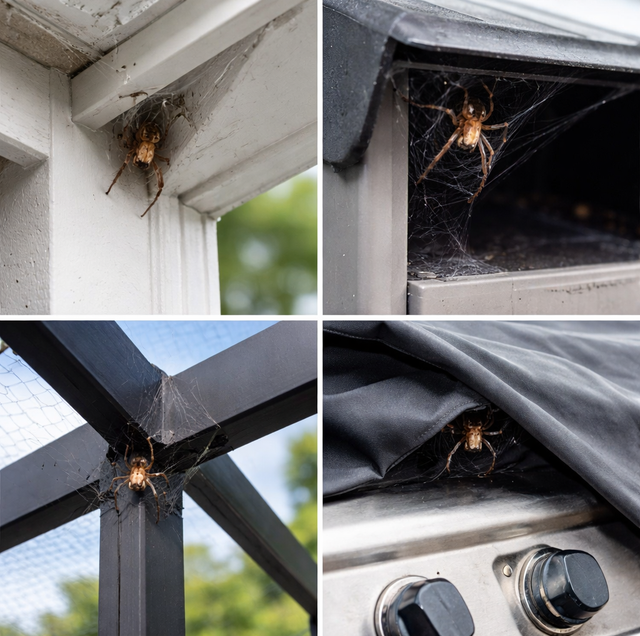
Quick Answer: Brown widow spiders rarely nest where the web is easiest to spot. Check lanai post corners, mailbox undersides, pool-cage frame joints, and folded grill covers instead- the tight voids where the spider can brace against a surface on two sides.
A single web strung across the porch light or hanging off the eave isn't where a brown widow spider actually lives. That strand is a snare, stretched into open air to catch whatever insect wanders through it. The spider herself, along with any egg sacs she's laid, stays somewhere else entirely: a corner, a seam, a fold, anywhere her body can brace against a surface from more than one side at once. Knock the visible strand down and a new one often appears by the next morning, spun from the same hidden spot, because the spot itself never changed.
Latrodectus geometricus has turned up in Florida since the 1930s, and the state's warm, humid climate never gives it the seasonal die-off that keeps populations in check farther north. What decides where one of these spiders sets up on a given property has less to do with sunlight or moisture than with geometry. Entomologists describe the species as thigmotactic, meaning it seeks out tight voids where its legs can contact a surface from two or more directions, rather than open, exposed spans. The pool cage, the lanai, the mailbox post, and whatever outdoor gear sits folded in the garage supply almost all of that geometry on a typical South Florida lot.
Why Brown Widows Pick Corners Over Open Air
A brown widow's web is a loose, tangled cobweb built to intercept crawling prey, ants, roaches, and other ground-level insects moving along a structure, not a symmetrical wheel spun to catch flying insects drawn to a porch light the way an orb weaver's web does. That hunting style shapes where the spider chooses to sit. A handful of traits show up again and again in the spots homeowners eventually find:
Contact on two sides: the spider positions itself where its body touches a surface above, below, or on either side, not out in the open.
Full, permanent shade: the site never gets direct sun and rarely gets rained on directly.
Low disturbance: nothing brushes the spot during normal daily use of the property.
A void to retreat into: if the web is disturbed, the spider has somewhere immediately behind it to pull back into rather than dropping to open ground.
Lanai Post Corners and Screen Track Voids
Screen enclosure support posts are hollow aluminum and bolted to a concrete footer or the slab itself, leaving a narrow, shaded gap right where the post meets the base. That corner checks every box: contact on two sides, permanent shade, and a base that almost never gets touched once the enclosure is installed. The aluminum screen track along the bottom rail runs the same risk for the same reason: a thin channel that holds a web out of sight unless someone is on their knees looking directly at it. On the same pool cages and lanai screens common across almost every home in this climate, these post bases are usually the first place worth a flashlight check.
The Underside of a Mailbox
A curbside mailbox gets opened from the front daily, but the underside, where the box body meets its mounting bracket or post arm, goes untouched for months at a stretch. That gap is small, shaded by the box itself, and close to ground level where crawling prey moves along the post. It's also one of the few outdoor structures on a property that a homeowner interacts with constantly without ever actually looking at it from below, which is exactly why a web can sit there for weeks before anyone notices.
A brown widow egg sac looks like a small spiked burr, not the smooth round white sac a black widow spins. Wear gloves before reaching under a mailbox or a stored item, since the female often stays nearby.
Pool-Cage Frame Joints and Kick-Plate Seams
Aluminum screen enclosures are assembled from extruded frame sections joined with corner brackets, screws, and rivets, and each hardware point creates a small pocket where two pieces of metal meet without quite sealing flush. The kick plate along the base of the enclosure, the low aluminum panel that replaces the screen near ground level, adds another run of these seams close to where ground insects travel. None of it is visible from a normal standing height, which is part of why a pool cage can carry several separate brown widow sites at once without any of them showing up in a casual walk-through.
Folded Grill Covers and Stacked Outdoor Gear
Anything folded creates a temporary version of the same geometry: a fabric grill cover draped and gathered at the base, a stack of empty planters, coiled hose looped over a hook, patio cushions leaned against a wall for the season. Each fold or stack puts fabric or plastic in contact with itself or another surface on more than one side, and none of it gets moved often enough to disturb a web building underneath. This is also the category most likely to travel: a spider that's set up inside a folded cover or a stacked planter can end up relocated to wherever that item is stored or moved next, which is how a single brown widow occasionally turns up somewhere on the property with no obvious web nearby.
Why Spraying the Visible Web Rarely Ends It
A contact insecticide only affects what it directly touches, and none of the four spots above are places a general spray reliably reaches. Treating the porch light or the railing where a web happens to be visible does nothing for the post corner, the mailbox underside, or the frame joint a few feet away where the spider is actually living. The visible web comes back because the site that produced it was never addressed, and because a female brown widow that gets displaced from a knocked-down web often rebuilds in the same void system within a day or two rather than moving on. Closing the site itself, sealing the gap, adjusting the screen track, and relocating stored items away from structural joints does more to stop repeat webs than another pass with a spray bottle aimed at whatever strand happens to be in view.
One Cleared Web Rarely Means the Spider Is Gone
Most South Florida properties with a pool cage, a lanai, and a mailbox post have more than one of these voids at once, and a brown widow doesn't need much more than a few inches of tight, shaded contact to set up in any of them. Checking all four spots together, rather than treating the one visible web as the whole problem, is what actually tells you whether the property has a single spider passing through or a handful of established sites feeding on the same nearby insect activity.
Frequently Asked Questions
No. Researchers who study the species describe it as notably non-aggressive compared with the black widow, and note it's far more likely to curl its legs and play dead, a defense behavior called thanatosis, than to bite when a web is disturbed. Most reported bites happen when a hand or bare foot presses directly against the spider inside a glove, shoe, or stored item rather than from any active pursuit on the spider's part.
Color and pattern are the fastest tells. A black widow is glossy, uniform black with a solid red hourglass; a brown widow's abdomen is mottled tan to dark brown with striped legs, and its hourglass marking usually reads orange or yellow rather than red, sometimes appearing as two separate triangles instead of one solid shape. Venom potency comparisons actually run the other way: researchers who've studied the two species generally find brown widow venom comparable to, or even somewhat more potent than, a black widow's on a milligram-for-milligram basis. Bites still read far milder in practice because a brown widow injects much less venom per bite and rarely bites defensively at all, more often curling into a defensive ball than striking. Any suspected bite from either species still warrants medical attention rather than a color-based guess.
A single female can produce roughly a dozen to twenty egg sacs over her lifetime, each typically holding somewhere around 120 to 150 eggs. That reproductive volume is part of why a property with one established female often shows multiple webs nearby within a season rather than staying a one-spider problem, and it's also why finding an egg sac tucked into a void is worth treating as a sign more spiders are already on the way, not just evidence of the one you can see.
Not the way they do farther north, and there's a practical way to tell an active site from an old one without waiting a season to find out. A web still in use stays taut and slightly tacky, with a fresh, almost glossy sheen to the silk; an abandoned one collects windblown dust and pollen within a week or two, turns visibly grayish, and breaks apart at a light touch. South Florida's climate rarely produces the sustained cold that triggers a true seasonal die-off, so brown widow activity here stays fairly continuous year-round rather than dropping off in cooler months and rebuilding each spring, which is why checking a web's condition tells you more than checking the calendar does.
The venom works the same neurotoxic way on a cat or small dog as it does on a person, and a pet's smaller body weight means a bite can produce more pronounced symptoms, muscle rigidity, drooling, or labored breathing than the same bite would in an adult human. A pet that shows those signs after getting into a stored item, a shed, or a garage corner should see a veterinarian rather than be watched at home, since presenting the spider (dead or alive, in a sealed container) helps a vet confirm the cause more quickly.
A single, obviously empty web on an open railing is reasonable to clear yourself: gloves and a shop vacuum pull the strand, along with any spider or egg sac, into a sealed canister rather than knocking them loose with a broom and risking a stray bite. Closing off the voids this article covers usually means partly disassembling the enclosure or fixture itself, which is where a professional earns the call instead of a DIY pass.
Stop chasing visible webs — have the actual voids on your lanai, mailbox post, and pool cage checked and closed off. Buggify Pest Solutions serves Boca Raton, West Boca, and communities across Palm Beach and northern Broward. Call Tyler: (561) 672-0200.
