

Brown Widow Spiders in Shoes and Gloves: Check First
Quick Answer: Brown widow spiders favor dark, undisturbed gaps that touch their body on two sides: a shoe toe, a rolled glove, a folded cushion. Shake gear and knock it against a hard surface before you reach in.
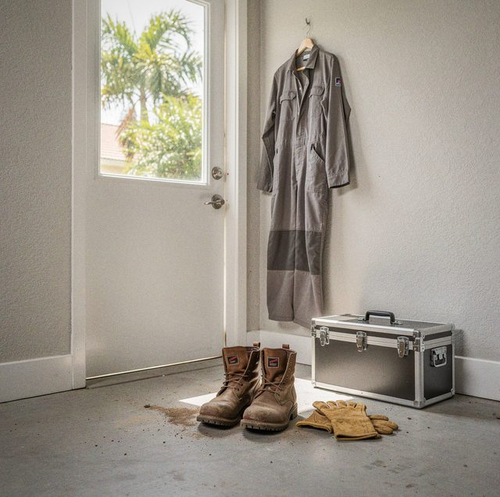
A brown widow doesn't care whether the tight, dark gap it has chosen is behind a downspout bracket or inside the boot sitting by your back door. Both offer exactly what the spider looks for: a space that closes around its body from more than one side and almost never gets disturbed. Gear left outside or in a garage checks that box constantly, which is part of why case reports tend to show boots, work gloves, and other worn gear turning up as bite sites more often than an open web strand does.
Latrodectus geometricus has been established across South Florida since the 1930s, and the region's mild winters mean it stays active in yards, garages, and sheds through every month of the year rather than dying back each fall. That constant activity, paired with how often outdoor gear sits untouched between uses, is why a simple habit, shaking and checking before you reach in, does more to prevent a bite than any amount of spraying visible webs ever will.
Why Stored Gear Reads the Same as a Structural Gap
This species has a strong preference, called thigmotaxis, for bracing its body against a surface from at least two directions before it settles anywhere, rather than resting in open space. A porch corner satisfies that requirement. So does the toe of a boot, the curled fingers of a glove, or a beach towel rolled tight enough that its own folds press together. The spider isn't drawn to rubber or fabric as materials; it's drawn to the shapes those items take when they sit still. A pair of shoes kicked off by the door, a glove dropped on a workbench, a cushion stacked in a shed for the season, all of them create a temporary version of the same tight, shaded void the spider would otherwise find behind a shutter or under a mailbox.
That's also why the risk isn't tied to a season. A shoe left in a hot garage in July offers the same undisturbed geometry as one left in a cooler shed in January. The trigger is time sitting still and darkness, not temperature, which is why this is a year-round habit rather than something to think about only before a specific chore.
Shoes and Boots Left by a Door or in a Garage
A closed-toe shoe is close to an ideal void: dark, narrow, shaded, and untouched for hours or days between wearings. Rubber garden clogs and rain boots carry the highest risk in the group because their toe boxes are fully sealed and rarely get aired out between uses. Sneakers and work boots kept just inside a garage door or under a bench run the same risk if they sit for more than a day without being worn.
Before your foot goes in: turn the shoe or boot upside down and knock the heel against a hard surface, concrete, a step, a driveway, two or three times.
If gear has sat for more than a few days: give it a firmer shake and a visual check inside the toe with a flashlight before assuming it's clear.
Gloves Rolled or Balled Up in a Toolbox
A pair of work gloves tossed into a toolbox or a garden bucket at the end of a task rolls into a tunnel shape, fingers curled inward, which is close to the same geometry as the void inside a shoe. Leather gauntlet-style gloves with a long cuff carry extra risk because the cuff folds over on itself, creating a second, separate pocket above the hand opening. A glove that gets balled up and left in a bucket for a week between gardening sessions is a more realistic bite risk than one hung open on a hook the same week.
Snap each glove open and give it a shake before your hand goes in, the same motion as checking a shoe. If a pair has been folded or rolled rather than hung, treat that as reason enough to check both gloves, not just the one you're reaching for first.
Hand Tools With Hollow Grips and Handles
Bypass pruners, hori-hori knives, and hand trowels with foam-cushioned or hollow rubber grips create a small enclosed channel along the handle, and a wheelbarrow's underside lip does the same at a larger scale. None of these are places most people think to check, because the void isn't obvious from a glance the way a shoe's opening is. A pruner left clipped shut in a garden bag for a season, or a trowel left blade-down in a bucket of stored tools, sits in exactly the kind of undisturbed contact a brown widow settles into.
Tapping a tool handle against a bench or the ground before gripping it takes the same second or two as checking a shoe, and it's worth doing on anything with a hollow or foam-wrapped grip that hasn't been picked up in a while.
Coveralls, Sun Sleeves, and Aprons Hung on an Outdoor Hook
A lightweight garden coverall or a pair of arm sun sleeves hung on a hook by the shed door folds into the same tight, shaded geometry as a rolled glove once it's been hanging untouched for a few days, the fabric pressed against itself at the elbow and cuff. A canvas or vinyl gardening apron adds a second risk on top of that: the front pouch pocket, meant to hold hand tools or seed packets, is its own small enclosed void that stays undisturbed between gardening sessions the same way a toolbox does.
Make shake-and-check a two-second reflex, not a special occasion: knock shoes toe-down on a hard surface, snap gloves open before your hand goes in, and do it every time gear has sat untouched for more than a day or two.
Turning a hung coverall right-side out, shaking the sleeves before stepping in, and checking an apron's pouch pocket by hand or with a flashlight before reaching into it cover the same risk this habit already covers for shoes and gloves, just for gear that's worn rather than carried.
When the Habit Matters Most
The habit matters most exactly when it's easiest to skip: gear that just came out of storage after a season sitting unused, tools borrowed back from a neighbor, or items moved from a shed to a garage during a cleanout. Those are the moments when something has sat still the longest and hasn't been handled recently, which is also when a spider has had the most undisturbed time to settle in. Gear used daily, a favorite pair of sneakers worn every morning, rarely builds up enough undisturbed time for a web to form. It's the seasonal, occasional, and just-moved items that deserve the check, not the gear already in constant rotation.
Frequently Asked Questions
Wash the area with soap and water and apply a cold compress to ease swelling and discomfort; do not apply a tourniquet or attempt to cut or suction the site. If you can safely capture the spider, dead or alive, in a sealed container, bring it along, since a positive identification speeds up treatment. Most brown widow bites remain mild and resolve with home care, but contact Poison Control for guidance or seek medical evaluation promptly if you are a child, an older adult, or have an existing health condition, or if you notice muscle cramping, rigidity, or symptoms spreading beyond the bite site.
There's no fixed countdown, but treat anything that's sat untouched for more than a couple of days as due for a check. The check method matters more than the exact day count: don't just glance at the opening, turn the item over, shake it with the opening pointed down and away from your body, and look at what falls out before you trust it. Gear stored indoors in a closet or bedroom rarely needs more than that quick shake, since indoor spaces stay drier, are better lit, and see far less spider traffic to begin with. Gear kept in a shed or garage deserves the fuller check every time, flashlight included, because those spaces stay dark, humid, and undisturbed for days at a stretch, exactly the conditions a brown widow looks for. Gear handled daily rarely needs a second thought; gear pulled out after a week or more in shed or garage storage always does.
Storing shoes toe-down on a rack rather than tipped over on their side keeps gravity working against a spider settling into the toe box, and hanging gloves fingers-up on a hook instead of balling them into a bucket removes the rolled-tunnel shape that makes a glove attractive in the first place. Closed bins with lids reduce risk more than open shelving for anything stored longer than a few weeks, since a sealed bin limits how a spider can get in during storage.
Leather palms and thick rubber soles are generally too dense for a bite to reach skin, which is part of why the actual bite usually happens at the moment of putting gear on, not while it's already being worn. The vulnerable window is the opening: the ankle gap while pulling on a boot, or the wrist cuff while pushing a hand into a glove, both moments when a spider caught inside has direct contact with skin before the item is fully on.
Material itself matters less than what's nearby. Gear stored close to outdoor lighting or dense foliage tends to draw more prey insects, ants, small moths, and roaches, which in turn draws more spider activity to whatever sits within a few feet, regardless of whether that item is rubber, canvas, or vinyl. A shoe rack against a wall, lit by an outdoor path light, poses more risk than the same rack in an unlit interior closet, regardless of the shoes themselves.
A property-wide spider treatment reduces the outdoor prey-insect population and closes off exterior entry points, which lowers overall pressure, but a garage, shed, or closed storage bin is its own sealed environment that outdoor treatment doesn't fully reach. A yard treatment reduces how many spiders move toward the house in the first place; the shake-and-check habit is still what catches the one that already made it into a bag, a bin, or a boot.
Get a spider inspection for the garage, shed, and lanai — the tight voids where brown widows actually settle in around stored gear, not just the webs you can see. Buggify Pest Solutions serves Boca Raton, West Boca, and communities across Palm Beach and northern Broward. Call Tyler: (561) 672-0200.
