
Can Rats Climb Stucco? Reading a Wall Surface by Surface
Quick Answer: A textured surface like stucco gives a rat's claws real purchase, while a smooth, flat panel offers very little grip on its own. Downspouts, wires, and wall corners can extend a climb further than a bare wall alone would allow.
Look up at the side of a house and the question is a fair one to ask: could something the size of a rat actually get up that wall? The climber in question is the roof rat, the species that lives high in a structure and works vertical surfaces, while the ground-dwelling Norway rat keeps to burrows and openings down at slab level. Not every surface answers a roof rat the same way. A rough stucco coat, a smooth panel, a downspout, a length of service wire, and the corner where two walls meet each behave differently once claws and body weight are involved, and the difference has little to do with how tall the wall is. A trunk or a palm frond can offer its own route up, a separate question from what the wall itself can support, but the wall, pipe, and wire surfaces below a roofline are worth reading on their own terms.
Textured Masonry and Stucco
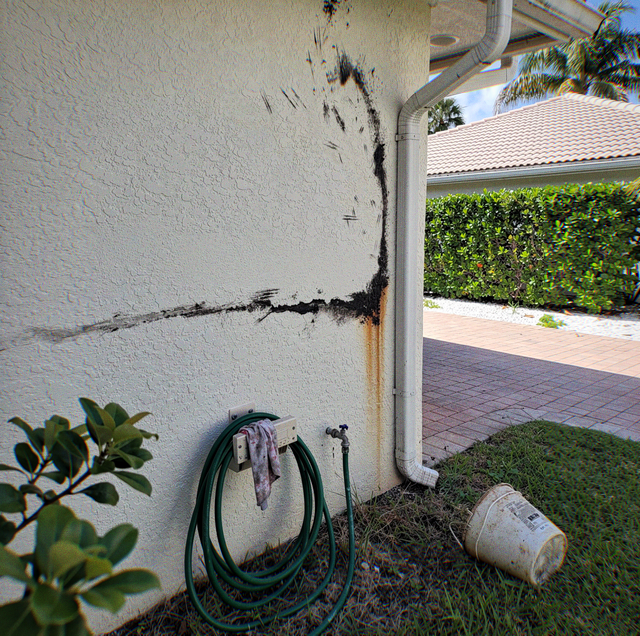
At close range, a stucco coat reads as ridges, pits, and high points across the wall face. A traditional cement stucco finish is troweled or sprayed on with a broken, granular texture, and that texture creates the small irregularities across the whole surface. A roof rat's claws are curved and built to hook into an irregular surface rather than grip a smooth one, so every one of those ridges and pits functions as a small hold. The rougher the finish, the more of those holds sit within reach of each other, and the more continuous a climb can be from grade to eave.
Concrete block finished with a heavier stucco coat, or a wall carrying a coarse dash texture, offers more of these holds per unit of wall than a smoothly troweled section does. Even a fine finish still carries enough texture to be climbed when nothing smoother interrupts it, because the underlying coat is applied by hand and rarely comes out perfectly even. Texture is the mechanism at work, and it varies from wall to wall inside the same finish name.
Smooth Painted or Tiled Surfaces
Some exterior surfaces are close to flat at any scale that matters to a claw. Glazed tile, tempered glass, smooth fiber-cement panel, and factory-finished metal siding do not carry the ridges and pits that a stucco coat does, so there is little for a claw to hook into. Without texture to grip, a climb depends on friction between the claw and the surface, and friction alone gives out quickly as a wall gets closer to true vertical.
That is the mechanism that makes a truly smooth, flat wall section difficult to climb on its own. Such a surface withholds the one thing a claw needs: texture at a scale the claw can catch. A large, unbroken run of smooth material, with nothing else nearby to work with, is a poor climbing surface by itself. The angle matters too. A smooth surface that leans even slightly off vertical gives friction more to work with than one running perfectly plumb, so a sloped or recessed smooth panel reads as the easier of the two.
Vertical Pipes and Downspouts
A downspout is a different kind of surface from a wall panel because it creates a curved, vertical edge directly against a flat one. Where a downspout runs tight along a wall, an animal climbing it has two surfaces to work with at the same contact point: the pipe on one side and the wall behind it on the other, which changes what is needed to hold on compared to a single flat face.
Diameter matters here. A slim pipe that a roof rat's body can nearly close around provides a real grip that both front and back paws can use. A wide downspout or a bulky duct forces a wider reach and offers less of that wraparound hold, closer to what an open flat panel asks of a climbing animal. Surface texture on the pipe itself also plays a part. A smooth aluminum or vinyl downspout offers less to grip than a corrugated one; the corrugation adds a repeating ridge that a claw can catch, texture doing the same job on a pipe that it does on any wall. The read comes down to the pipe's width, its texture, and how close it runs to the wall behind it, and it holds the same wherever on the house that pipe runs.
A downspout is hardware hung on light brackets, and an overhead service drop carries live conductors. Neither is built to hold a person's weight, and nothing about reading a wall's surfaces requires touching either one. The read happens from the ground.
Wires, Conduit, and Utility Lines
A wire or a run of rigid conduit is a narrow, continuous surface that runs from grade to a fixed point higher on the wall, and that continuity is what sets it apart from the wall next to it. Where a cable is mounted flush against the surface, it also acts as a fixed handhold set into an otherwise flatter section, something to grip at that exact line even where the surrounding wall offers little on its own.
The angle a line holds against the wall changes what it demands of the animal using it. Where a wire runs at a shallow angle, the climb it supports asks less of the animal's grip at any single point, because the length of the run carries more of the body's weight at any one moment. A steep, near-vertical run puts more of that weight on grip alone, closer to what a bare wall requires. The working part is the continuous line itself and the angle it holds against the wall, at whatever thickness that line happens to be.
What a Corner or Junction Offers That a Flat Face Does Not
A flat wall face asks an animal to hold itself against a single plane, using grip or friction against that one surface alone. A corner, an inside angle where two wall faces meet, or a junction where the wall meets a change of material works differently, because it puts two surfaces within reach at the same point instead of one. An animal at a corner can brace against both faces at once, which reduces how much any single surface's texture has to carry on its own.
That is why a section of wall that would offer little grip on its own, a smooth run of trim or a painted panel, still gets crossed when it sits inside a corner, where a second face is there to take part of the load. The same logic applies at the top of a wall, where the face meets a roof overhang or a fascia line at a right angle. That junction is where a vertical climb ends and where the animal is now working a different set of surfaces entirely.
Frequently Asked Questions
Yes, at the point where the strap sits. A strap pulls the pipe in tight against the wall and holds it there, closing the gap between the two surfaces and giving a firm, fixed hold right at that band, similar to what a corner offers. An unstrapped run can flex slightly away from the wall under weight, which is a less certain hold than a section that is fastened down.
Watch how the line behaves through the day. A band with real depth casts a shadow along its underside, and that shadow shifts and changes width as the sun moves across the wall. A color change, a texture break, or a scored line painted to look like trim keeps the same appearance in any light because there is no projection to cast a shadow at all. That shadow is the practical tell from the ground: a line that never casts one has no depth on it for an animal to stand on.
It does. A projecting band, water table, or ledge partway up a wall interrupts a climb by providing a flat resting surface, letting the animal pause and reset its hold partway up, where an uninterrupted wall would require a single continuous grip from grade to the eave. It works this way regardless of whether the wall above and below it is rough or smooth.
Not by itself. Paint and clear sealers fill in the very finest surface texture, but a coating applied over a coarse stucco finish generally follows the contour of the aggregate underneath and leaves that contour in place. The wall retains most of its underlying grip pattern even after being coated, so a textured wall reads much the same way after painting as it did before.
It can, at that one point. Anything bolted flush to a wall, a light housing, a hose reel bracket, a mounting plate for a hanging planter, creates a fixed edge or perch at that exact height. It offers a single, isolated foothold at a single height, useful for a single step in a climb where a band or ledge provides a continuous line across the wall.
A control joint is a recessed groove set into a large stucco field to steer where cracking occurs, and its cut edges sit at an angle to the surrounding wall face. Those edges give a claw something to hook along the full length of the groove. The groove stays within the wall plane, so it provides grip along its length. A vertical joint carries that line of grip up the wall, while a horizontal one runs sideways across a climb and reads as a line of travel.
Request a roofline access assessment — find out which surfaces around your home actually carry a climb. Buggify Pest Solutions serves Boca Raton, West Boca, and communities across Palm Beach and northern Broward. Call Tyler: (561) 672-0200.
