

Attic Droppings and Buying a Home: What They Actually Show
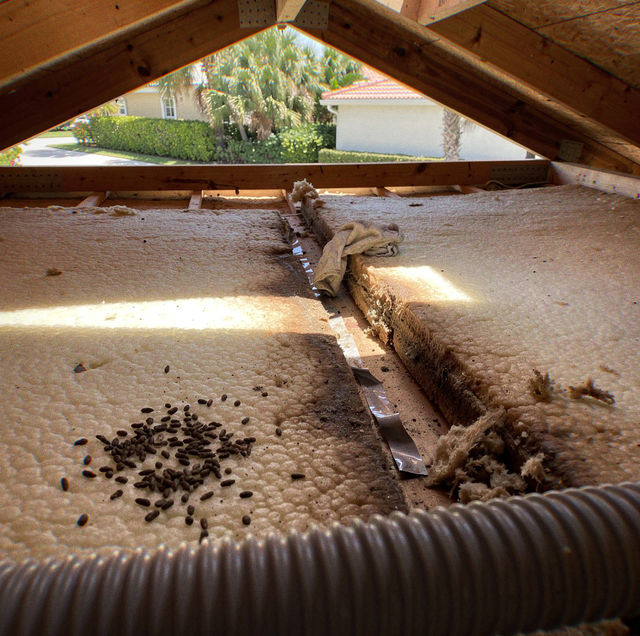
Quick Answer: A rodent inspection reads attic droppings as separate questions: whether activity is current, what the material's condition suggests about its age, and whether the entry route is still passable. None of those answers come from the droppings pile by itself.
A pile of droppings in attic insulation is a fact about one moment: the moment someone stood at the hatch and looked. It says nothing on its own about the week before that moment or the week after it, and a buyer walking through a house they don't yet live in is working from one moment's evidence and nothing on either side of it. The droppings are real. What they mean about the house going forward is a separate question, and a rodent inspection is built to answer it piece by piece rather than all at once.
Active Today, or Old Sign
The most immediate question a rodent inspection asks is also the one a buyer standing at the hatch can't answer just by looking: is anything living up there today? Droppings alone don't answer that, because a dropping doesn't carry a timestamp. An inspection instead reads a cluster of physical tells, all of them read by eye: material that still looks dark and intact versus faded and crumbled at the edges, whether nesting material still holds its shape or has flattened into the surrounding insulation, and whether there's fresh disturbance in dust at points a rodent would actually travel across. None of that work alone. A single dark, intact dropping sitting on old, undisturbed insulation reads differently than the same dropping in a freshly flattened travel path.
Age Markers and Their Limits
Age is the second question, and it's harder than it looks. The material carries relative markers rather than absolute ones: color faded from a fresh, dark tone toward gray or tan, edges gone from intact to crumbled, and a coat of ordinary attic dust settled over the surface rather than sitting clean on top of it. None of that produces a date. It produces a read of older versus newer, relative to other material in the same space and to how undisturbed the surrounding area looks.
Where the material sits matters as much as its condition. Droppings worked into the top layer of insulation, rather than resting loose on its surface, generally point to an older accumulation that predates whatever last disturbed that insulation. Droppings scattered loosely across the surface, with no fiber displacement underneath, read as more recent. Age evidence answers one narrow question well: whether what's in front of you happened once, a while back, or is still building up. It says nothing about whether the opening that let it happen is still usable, which is a different kind of evidence altogether.
The Entry Point Is a Separate Read
A dropping pile confirms a rodent was inside the structure at some point. It doesn't confirm where that rodent got in, or whether that opening is still usable. That's a separate, physical read at the point of entry, not an inference drawn from evidence sitting elsewhere in the attic.
Do not enter the attic to check droppings, gnaw marks, or a suspected opening firsthand. Florida attics run hot enough to be dangerous, footing is limited to exposed joists, and wiring in an area with existing rodent activity can already be compromised.
An opening still in active use tends to show continuity: a rub mark or worn track running right up to the edge of the gap rather than stopping short of it, an edge that stays clear of the dust and cobweb buildup that collects where nothing has brushed past recently, and traffic sign on both sides of the opening rather than only one. A gap that carries old wear but has since been blocked, even by something as simple as shifted insulation covering it, or that wears the same even coat of dust as the untouched surfaces around it, is a route that used to work and may not work anymore. Confirming which one is true is a check at the opening itself, not a conclusion drawn from what's piled up elsewhere.
What a Past Treatment Record Can and Cannot Confirm
A treatment record or service sticker left in a garage tells you something happened. It names a company, sometimes a date, sometimes a general description of the work. What it can't do is speak for the current moment, because a record is fixed at the date it was written, and a house keeps aging after that date closes out.
Two separate questions get collapsed into one when a treatment record turns up during a walkthrough: whether rodent activity was ever addressed at that address, which the record answers, and whether the attic's current condition, including any droppings visible today, reflects what that record described or something that happened since, which the record can't answer on its own. A structure can pick up new activity through a route that has nothing to do with the work the record lists, and nothing about a piece of paper from an earlier date changes what a current, physical look at the attic shows. The record and the inspection are two kinds of evidence from two different points in time, and one doesn't stand in for the other.
The Attic Read and Where It Stops
A look from an attic hatch covers what's visible from and near that opening and confirms conditions in that specific space. It doesn't extend down into wall voids, behind cabinetry, or to ground level, because none of those are the same physical space as the attic, connected framing or not. What an attic-focused look can rule in or out is limited to the attic itself, and anything found there raises questions about the rest of the house without settling them. A quiet attic and a quiet house are two different findings, and on a visit scoped to the hatch, only one of them has been checked.
A General Inspector's Note and What Sits Behind It
A line noting possible rodent activity on a general home inspection report is easy to read as a finding. It's closer to a flag. InterNACHI's standards of practice list the presence of evidence of rodents, birds, and other pests among what an inspector is not required to determine. When a general inspector does mention it, the note tends to stay deliberately narrow: language like "signs of possible rodent activity observed" rather than any claim about how much, how recent, or where it's coming from.
That narrowness isn't a shortcoming in the inspector's work. A general home inspection covers a wide range of systems in a single visit, and evidence of pests falls outside its defined scope by design. A rodent-specific inspection exists to answer what a general note leaves open: the current-versus-old read, the entry-point read, and the extent of what's actually there, in one visit built around that question alone. A brief mention in a general report and a dedicated look at the same attic are not the same depth of evidence, even when they're describing the same droppings.
Frequently Asked Questions
In a lived-in home, evidence in the kitchen or pantry, food packaging, or ordinary household clutter can corroborate what turns up in the attic. A staged or vacant showing strips away context, since there's no ongoing food storage or daily activity to check against, so a rodent inspection ends up leaning almost entirely on the attic and its entry points rather than on signs from the rest of the living space.
Not necessarily. Removing old droppings and nesting material also removes the physical history an inspection would otherwise use to read age and extent, which can make a cleaned attic look inconclusive rather than clear. Without that material to examine, the read shifts almost entirely to the condition of the entry points themselves, since that's evidence a cleaning doesn't reach.
It names what was performed on that visit in the company's own billing terms: an interior service, a treatment, a callback, and it rarely spells out the physical scope behind those words. A visit that set traps and a job that sealed a roofline are usually two separate records with separate materials listed, so a line reading "general pest service" does not, by itself, say that any opening was closed. Reading a treatment ticket as evidence of exclusion is where that distinction gets lost.
Yes, in terms of what stays visible. Batt insulation presents a flat, continuous surface, so loose droppings and flattened travel paths sit on top of it and read easily. Blown loose-fill sits deeper and settles unevenly, so material can work down below the surface and out of sight, which means a surface read of a loose-fill attic can understate what is present rather than overstate it. The read is still valid. Its coverage is narrower than it looks.
Access, usually. The hatch may sit in a closet with the seller's belongings stacked under it, or in a finished ceiling in a room being actively shown, and any move to reach it is arranged on the seller's side rather than decided on the spot. A visit scheduled around a showing window also ends when that window does. Neither limit changes what the attic holds, but both change how much of it gets seen on one visit.
Reroofing changes the closure condition at the roof deck and its penetrations, but it doesn't extend into the attic to disturb droppings, staining, or nesting material already on the insulation or framing below. Evidence found lower in the attic still reads on its own terms, independent of how new the roofing above it is, since a new roof doesn't erase what was already sitting underneath it.
Request a point-in-time rodent evidence inspection — an on-site read of what that attic actually shows today. Buggify Pest Solutions serves Boca Raton, West Boca, and communities across Palm Beach and northern Broward. Call Tyler: (561) 672-0200.
